News   GLOBAL  |  Apr 02, 2020
 10K     0 
News   GLOBAL  |  Apr 01, 2020
 42K     0 
News   GLOBAL  |  Apr 01, 2020
 6.1K     0 

October 17

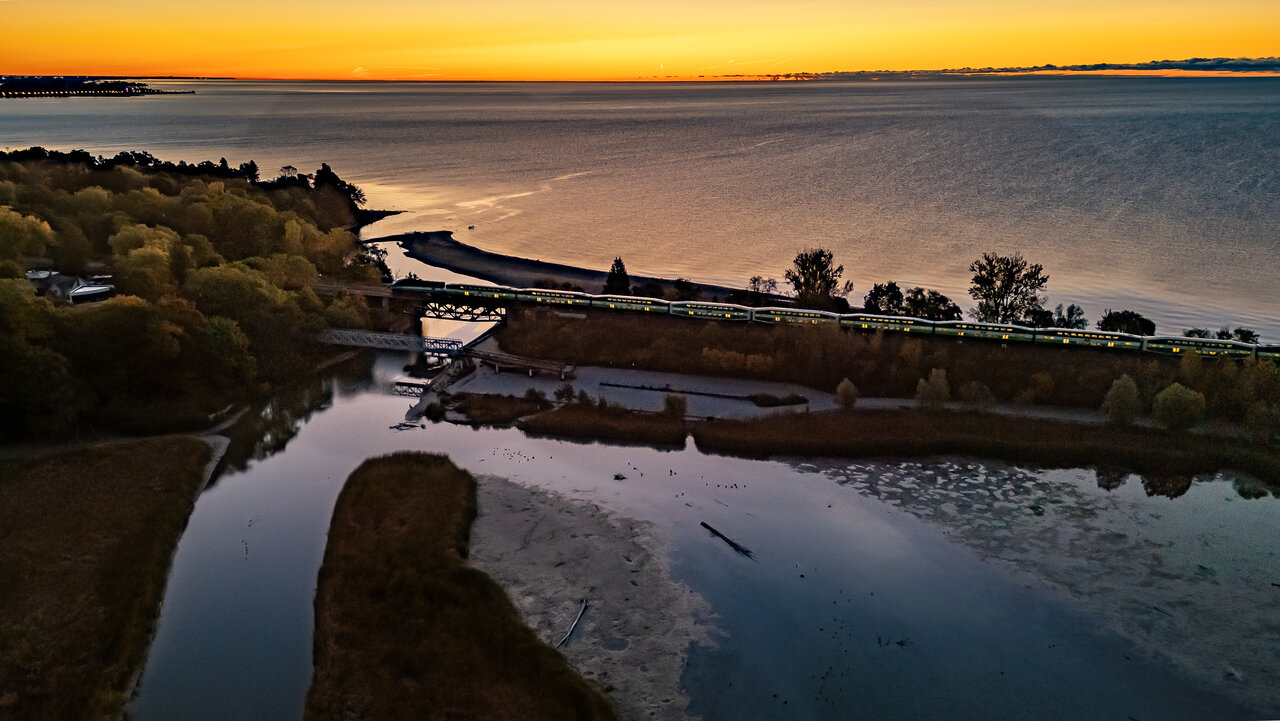
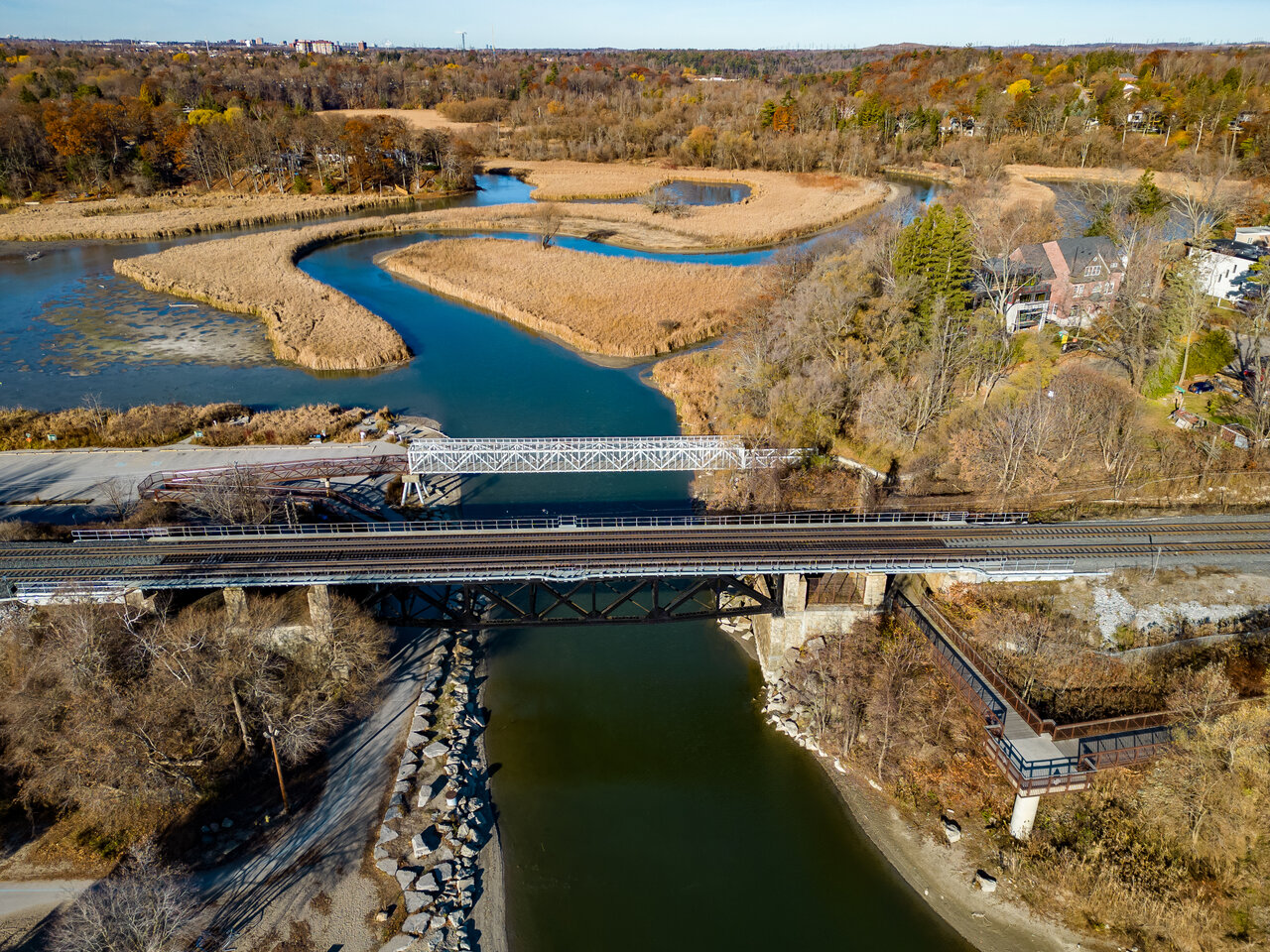
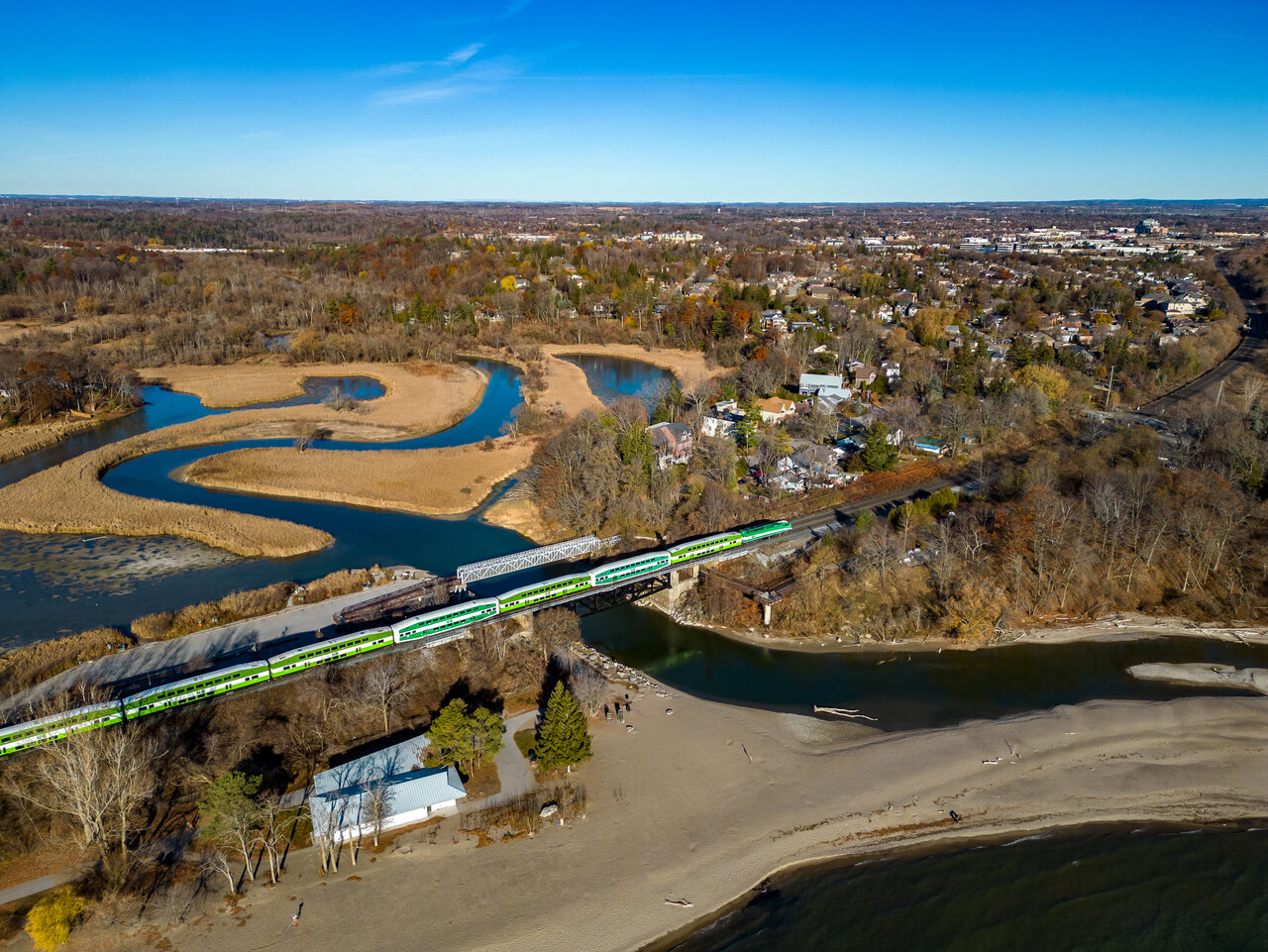
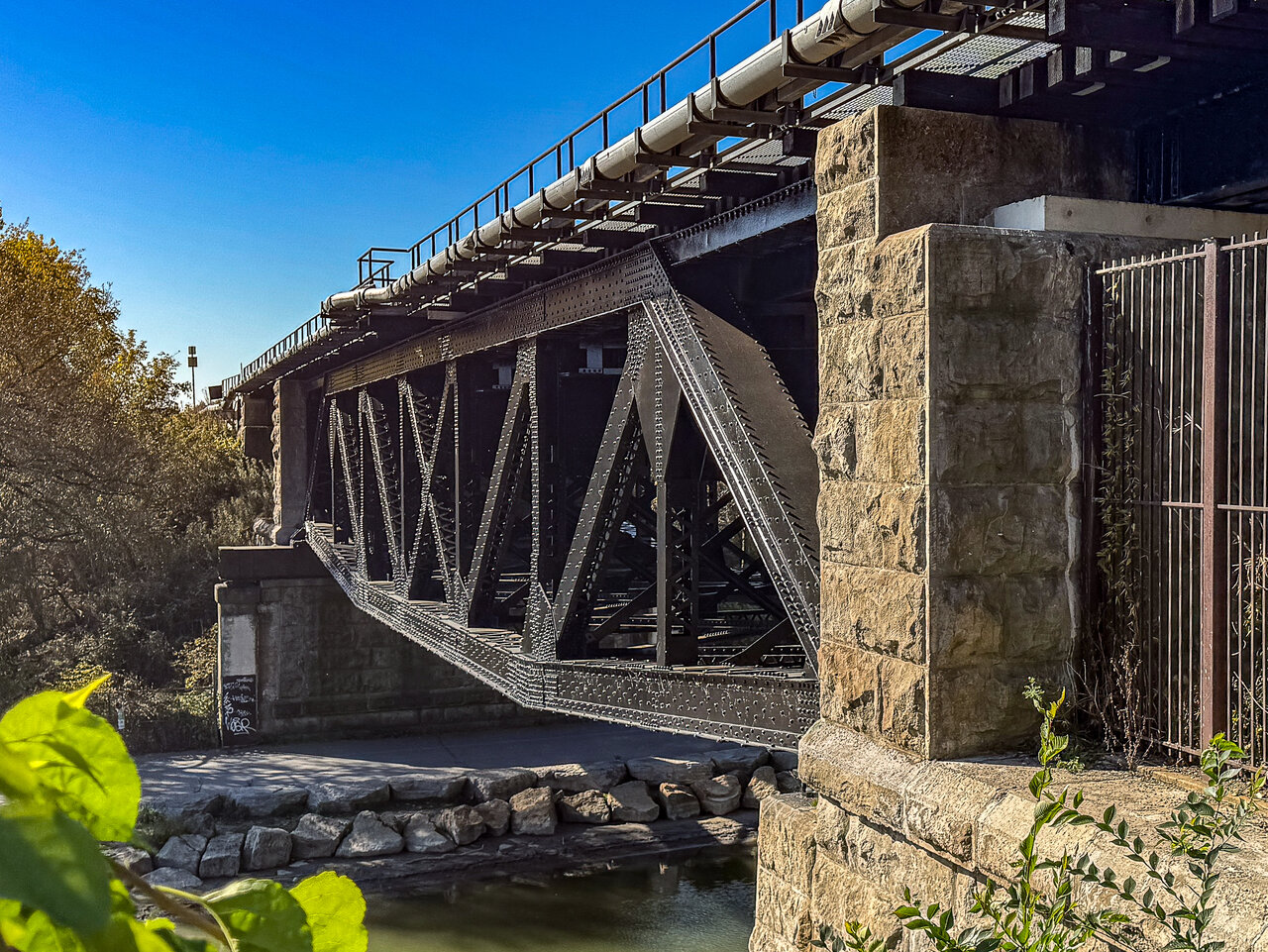
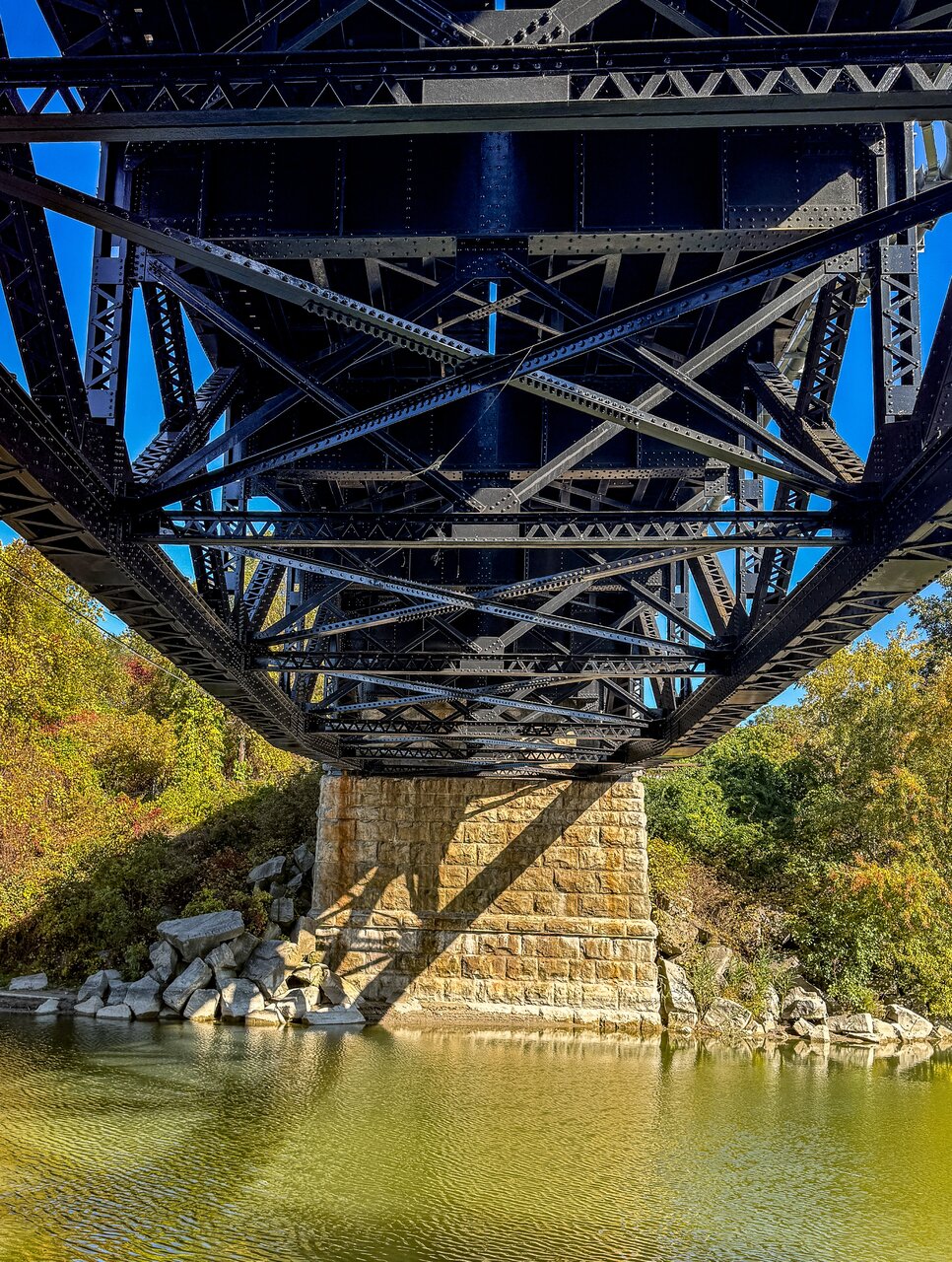
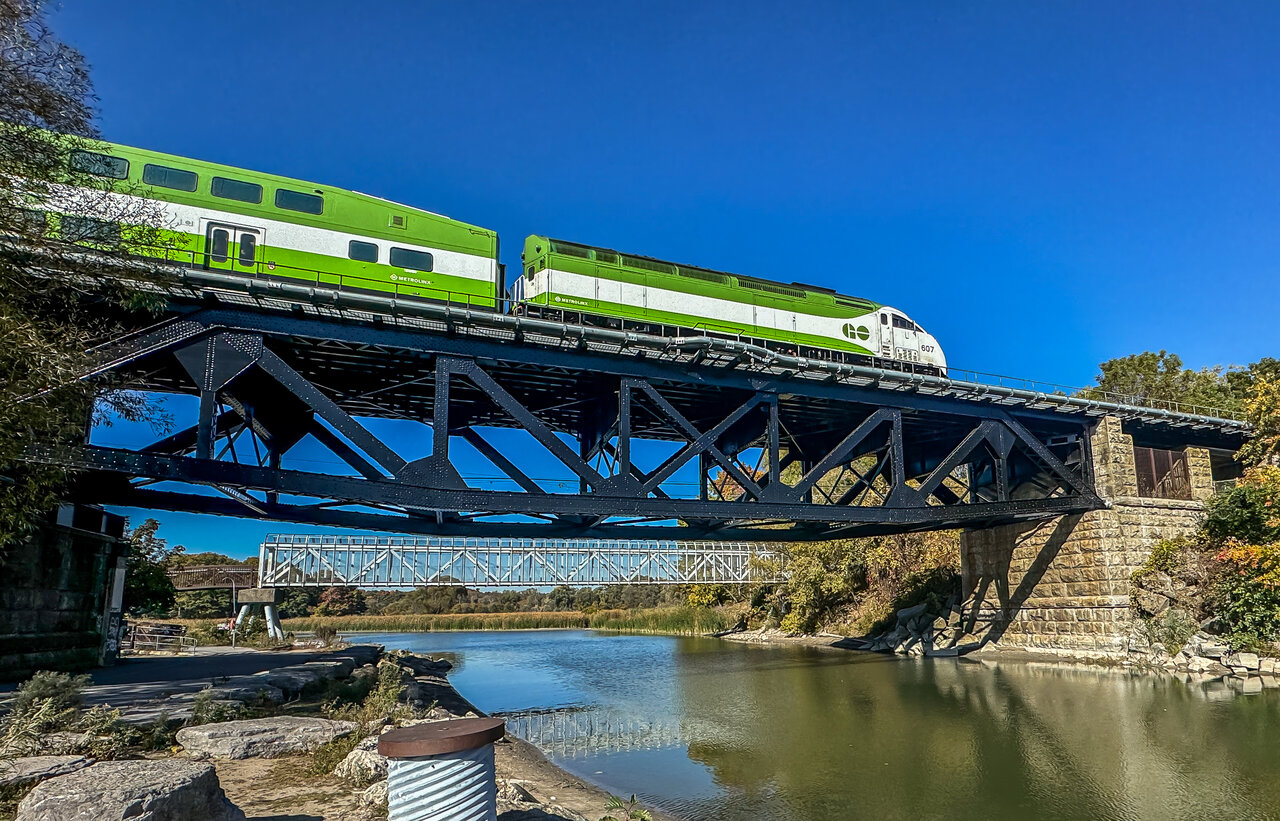
Rouge River Bridge as seen from Rouge National Urban Park.

DJI_0006-HDR.jpeg


November 2023
DJI_0012.jpeg

DJI_0006.jpeg


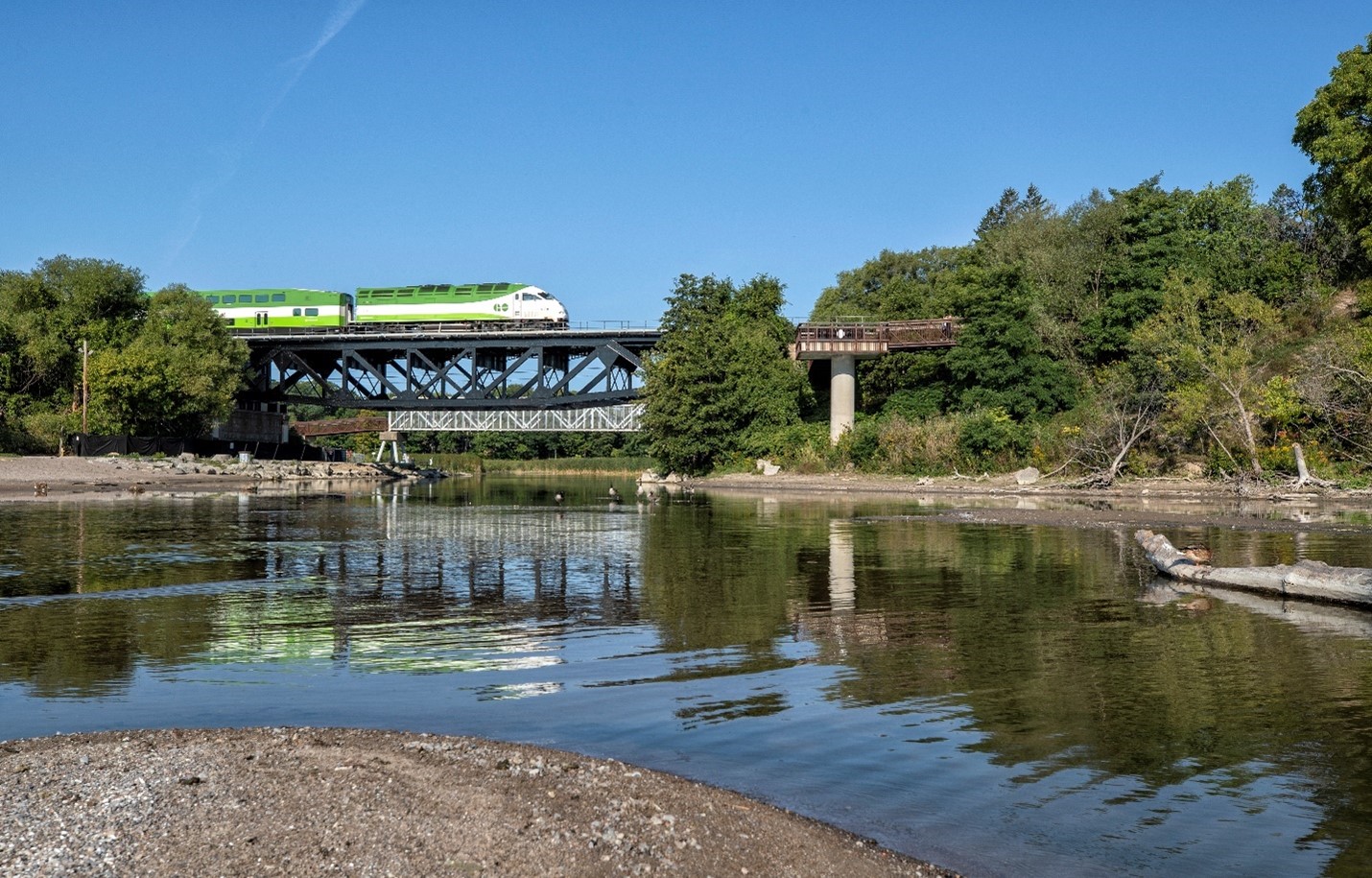
Rehabilitation work was completed in 2022. The 120 yr old bridge has been designated as a Provincial Heritage Property.


Edit - We cycle the Waterfront Trail through here often and on today's ride I stopped to take some non drone photos of this amazing bridge. :)

IMG_9955.jpeg

IMG_9952.jpeg

IMG_9947.jpeg
 
Last edited:
October 17

Rouge River Bridge as seen from Rouge National Urban Park.

View attachment 605203

November 2023
View attachment 605204
View attachment 605205

Rehabilitation work was completed in 2022. The120 yr old bridge has been designated as a Provincial Heritage Property.

And yet it does not look future-proofed for a third or fourth track.
 
A second area that I see is the extreme rigour in using jersey barriers and elaborate measures to separate work from active rail lines. I am very keen to see safe work sites, but these measures are beccoming so elaborate I feel it's reasonable to ask if ML has reached overkill. I don't know if ML requires these measures or if contractors insist on them.... or how much is required by law....and again I am all for erring on the side of safety. But as the barriers far exceed how work was done even a few years ago, one has to ask why the change. Site prep generally seems to go on for ever on ML sites.
I don't know how prescriptive federal or provincial workplace regulations are, but every player is very risk-averse these days. I think back to the days of working on the 400-series highways in the GTA, where once we used to work behind cones and a maybe a blocking car, now it is lane closures and barriers trucks.
 
I don't know how prescriptive federal or provincial workplace regulations are, but every player is very risk-averse these days. I think back to the days of working on the 400-series highways in the GTA, where once we used to work behind cones and a maybe a blocking car, now it is lane closures and barriers trucks.
Its because of the MTO and our proficiency with building roads that I start to think that safety regulations aren’t the lowest hanging fruit. At least, it’s hard for me to square that when it affects both equally yet the costs differ so much. We haven’t built a highway in a long time, mind you, but we do continuously expand them. I wonder how much better the MTO is at controlling costs in general- they seem to know how to build a highway, but the jury’s still out if Metrolinx can build rail systems.

Hence I wonder if bringing the MTO and Metrolinx closer together could help. Either on the planning/implementation side, or just leveraging infrastructure collaboration. I picture giving teeth to the MTO’s ‘Transit alternatives’ (as a real option) by putting Metrolinx in the same room from the outset to execute said transit, with the oversight of a more well-equipped agency. But take that as my uninformed opinion.
 
Its because of the MTO and our proficiency with building roads that I start to think that safety regulations aren’t the lowest hanging fruit. At least, it’s hard for me to square that when it affects both equally yet the costs differ so much. We haven’t built a highway in a long time, mind you, but we do continuously expand them. I wonder how much better the MTO is at controlling costs in general- they seem to know how to build a highway, but the jury’s still out if Metrolinx can build rail systems.

Hence I wonder if bringing the MTO and Metrolinx closer together could help. Either on the planning/implementation side, or just leveraging infrastructure collaboration. I picture giving teeth to the MTO’s ‘Transit alternatives’ (as a real option) by putting Metrolinx in the same room from the outset to execute said transit, with the oversight of a more well-equipped agency. But take that as my uninformed opinion.

I'm not sure the two functions do construction in the same way, but there are always things people can learn from each other.

There has been a dearth of contractors (and workers) in Ontario who have the knowledge and experience on rail projects. One part of this is knowing how to build the specific product - as we've seen with LRT projects, there has been a learning curve in roadbed construction and track laying. Signals and info tech is a very different field for railway construction than anything highways require. .

A bigger part is the interface between the running railway and the construction. The rules for working around running trains are pretty elaborate and don't intersect with anything that is done when building highways. MTO may know very well how to plan and lay out barriers and pylons for a work zone, but controlling work around a live rail line is a much more minute by minute proposition governed by an exacting set of operating rules and regulations. The information and communication flows between MTO and a contractor are very different from the interface between CN/CPKC, ML, and the contractors when planning and executing work.

Similarly, procurement may be quite different. I suspect the provincial bureaucracy that does this is a lot more familiar with highway projects than railways. The process for rail seems to be byzantine, with people triple checking each step, likely out of fear of missing something (which still seems to happen anyways).

I do think ML has a basic deficiency in project planning. One wonders if MTO could teach ML a lot about that. I'm a little long in the tooth to know what tools are used these days, but a good old fashion Gantt chart sure seems to be outside ML's skill set. Maybe start there.

- Paul
 
Last edited:
Its because of the MTO and our proficiency with building roads that I start to think that safety regulations aren’t the lowest hanging fruit. At least, it’s hard for me to square that when it affects both equally yet the costs differ so much. We haven’t built a highway in a long time, mind you, but we do continuously expand them. I wonder how much better the MTO is at controlling costs in general- they seem to know how to build a highway, but the jury’s still out if Metrolinx can build rail systems.

Hence I wonder if bringing the MTO and Metrolinx closer together could help. Either on the planning/implementation side, or just leveraging infrastructure collaboration. I picture giving teeth to the MTO’s ‘Transit alternatives’ (as a real option) by putting Metrolinx in the same room from the outset to execute said transit, with the oversight of a more well-equipped agency. But take that as my uninformed opinion.
Haven't built a highway in a long time? MTO regularly builds new highways.

They opened the 407 extension to Highway 35 less than 5 years ago.

MTO has also built the 400 extension to Sudbury slowly over the last 20 years.. issues with indigenous reserves has limited progress the last few years, but it continues to chug along.

Honestly one of the biggest differences in controlling costs is that MTO (mostly) still just does traditional procurement, one contract at a time.

Metrolinx has shifted back a bit towards this model with smaller, more bite-sized contracts for the OL instead of one, single mega-contract.

Highways are ultimately also just far less complex pieces of infrastructure to build. There is a reason they are substantially cheaper per kilometre despite being far larger in footprint.
 
Haven't built a highway in a long time? MTO regularly builds new highways.

They opened the 407 extension to Highway 35 less than 5 years ago.

MTO has also built the 400 extension to Sudbury slowly over the last 20 years.. issues with indigenous reserves has limited progress the last few years, but it continues to chug along.

Honestly one of the biggest differences in controlling costs is that MTO (mostly) still just does traditional procurement, one contract at a time.

Metrolinx has shifted back a bit towards this model with smaller, more bite-sized contracts for the OL instead of one, single mega-contract.

Highways are ultimately also just far less complex pieces of infrastructure to build. There is a reason they are substantially cheaper per kilometre despite being far larger in footprint.
Apologies, as I didn’t really keep up with what the MTO was doing then. I think it does lend something to my argument if they actually do continuously build things when saying we should emulate them, but it’s neither here nor there in light of your other points.

I’d add my basic assumption was that Metrolinx is in need of accrued expertise, that the MTO has at least some of by comparison.

Nonetheless, it seems like an ‘easy’ couple of improvements would be to:

1. not reinvent the wheel as it pertains to contracting work, and

2. keeping a continuous pipeline of work to do.

Both of these seem to be works-in-progress, and we can’t really know if one of these change (ie., no transit funding for a decade…) till the time comes.

Also, its fairly obvious building highways is easier- I just wonder if there’s something to gain in the transit sphere given that fact. Ala building concrete viaducts or greenfield alignments, especially considering how much greenfield transit Mx has thrown into RTPs. The MTO doesn’t know a thing about building a rail system, but on some level any right-of-way need to be cleared, graded, etc.

I suppose my point here is that I agree the MTO isn’t going to help at all on building an Ontario Line, but they probably could do plenty for the rail-407 transitway or similar.

I'm not sure the two functions do construction in the same way, but there are always things people can learn from each other.

There has been a dearth of contractors (and workers) in Ontario who have the knowledge and experience on rail projects. One part of this is knowing how to build the specific product - as we've seen with LRT projects, there has been a learning curve in roadbed construction and track laying. Signals and info tech is a very different field for railway construction than anything highways require. .

A bigger part is the interface between the running railway and the construction. The rules for working around running trains are pretty elaborate and don't intersect with anything that is done when building highways. MTO may know very well how to plan and lay out barriers and pylons for a work zone, but controlling work around a live rail line is a much more minute by minute proposition governed by an exacting set of operating rules and regulations. The information and communication flows between MTO and a contractor are very different from the interface between CN/CPKC, ML, and the contractors when planning and executing work.

Similarly, procurement may be quite different. I suspect the provincial bureaucracy that does this is a lot more familiar with highway projects than railways. The process for rail seems to be byzantine, with people triple checking each step, likely out of fear of missing something (which still seems to happen anyways).

I do think ML has a basic deficiency in project planning. One wonders if MTO could teach ML a lot about that. I'm a little long in the tooth to know what tools are used these days, but a good old fashion Gantt chart sure seems to be outside ML's skill set. Maybe start there.

- Paul

This helps make apparent just how different the types of work the two entities do are. Safety seems to be something we cannot address by looking to our highway builder. Since I addressed parts of this above, I’ll just say that whatever crossover there might be should be capitalized upon ravenously, if only so Mx isn’t the one trying to do it…

My interpretation of the issues with procurement are that you’d need a systemic shift to acquaint the agencies and the industry with rail construction in a simple and straightforward way. Otherwise we are just going to have to cross this learning curve one way or another.

I can echo that there are those in Ontario that have been accruing knowledge/ experience. I just hope we don’t throw these modes out now that we’re starting to get the hang of it. For all the stuff in the news, Hurontario, Finch, and Xtown West are leagues from the headache of Crosstown. Perhaps the Hamilton LRT will see that expertise put into action, especially given it’s not even the primary goal of the project.

Also, I got acquainted with Gantt charts halfway through schooling and never looked back. Perhaps Metrolinx just needs more Interns that are with the times.

 
Nonetheless, it seems like an ‘easy’ couple of improvements would be to:

1. not reinvent the wheel as it pertains to contracting work, and

2. keeping a continuous pipeline of work to do.

These are both hallmarks of The Spanish Transit building program in Madrid.

***

They are also hallmarks of the way Centre Court builds condos in Toronto. In general keep the same in-house team, the same planners, the same architects etc wherever possible over time. Feed them a steady diet of the same type of work with the same expectations, watch like a hawk, rinse, repeat.
 
Took some photos of Kennedy GO station today. When are they going to knock down the old Scarborough RT track to allow for the extension of the western platform? Most of the work seemed to be taking place in the parking lot and inside the station building. The station is still closed off.

I'm glad I got to the GO station to catch the last "Union bound" train at 4:10pm before that long gap in Southbound service. I wasn't looking forward to taking the subway back to Union. There were a lot of homeless and mentally ill people on Line 1 as I rode up to Bloor-Yonge. Really becoming an issue. I could tell by looking at other rider's faces that they were really uncomfortable. Homeless guy started chatting me up on the subway. He asked for a sip of my coffee. I laughed and said "Hell no, mate! You don't want what I got."

20241018_155808.jpg
20241018_155911.jpg
20241018_155918.jpg
20241018_160107.jpg
20241018_160158.jpg
20241018_160231.jpg
20241018_160330.jpg
20241018_160629.jpg
20241018_160725.jpg
20241018_160738.jpg
20241018_160747.jpg
 

Attachments

  • 20241018_160147.jpg
    20241018_160147.jpg
    231.5 KB · Views: 67
  • 20241018_160005.jpg
    20241018_160005.jpg
    175.1 KB · Views: 61
Last edited:
It's possible some GO enforcement officers are also designated by some or all municipalities to enforce the Highway Traffic Act in vicinity of GO stations, or there's some other legal allowance somewhere, but I can't say for sure. But hey, I've jumped into intersections and helped direct traffic as a regular citizen before.
I know CN police can enforce the HTA within 500 meters of CN property. Wouldn't surprise me if GO officers can do similar
 
These are both hallmarks of The Spanish Transit building program in Madrid.

***

They are also hallmarks of the way Centre Court builds condos in Toronto. In general keep the same in-house team, the same planners, the same architects etc wherever possible over time. Feed them a steady diet of the same type of work with the same expectations, watch like a hawk, rinse, repeat.
Add the Feds National Shipbuilding Strategy to this list - a similar program to develop, retain and expand an industry and its expertise by continuing flows of contracted work.

It is going to be crucial to keep workflows of light and heavy rail transit flowing - be it here in the GTA or out west in Vancouver, Edmonton-Calgary etc. ( Toronto Waterfront, Hamilton, Cambridge and possibly more in Ottawa to name some) And possibly not just transit, we have all discussed quite significant freight rail developments as well.
 
That's because they haven't actually done any construction through here. It's been 2 tracks since the 1850s.

Dan
Not denying the extent of 2 tracks is significant, I just find it funny when we have VIA running through here, as well as a new MSF.
 

Back
Top