Transit fans focus on the operational details, but 98% of transit riders only care about the total travel time, wait time, and whether the vehicle is crowded or not.
The details we are discussing are ones that affect travel times.
What safety reasons are those?
As for the light changes, don't all traffic light cycles come with brief periods of time where no one has the light, to deal exactly with scenarios like this? A fully loaded bus or an 18 wheeler can't stop at a moment's notice, either.
Trams take longer to stop vs. a bus because of the low friction between the wheel and rail. This means that a tram has to start braking further away from the light than a bus would. If visibility of the signal is poor at the braking point, the tram always has to brake before the intersection.
In Vienna, this issue is mitigated by placing a distant signal (right side of the image) well before the intersection to indicate to the tram whether it should start braking. The timing of the distance signal is set so that if a tram passes it at the speed limit while it is showing 'proceed', it is guaranteed that the tram will be able to proceed past the main signal at the intersection. This allows trams to avoid unnecessary braking when approaching a signal that is about to change, reducing travel time.
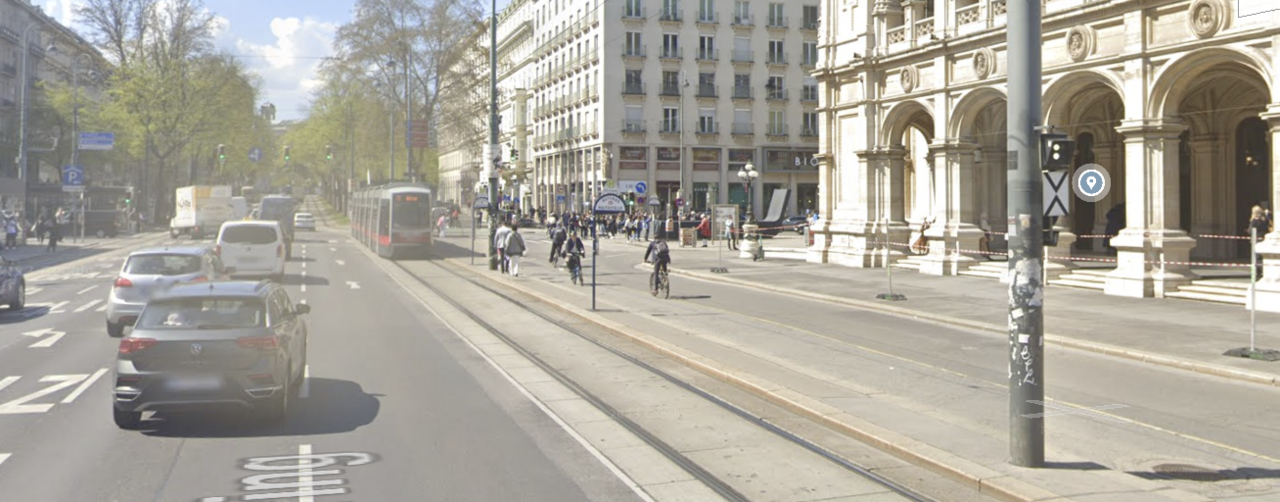
The reason this can't be done in Toronto (or is difficult to implement) is because the lights at (most) intersections are operated in a demand-responsive manner, where light phases can be lengthened (or shortened) in response to variation in demand. For safety reasons, once the distant signal for the tram starts to show 'proceed', the main signal must change to 'proceed' shortly after (otherwise the tram will be unable to brake in time). This means the intersection controller needs to commit to authorizing the tram to proceed well before the signal actually changes. Additionally, the main signal for the tram cannot be changed to 'stop' unless the distant signal has displayed 'stop' for the amount of time required for a tram to travel from the distant signal to the intersection. This in turn limits the flexibility of the controller to respond to variation in cross traffic flows. (i.e. cross-traffic is very high, it may not be possible to give a green extension or finish the tram's phase early.)
In Austria, traffic lights operate on a fixed-time control (i.e. the intersection controller will never extend, shorten or skip a light phase in response to changes in demand), so these issues aren't present. In other countries where intersection control is demand-responsive (e.g. Netherlands), this is never done.
Additionally, the 'clearing time' (where no vehicle is authorized to pass through the intersection) represents a loss of road capacity, which you generally want to minimize.







