News   GLOBAL  |  Apr 02, 2020
 10K     0 
News   GLOBAL  |  Apr 01, 2020
 42K     0 
News   GLOBAL  |  Apr 01, 2020
 6.3K     0 

Raise your hand if you think the TTC will operate this line like a streetcar route? :eek:

Depends upon what roadblocks, legalize, and "you can't do that"'s from transportation services (traffic lights and roads), fire services, paramedic services, police services, and other departments, and NIMBY's ("I want more stops", "I want less stops", etc.) have to say.
 
Raise your hand if you think the TTC will operate this line like a streetcar route? :eek:

You are asking the most important question of all. I think there is a huge risk of this, but it doesn't have to be. It will take an awful lot of watchfulness and advocacy as the design comes together and as the line is comissioned to ensure that tradeoffs don't creep in and so the line is managed as *rapid* transit and not as a streetcar.

- Paul
 
Depends upon what roadblocks, legalize, and "you can't do that"'s from transportation services (traffic lights and roads), fire services, paramedic services, police services, and other departments, and NIMBY's ("I want more stops", "I want less stops", etc.) have to say.
The signals on the midblock streets aren't synchronized. It wouldn't matter much if the stops are removed or not if they don't offer full prioritization for those midblock intersection. Enough with the farside stops. They have yet shown any working prioritization that doesn't double stop at any intersection in the GTA. Spadina, St Clair and VIVA all suffered from this car first approach.

Physically it would be possible, but it would run into several problems especially at intersections and with station placement to the point where it could potentially drive up costs further compared to building it on Eglinton itself. The ROW that was sold off would have allowed for a multitude of options compared to what we've been left with today.
Right now many intersection on Eglinton west doesn't have right turn lanes. I rather they keep it that way and they'll have enough for a platform on each side. If they are at grade, it would offer no speed advantage being in the middle or not but it would be safer for riders as they wouldn't bolt through the roadway trying to catch a train in the middle.
 
The signals on the midblock streets aren't synchronized. It wouldn't matter much if the stops are removed or not if they don't offer full prioritization for those midblock intersection. Enough with the farside stops. They have yet shown any working prioritization that doesn't double stop at any intersection in the GTA. Spadina, St Clair and VIVA all suffered from this car first approach.
...

The TTC has no control on traffic signals. Traffic signals are under the control of Transportation Services. They see light rail vehicles, streetcars, and buses as a vehicle (singular). They give priority to left turning single-occupant vehicles, usually three or four, because those three or four vehicles are more than one streetcar or bus or light rail vehicle. The mayor, executive committee, or city council should tell Transportation Services that transit vehicles must be given priority over ordinary motor vehicles. However, they are afraid, very afraid, of angering the suburban auto-centrist voter.

 
You are asking the most important question of all. I think there is a huge risk of this, but it doesn't have to be. It will take an awful lot of watchfulness and advocacy as the design comes together and as the line is comissioned to ensure that tradeoffs don't creep in and so the line is managed as *rapid* transit and not as a streetcar.

- Paul
it will on;y be managed as a streetcar if many stops are put in
 
it will on;y be managed as a streetcar if many stops are put in
Not so. We can also consider it streetcar operation if they choose to stop and proceed after every switch, or if they choose to proceed and crawl at 5-10km/h at each intersection.
 
Not so. We can also consider it streetcar operation if they choose to stop and proceed after every switch, or if they choose to proceed and crawl at 5-10km/h at each intersection.
I've not seen streetcars stopping at every switch in Toronto. Where are you seeing this? Nor do I see them slowing down at most intersections - I've seen many streetcars ripping through intersections above the speed limit late at night.

Yes, they slow down at a switch; they don't stop.
 
Not so. We can also consider it streetcar operation if they choose to stop and proceed after every switch, or if they choose to proceed and crawl at 5-10km/h at each intersection.

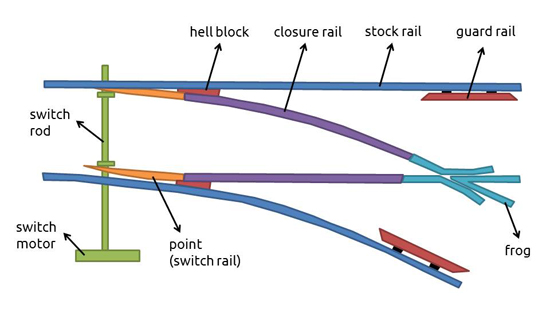
The streetcar network downtown uses single point switches.
StreetSwitch_800x350.jpg


The Transit City tracks are supposed to be double point switches, like in the subway.
Street%20Track.jpg


Slide1.jpg


Again, its the accountants and bean-counters doing their work.
 
Single point are traditionally easier to install and maintain in city pavement, more reliable in the sense that there is only one place that foreign material can jam the points, but less reliable in the sense that it's easier for the wheels to pick the switch. I wonder whether improvements in street construction (@W.K.Lis's photos contrast a very modern double point trackbed, versus old-school single point in ashphalt) makes double point more practical for street cars too..... not that TTC would give up its old school ways without a fight.

The premise of LRT is operating like subway: shut the doors, accelerate, go full speed to the next station, brake, open the doors, repeat.

Anything that disrupts that cadence - track switches, u-turn lanes, red traffic lights - is a recipe for slower service and a 'streetcar mentality'.

On Crosstown, track switches ought to be a non-issue - there are fewer of them, and dual point on a segregated row should be navigable without a stop. (Will Crosstown have traffic control, like the subway? If so, the operator will comply with a signal, versus worrying about the switch points per se)

More stops won't help, but the biggest risk is that traffic lights will force operators to coast or stop between stops. Building in U-turn lanes, as is being proposed for Eglinton West, actually increases the number of intermediate potential stopping points. Inadequate U=turn merge lanes could leave autos lingering on the tracks until everything ahead has moved on. If this is allowed to become the norm, 'coasting' habits will form and schedules will be padded.

I hope the line is managed from the subway control organization - and not as a surface line.

- Paul
 
Last edited:
For the streetcar network, the problem is funding shortages for the TTC. With the Mayor asking for a reduction in TTC funding (2% for 2016), don't expect to see much improvement in streetcar speeds. The cuts have to come from somewhere, so cut on track switch improvements.

See link.
 
I've not seen streetcars stopping at every switch in Toronto. Where are you seeing this? Nor do I see them slowing down at most intersections - I've seen many streetcars ripping through intersections above the speed limit late at night.

Yes, they slow down at a switch; they don't stop.

There have been rules in place for about 10 years that require every operator to stop at every facing-point switch. And it's been my experience that the vast majority of the operators abide by this, seeing as how their jobs are at stake.

Dan
Toronto, Ont.
 
Stop? Even running east on Queen East to Connaught, they only slow going past the switches between Greenwood and Connaught for the yard, before coming to a stop at the stop Connaught itself. I don't see full stops.

And I certainly don't see any slowing down at most intersections!
 
We are all going to have to have some faith that the leadership at the TTC will start to put this right. Criticizing them is pointless. The money comes from the city. It is up to us to get on top of our city councillors and agitate for improvement. They are dolling out the funds. And they respond to voter and citizen feedback. The TTC managment is bound to live with the envelope it is granted.

The TTC knows how to do its job. The switches at Leslie Barns are all double throw. Great.

If we were all paying attention, at Greenwood Yard, Justin Trudeau doled out over $800M in transit maintenance funding about eight weeks ago. So one of these days, the citizens of Toronto need to see what repair work has become funded and from where. Whether it's 60 more Flexities, or more track work, or ATO/ATC on the subway, these projects are needed to make it all work better.

I see Brad Ross is in the habit of answering public questions. How about someone tweet him and ask when we are going to see additional maintenance scheduled?

Here was Steve Munro's report on the TTC track repair schedule earlier this spring. In the link is a 5 year track plan for the legacy streetcar network. Looking at the picture from W. K. Lis above, it is a miracle that there are not more derailments daily.

https://stevemunro.ca/2016/02/26/ttc-streetcar-track-plans-2016-2020/
 

Back
Top