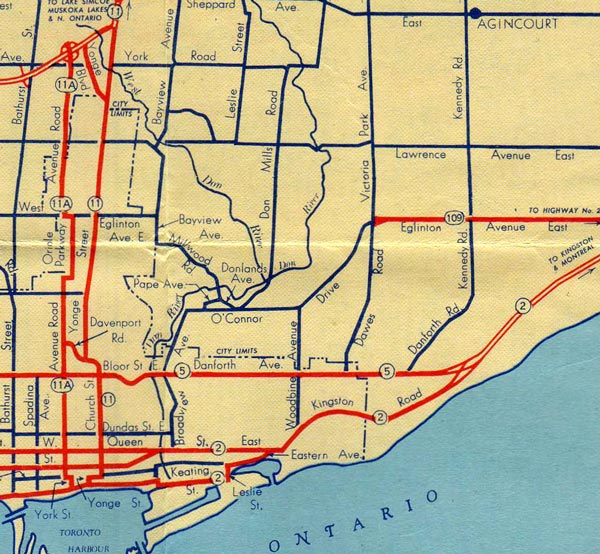
Highway 11 was first established in 1920. The highway began in Toronto and followed Yonge Street to Bradford and Barrie. The highway then continued north to Orillia and ended at the Severn River. Beyond the Severn River, the road was maintained as a Northern Development Trunk Road, which did not have a highway number. The trunk road went as far as North Bay, but it did not proceed any further. The Government of Ontario sought to improve access to the booming Timiskaming and Cochrane Districts, as it was felt that improved road access to these regions was vital in order to ensure their ongoing prosperity. Construction began on an extension to the trunk road from North Bay to Cobalt in 1925, to permit traffic to enter the Timiskaming District from the south. The trunk road was completed and officially opened to traffic on July 2, 1927. The trunk road was named the Ferguson Highway, in honour of Premier G. Howard Ferguson. Premier Ferguson was one of the largest proponents of northern development and procured the construction of many new trunk roads including the North Bay to Cochrane Trunk Road. The trunk road from the Severn River to North Bay soon became known as the Ferguson Highway as well, even though it wasn't actually part of the highway that Ferguson's Government had constructed. The Ferguson Highway was gradually extended from Cochrane to Hearst in the late 1920s and early 1930s. In the mid-1930s, the Department of Highways of Ontario (DHO) amalgamated with the Department of Northern Development (DND). The DHO assumed responsiblity for the trunk roads previously maintained by the DND, including the Ferguson Highway from Severn River to Hearst. The entire Ferguson Highway was designated as Highway 11 in 1937.
During the late 1930s, an access road was built from Highway 17 at Nipigon to the booming gold mines near Geraldton. During World War II, a road was completed between Geraldton and Hearst, forging a new highway link across Northern Ontario. This new road was technically the first Trans-Canada Highway, because the famed Trans-Canada Highway around Lake Superior via Wawa was incomplete until the 1960s. Upon the road's completion in 1943, the entire highway from Hearst to Nipigon was designated as Highway 11. For many years, Highway 11 ended in Nipigon. In the 1950s, construction got underway to provide a new highway link between Thunder Bay and Fort Frances. Initially, this highway was known as Highway 120, but the road was later designated as an extension of Highway 11. In order to do this, the DHO had to sign a 180 km section of Highway 17 concurrently with Highway 11 between Nipigon and Shabaqua Corners and redesignate a section of Highway 71 from Fort Frances to Rainy River as Highway 11. The new highway from Thunder Bay to Fort Frances was completed in 1965. The new highway link boasted an impressive 4.8 km (3 mile) causeway across Rainy Lake. The new Highway 11 link greatly reduced the highway distance between Fort Frances and Thunder Bay. It also marked the completion of Highway 11, which now covered a distance of almost 1,900 km. Highway 11 was designated as a Trans Canada Highway route from North Bay to the Highway 71 Junction near Emo during the 1960s.