News   GLOBAL  |  Apr 02, 2020
 11K     0 
News   GLOBAL  |  Apr 01, 2020
 43K     0 
News   GLOBAL  |  Apr 01, 2020
 6.5K     0 

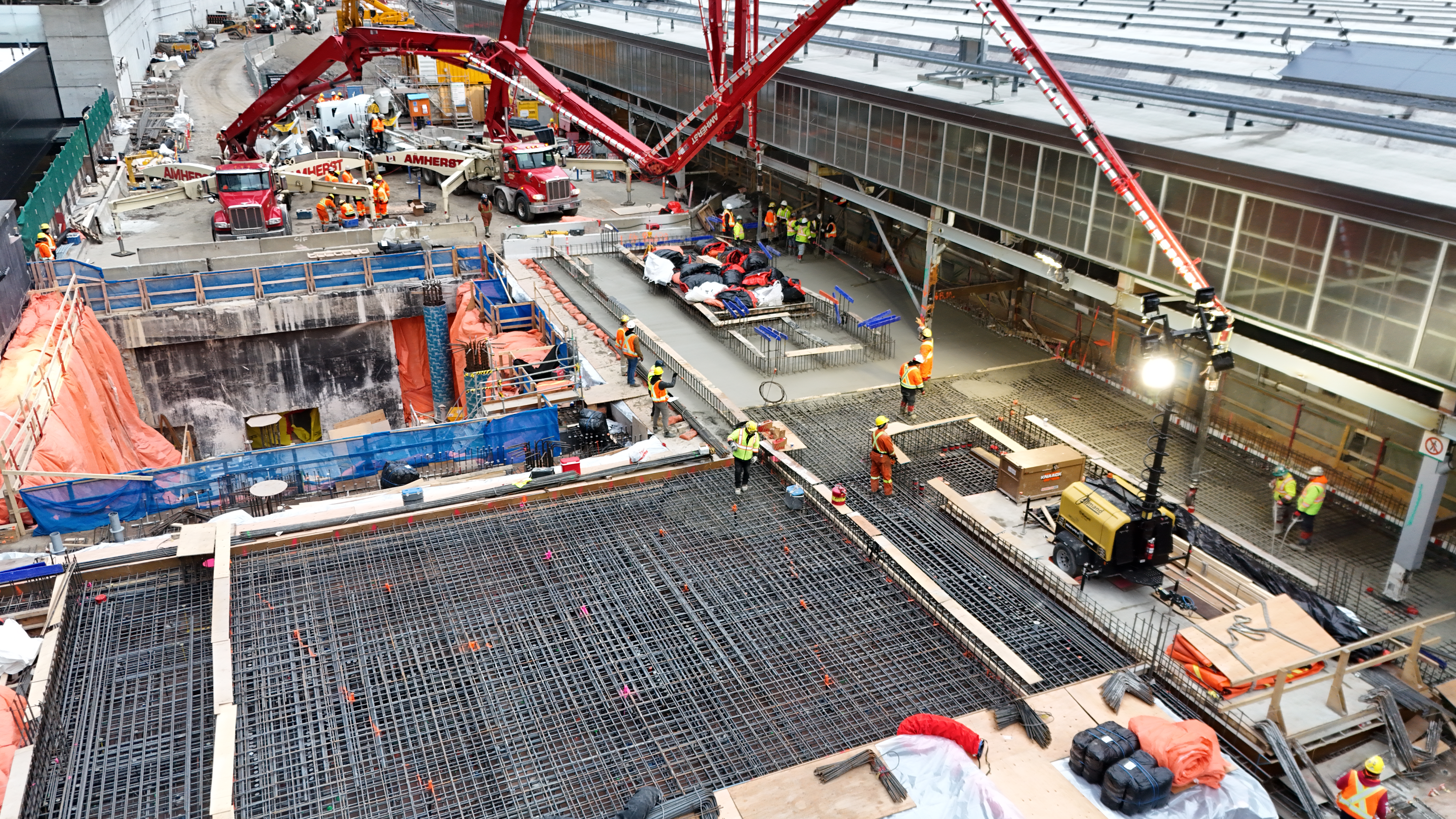
They're literally widening the platforms at Toronto Union as we speak.


While the work begins with the new GO concourse at the south end of the station, the plan for the project's lifecycle is to, once the new concourse is open, circle back and widen/enhance the existing platforms.
Someone tell them to rough in some high level platforms.
 
Add Kingston! Add Fallowfield! Add Ottawa Union! Move Peterborough station downtown!

The risk of scope creep is growing. I really hope the project staff have both the gumption and authority to refuse all this. Nothing will kill this faster than adding billions to the build and slowing service.
There are a few things I think about this:
1) lets avoid as much scope creep as possible. We don't want this to not be a true high speed rail system.

2) This is screaming that there is a desire for passenger rail transportation and it is lacking. This speaks to the possibility that when ALTO opens, the existing service may be maintained. Maybe more of the trains will stop at those places that currently don't stop as often or even at all.

3) With no freight maybe those small places get a station but is part of a 'milk run' service. Remember, the route is expected to be double track, so bypassing a milk run train could be possible.
 
What infrastructure is restricted at Union and Central to cause them to have to do this? If anything stations like Kingston and Dorval, with their outdoor platforms would I think be more limiting.
We've discussed this so many times, but I'll try to provide a handy table so that I can throw it at someone's head every time these questions get repeated:
Infrastructure limitationDifference to customer-centric infrastructure in EuropeImplication for passenger handling at stations
Vertical accessModern European stations have wide staircases which allow multiple passengers to safely move in both directions. Conversely, VIA's stations in MTRL, OTTW (except platform 1) and TRTO rely on narrow staircases and single escalators, which prevent bidirectional passenger flows.Passengers can only access the platform once all detraining passengers have left the platform, as they would otherwise be stuck on the platform.
Platform widthModern European stations have platform widths of 10-20 meters, which allows for the safe and free bidirectional circulation of passengers. Conversely, VIA's stations especially at TRTO and OTTW (except platform 1), but also at MTRL (around the staircase), are extremely narrow.Trains cannot move safely while passengers are present on the platform. Passengers can only access the platform once all detraining passengers have left the platform, to prevent gridlocked between detraining passengers and those wishing to board a train.
Platform heightModern European stations have high-level platforms, which allow passengers to board the train with 3 or less steps up. Conversely, VIA's platforms at all stations except MTRL, QBEC and Platform 1 at OTTW are extremely low, which requires the passenger to climb 5 or more steps.Trains cannot move safely while passengers are present on the platform, as the low gap between platform height and the top of rail is insufficient to make passengers unconsciously keep a safe distance to the platform edge.

Staff needs to be available at every door and boarding takes much longer per passenger, as they need to make more steps, but crucially, the risk of injuries while handling of heavy luggage rises significantly, as luggage has to be lifted vertically and horizontally over a much larger distance (109 cm at TRTO vs. 20 cm at a regular ICE station in Germany). I've read that VIA's disability insurance provider and workplace safety regulators forced the strict luggage rules and their widespread enforcement due to the high volume of passengers who are unable to lift their luggage themselves over such extreme obstacles.
Lack of train indicators on platformsVirtually any major railway station in Europe has big screens which clearly indicate which train is expected or stationary at which platform, thus allowing passengers to identify the correct train. Conversely, no such screens are present at any VIA station or (in the case of Union Station) so tiny that they don't provide sufficient information to be read by most VIA passengers.There cannot be multiple trains receiving passengers at the same time, due to the high risk of passengers boarding the wrong train. Also, staff has to be available at every door.

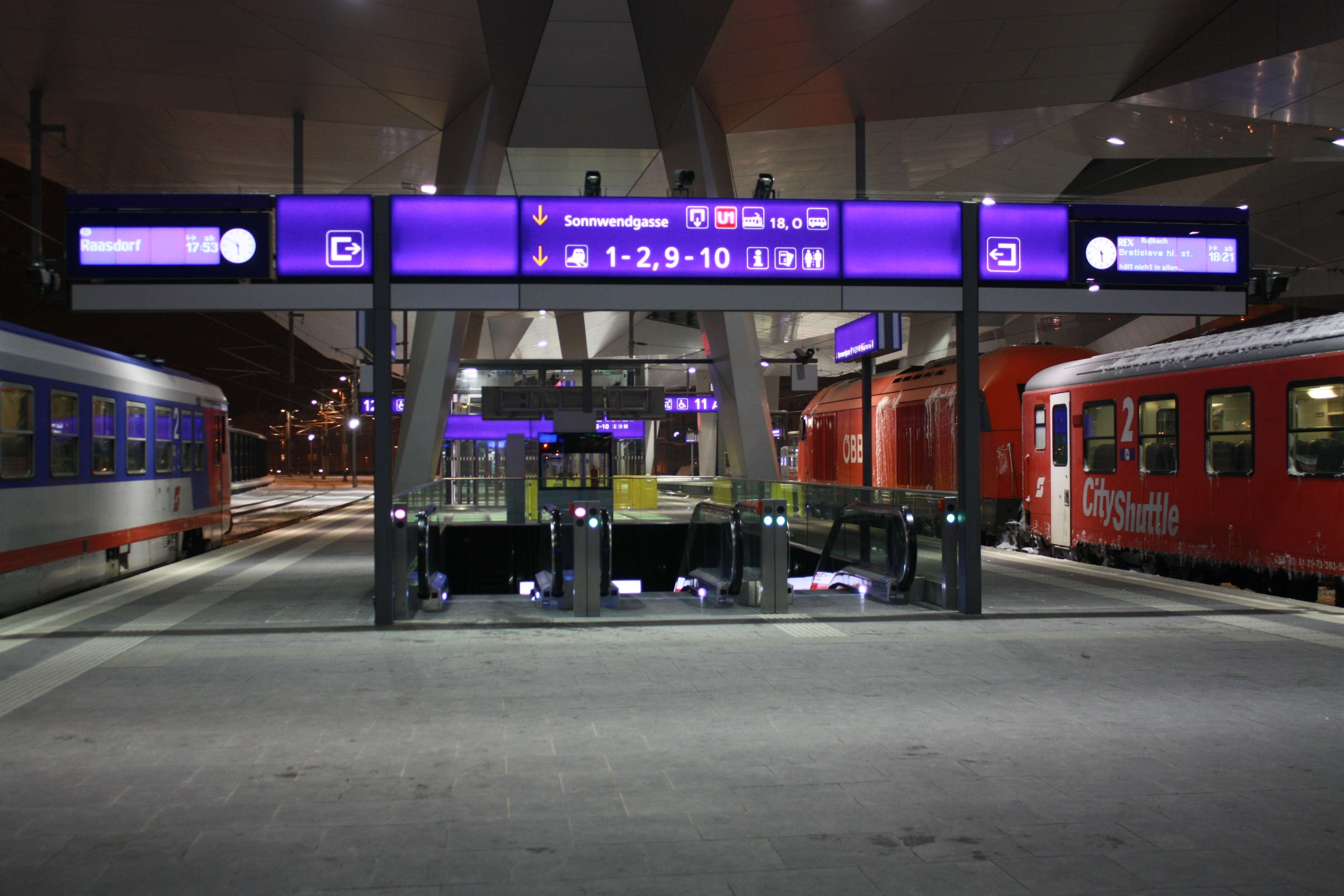
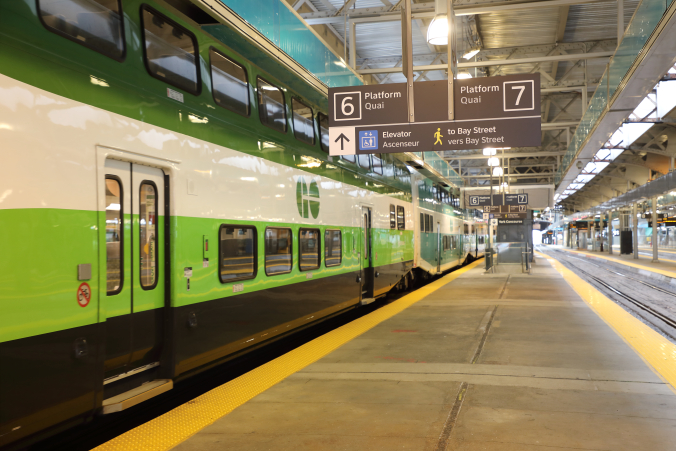
I guess it's time again to illustrate the above with my periodic repost of the contrast between Vienna Hauptbahnhof and Toronto Union:
Thank you for sharing this great European example of a passenger-centric rail hub, but I believe the most important difference between European rail hubs like Wien Hauptbahnhof and North American rail hubs like Toronto Union only becomes clear when you draw the attention at the width of the platforms and of the vertical access (stairs or escalators):

img_7762.jpg

Source: 5TEF4Ns Blog

39546-131241.jpg

Source: Urban Toronto article by Robert Mackenzie


We can laugh all we want about the archaic boarding practices on which VIA insists, but they are a direct consequence of the severe historic underinvestment in rail infrastructure on this continent. If we want passenger-centric boarding processes like across Europe, we'll have to heavily invest into passenger-centric infrastructure first...

And even at Union and Central - what has changed? They didn't used to give a damn about how heavy (or bulky) as suitcase was, that you could carry. Even more so I'd think these days, with the addition of the baggage racks near the entrance, rather than having to put everything overhead - or have they eliminated them?
What has changed? To name the two most obvious changes: checked baggage is no longer offered and work injuries are no longer accepted as workplace risks inherent to being responsible for assisting passengers while boarding...

***

Anyways, thankfully, nothing of the above should constrain ALTO, as they fortunately can build their own passenger-centric facilities, just like VIA would have done decades ago, if they had been provided with the necessary funding and mandate...

 
Last edited:
With all the talk on Facebook among Kingston political folk to push for a Southern route option (that still won't be anywhere near close to Kingston...), I can't help but think: where the hell have these people been for years? If they truly wanted better VIA service to Kingston, that could have happened very quickly if the federal government simply threw money at it. It's very irritating.
 
We've discussed this so many times, but I'll try to provide a handy table (lots of talk about modern stations elsewhere) ...
I see no such restrictions in non-modern stations in such places either.

But still, if you are correct and these ARE the issues, then why is it not an issue at most stations, and only the termini?

And if it's about health and safety for railroad staff, why is the limit 23 kg when the customer carries it, but 32 kg when VIA staff check it in? That suggests that (up to 32 kg) is not a H&S limit.
 
Anyways, thankfully, nothing of the above should constrain ALTO, as they fortunately can build their own passenger-centric facilities, just like VIA would have done decades ago, if they had been provided with the necessary funding and mandate...

This is the most important part of your very compelling presentation. While things may be as they are for a reason, they are nonetheless disfunctional, welll behind world standard, and need to be corrected. Aspirationally, one would hope that VIA is pushing forward where it can as opposed to trotting out your (valid) explanations and using them as a reason to do nothing.

- Would the platforms in Montreal Central not be amenable to open boarding, as they are wide enough and do not impose safety issues for luggage carrying passengers and staff?

- Would Platform 1 at Ottawa not be amenable to open boarding, for the same reasons?

Toronto may be a tougher nut to crack, but perhaps VIA ought to articulate what its plan is once the USRC work is further along?

- Paul
 
"Open boarding here and here but not here unless here and definitely not here except when here" is perhaps not the best approach from a customer service perspective, especially when the vast majority of passengers are only travelling between 3 cities: having completely different procedures at all 3 would be a pretty awful outcome.

With that being said, having these slap-fights over the boarding procedures for a hypothetical future train which won't exist until the 2040s does feel like an exercise in something other than factual discussion.
 
Last edited:
We've discussed this so many times, but I'll try to provide a handy table so that I can throw it at someone's head every time these questions get repeated:
Infrastructure limitationDifference to customer-centric infrastructure in EuropeImplication for passenger handling at stations
Vertical accessModern European stations have wide staircases which allow multiple passengers to safely move in both directions. Conversely, VIA's stations in MTRL, OTTW (except platform 1) and TRTO rely on narrow staircases and single escalators, which prevent bidirectional passenger flows.Passengers can only access the platform once all detraining passengers have left the platform, as they would otherwise be stuck on the platform.
Platform widthModern European stations have platform widths of 10-20 meters, which allows for the safe and free bidirectional circulation of passengers. Conversely, VIA's stations especially at TRTO and OTTW (except platform 1), but also at MTRL (around the staircase), are extremely narrow.Trains cannot move safely while passengers are present on the platform. Passengers can only access the platform once all detraining passengers have left the platform, to prevent gridlocked between detraining passengers and those wishing to board a train.
Platform heightModern European stations have high-level platforms, which allow passengers to board the train with 3 or less steps up. Conversely, VIA's platforms at all stations except MTRL, QBEC and Platform 1 at OTTW are extremely low, which requires the passenger to climb 5 or more steps.Trains cannot move safely while passengers are present on the platform, as the low gap between platform height and the top of rail is insufficient to make passengers unconsciously keep a safe distance to the platform edge.

Staff needs to be available at every door and boarding takes much longer per passenger, as they need to make more steps, but crucially, the risk of injuries while handling of heavy luggage rises significantly, as luggage has to be lifted vertically and horizontally over a much larger distance (109 cm at TRTO vs. 20 cm at a regular ICE station in Germany). I've read that VIA's disability insurance provider and workplace safety regulators forced the strict luggage rules and their widespread enforcement due to the high volume of passengers who are unable to lift their luggage themselves over such extreme obstacles.
Lack of train indicators on platformsVirtually any major railway station in Europe has big screens which clearly indicate which train is expected or stationary at which platform, thus allowing passengers to identify the correct train. Conversely, no such screens are present at any VIA station or (in the case of Union Station) so tiny that they don't provide sufficient information to be read by most VIA passengers.There cannot be multiple trains receiving passengers at the same time, due to the high risk of passengers boarding the wrong train. Also, staff has to be available at every door.

I guess it's time again to illustrate the above with my periodic repost of the contrast between Vienna Hauptbahnhof and Toronto Union:


What has changed? To name the two most obvious changes: checked baggage is no longer offered and work injuries are no longer accepted as workplace risks inherent to being responsible for assisting passengers while boarding...

***

Anyways, thankfully, nothing of the above should constrain ALTO, as they fortunately can build their own passenger-centric facilities, just like VIA would have done decades ago, if they had been provided with the necessary funding and mandate...

What did they do when Grand Central ran out of space? They dug down. Not easy and certainly not cheap, but it is an option. Everything should be on the table till something is approved. One option could be not to go into Toronto Downtown with this first phase. Maybe all of he tunneling is a second phase. It isn't like we don't build other transportation in phases. Unless you are part of the consortium building this (and you might be but cannot say) Everyone here is effectively throwing out their fantasies and seeing what sticks. Before that map showing the study areas, no one expected Dorval area to be bypassed. No one expected an in and out for Central. Everyone thought the Havelock sub with minor corrections would be the only route through eastern ON. We are now seeing they are looking at all options and then will pick one that is the best compromise within the scope of the project.

If you are part of the consortium and can speak on what options they are looking at, by all means, let it all out.

That is what I have said it could do. Kinda cool that they made a video about a way to do it.
 
The elevated approach is feasible. A tunnel would take almost exactly the same route. Anyone care to Photoshop an elevated guide-way and portal into some of the tourist-promo photos of skating on this UNESCO heritage site? I lack the skills. It would go more or less where the trees are on the right side of this shot, I guess.

1769315485379.png
 
They just spent an absolute bundle on rebuilding the below-grade concourses. Tearing that all out is not an option. They would sooner put the station at the bottom of Lake Ontario.
I did not say tear it out. I did say tunnel under it. That does mean tunnel under the existing infrastructure, including the mall. Again, it is only money. And if they see it as a viable option, then it will happen. If they don't we will see something else.
 
I see no such restrictions in non-modern stations in such places either.
Please provide specific examples for what “such policies” in what “such places” you are referring to…
But still, if you are correct and these ARE the issues, then why is it not an issue at most stations, and only the termini?
Again, could you provide more specific examples?
And if it's about health and safety for railroad staff, why is the limit 23 kg when the customer carries it, but 32 kg when VIA staff check it in? That suggests that (up to 32 kg) is not a H&S limit.
The main difference between checked baggage and baggage brought by the passenger on board is that luggage can be lifted horizontally into a bagge car, whereas all other cars require luggage to be simultaneously lifted horizontally and vertically. Try to lift a suitcase up with your arm next to your body. Now try the same while stretching your arm as far as your arms goes…
 

Back
Top