News   GLOBAL  |  Apr 02, 2020
 11K     0 
News   GLOBAL  |  Apr 01, 2020
 43K     0 
News   GLOBAL  |  Apr 01, 2020
 6.7K     0 
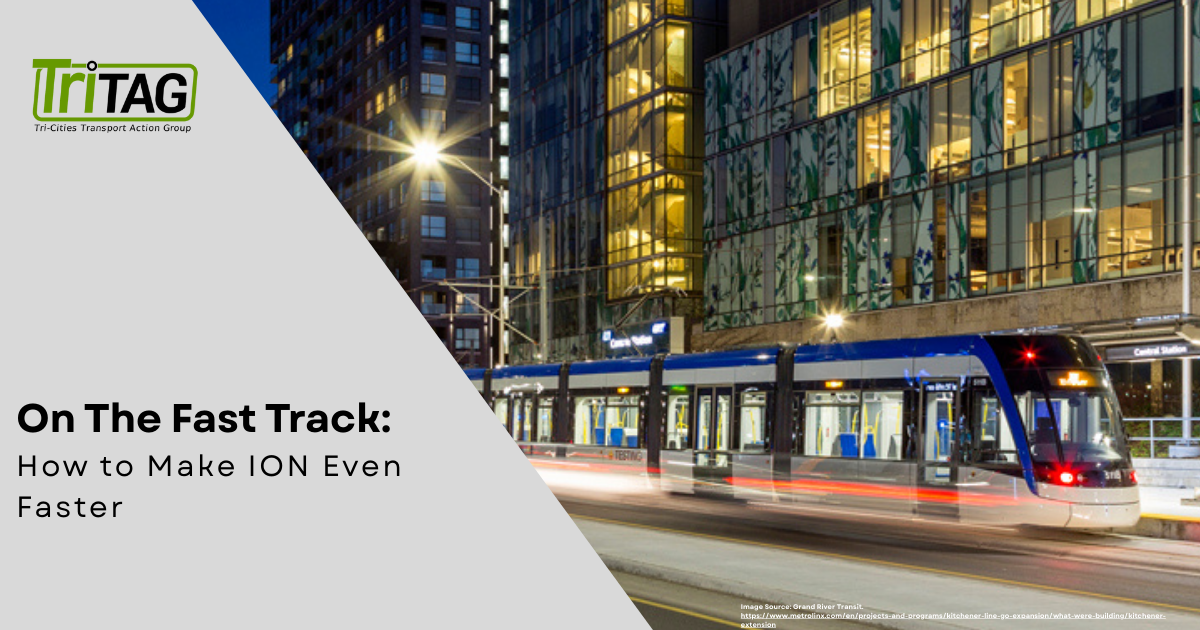
There's a new article by Tritag describing the changes needed to improve ION speeds. Seems topical given speed concerns of Lines 5 and 6:


Full disclosure: I donated my diagram describing ION speed concerns (shared a couple of pages ago) to Tritag
 
There's a new article by Tritag describing the changes needed to improve ION speeds. Seems topical given speed concerns of Lines 5 and 6:


Full disclosure: I donated my diagram describing ION speed concerns (shared a couple of pages ago) to Tritag

Thanks.

The Tri-tag article mentions beacons for the ATP system, but my understanding was that ours leverages the AC signals in the crossing prediction blocks. There certainly aren't any conspicuous fobs bolted between the rails like you see on Line 1, Line 5, or in Ottawa. I believe that's what it made it particularly finicky to tune initially, and why sections like southbound approaching Hayward got awkwardly slow once it was switched on, and have never been fixed.

If that's true, then I suspect there's no way to fix it without splitting some of the signaling blocks, a major infrastructure change that may not be feasible without renegotiation of the Design-Build-Finance-Operate-Maintain (DBFOM) contract, and would also require a (lengthy?) bustitution period.

I sincerely hope that my understanding is wrong.

At the very least, I wish they would tune the crossing predictors on Courtland and a few other notorious spots on the line. The gates go down far too early now and stay down far too long, but they weren't that bad when the system opened. The analog parameters of the track have changed as it's built up grime and worn in, but it seems like no one's ever gone back to tweak the programming to align with reality. Oh happy day when we finally see the clipboard and stopwatch crews out there again like they were during commissioning. (Although you'd think that just videoing the operations in various weather conditions and frame counting would be sufficient -- but I have no idea what the rules 'written in blood' actually are.)

 
Last edited:
Thanks.

The Tri-tag article mentions beacons for the ATP system, but my understanding was that ours leverages the AC signals in the crossing prediction blocks. There certainly aren't any conspicuous fobs bolted between the rails like you see on Line 1, Line 5, or in Ottawa. I believe that's what it made it particularly finicky to tune initially, and why sections like southbound approaching Hayward got awkwardly slow once it was switched on, and have never been fixed.

If that's true, then I suspect there's no way to fix it without splitting some of the signaling blocks, a major infrastructure change that may not be feasible without renegotiation of the Design-Build-Finance-Operate-Maintain (DBFOM) contract, and would also require a (lengthy?) bustitution period.

I sincerely hope that my understanding is wrong.

At the very least, I wish they would tune the crossing predictors on Courtland and a few other notorious spots on the line. The gates go down far too early now and stay down far too long, but they weren't that bad when the system opened. The analog parameters of the track have changed as it's built up grime and worn in, but it seems like no one's ever gone back to tweak the programming to align with reality. Oh happy day when we finally see the clipboard and stopwatch crews out there again like they were during commissioning. (Although you'd think that just videoing the operations in various weather conditions and frame counting would be sufficient -- but I have no idea what the rules 'written in blood' actually are.)
I believe its correct to say that ION uses track circuits (not tags). Although I've also seen control points referred to as "beacons". I'd assume whats more important is what type of control action is occurring at the point rather than the actual infrastructure. If hard "overspeed" directives are changed to "suggestions" then we could have the speed benefits without expensive infrastructure work (as the article suggests).
 
It's sad how there is a general ack of "future proofing" in Ontario's transit designs.

This stations should be built to accommodate a potential, future third track.

The original design was future-proofed for a third track. The north platform would become an island platform with an additional track on the north side, and an additional bridge would be added across King. The bridge abutment design leaves space for an additional bridge on the north side.
Screenshot 2026-02-26 at 15.39.44.png


However, ever since the design shifted the platforms eastward (such that they need to close or grade-separate Duke St) they don't seem to be displaying the future-proofing for the third track anymore.
 

Back
Top