News   GLOBAL  |  Apr 02, 2020
 11K     0 
News   GLOBAL  |  Apr 01, 2020
 43K     0 
News   GLOBAL  |  Apr 01, 2020
 6.6K     0 
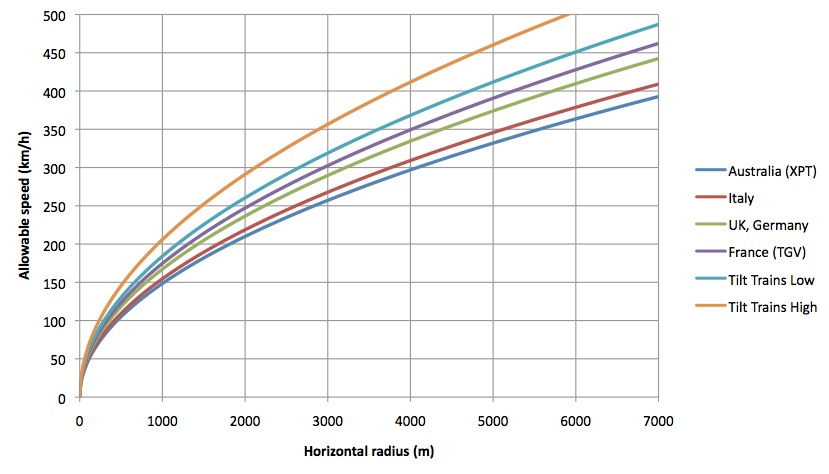
The 401 is designed with a curve radius meant for speeds of 100-130km/h. Alto will be designed in mind for at least 300km/h, which means the curve radii need to be almost 7km. The 401 is not as straight as you think it is, if you were to build Alto along it you would need significant realignments in many places. The corridor is also not as wide as you think it is, an Alto corridor would probably need at least 30m of space, maybe even more in some places, which simply does not exist nicely to the side or anything in the 401 corridor. In fact, from my rudimentary Google Maps measurements, the 401 ROW is maybe only 60m itself in many places if we are being generous. So it would require a new expropriated corridor somewhere next to the highway anyway...
View attachment 721340View attachment 721341

Also, if a train went by anywhere near me at 300 km/h (especially coming from behind, blowing wind and snow), I would absolutely crash my car.
 
You're kidding, right?

Hey, no biggie..... just rip out a couple hundred miles' worth of poured concrete dividing wall, relocate all the underground center drainage, and raise all the overpasses that don't offer enough clearance for OCS..... only the last 40 years' worth of investment in 401 infrastructure.

- Paul

1773350644387.png
 
It doesn't literally need to follow the 401 corridor.

And you would need to do all that if you built a new corridor anyway.

But the 401 does have a lot of steep hills around Kingston that wouldn't work for trains.
 

With the flurry of floor crossing and the upcoming 3 by elections (two of which are 99% liberal safe seats), this will get Carney’s 172 majority and ensure passage of bill C-15 and any other HSR related legislation for the foreseeable future.
 
It doesn't literally need to follow the 401 corridor.

And you would need to do all that if you built a new corridor anyway.

But the 401 does have a lot of steep hills around Kingston that wouldn't work for trains.
But that's what you said and that's what we are responding to.

Not only are some of the 401 grades not suitable for HSR, a lot of the curves aren't either.

It is a given that a new corridor is proposed and required, but that's why they are not proposing it through the most densely populated and expensive corridor in eastern Ontario.
 
High speed rail lines do go next to highways quite often, but it's only for short distances because of the geometry issues others have mentioned. Highway curves are much sharper than on a high speed railway.
 
High speed rail lines do go next to highways quite often, but it's only for short distances because of the geometry issues others have mentioned. Highway curves are much sharper than on a high speed railway.

It’s much more common that highways follow railways, actually! The Gardiner, Highway 401 in Durham Region and east of Kingston, and Highway 7 between Acton and Rockwood are examples.
 
It’s much more common that highways follow railways, actually! The Gardiner, Highway 401 in Durham Region and east of Kingston, and Highway 7 between Acton and Rockwood are examples.
True enough! And it's a lot easier for highways and conventional rail to follow each other because the speeds are a lot more compatible.
 
It’s relatively easy to build railways within a highway corridor if both are designed at the same time, but very challenging to retrofit an existing highway with a new railway, especially one with a design speed two or three times as fast:

 
I know a lot of people are quoting a 7km turning radius as being the minimum. However, seems like the minimum on new TGV lines is 4km. I found this graph particularly insightful...
Screen-Shot-2014-08-21-at-10.01.32-pm.jpg
 
It’s relatively easy to build railways within a highway corridor if both are designed at the same time, but very challenging to retrofit an existing highway with a new railway, especially one with a design speed two or three times as fast:

This is a great point. Honestly, if Alto an MTO were smart, they would be planning a Highway 7 freeway upgrade in tandem with ALTO from Peterborough to Ottawa. That highway would pull a lot of traffic off the 401 and likely delay the need for widening on that corridor, and provide faster vehicle travel times from Toronto to Ottawa as well. At a minimum design the corridor to protect for it.
 
This is a great point. Honestly, if Alto an MTO were smart, they would be planning a Highway 7 freeway upgrade in tandem with ALTO from Peterborough to Ottawa. That highway would pull a lot of traffic off the 401 and likely delay the need for widening on that corridor, and provide faster vehicle travel times from Toronto to Ottawa as well. At a minimum design the corridor to protect for it.
The rural opponents wouldn’t know what to think.
 

Back
Top