




Voltz
Senior Member
He’s latching onto the loud mouths like he did with the trucker convoy, to stay relevant.Then why would PP come out and openly opposed it?!
|
|
|
He’s latching onto the loud mouths like he did with the trucker convoy, to stay relevant.Then why would PP come out and openly opposed it?!

Which makes sense. They announced that the first phase would be Ottawa-Montreal so it is reasonable that that area would see detailed planning steps first.Notice how none are west of Ottawa?

... yes .. but...Which makes sense. They announced that the first phase would be Ottawa-Montreal so it is reasonable that that area would see detailed planning steps first.
Very excellent point. Cons would very likely need quebec to form that majority thus protecting that part of the project.The thing with parties soaring from opposition into majority positions is that, whatever their previously-stated principles, they tend to fold themselves into pretzels for whatever constituencies made their majority.
In this case, while it's true the Conservatives hold very few Quebec seats at the moment, it's very possible that a future Conservative majority would be built on several seats in Quebec, particularly in greater Quebec City and in Montreal's off-island suburbs. To cut a major infrastructure project in the region could become politically costly through the alchemy of forming a majority government.
It is unlikely that this future Conservative majority would hold very many seats in downtown Toronto or central Ottawa. And if the perception in English Canada is that this expensive train line is a toy for downtowners and a smug affront to all the good, honest rural folk and small-towners trapped in between, that makes it an easy cull.
I'm not sure what point you are trying to make. Property owner contact and site visits are in furtherance of actual planning in the section that will be developed first.... yes .. but...
All the protesting about it and no one actually has found out if they are even affected by it. More and more, I feel these protests would be happening regardless of where it would go and who is affected.
Notice how nothing has been said about the areas to the east of Ottawa?
Part of a party rebranding exercise. Moving from angry populist PP to fiscal conservative PP. He also recently demanded that his shadow ministers justify their jobs.Then why would PP come out and openly opposed it?!
I'm not sure what point you are trying to make. Property owner contact and site visits are in furtherance of actual planning in the section that will be developed first.
A lot of the vocal opposition can be divided into several groups; north corridor vs south, environmental ('Frontenac Arch')and just plain 'anti'. I'm convinced a lot of what we are seeing is fired up by the Randy Hillier/landowner rights folks. The Ottawa - Montreal section is largely flat and agricultural. No doubt we will hear more from that area once a route has become firmed up.

Because it’s politics and media optics. Today it’s Alto. Tomorrow is the pipelines. Next day it’s dental program or pharmacare.Then why would PP come out and openly opposed it?!
Perhaps. Lots of social media space being taken up by the 'stop it - it's a waste of money' crowd plus guidance how to mark your property with 'no trespassing' signs and admonishing people to refuse entry if requested. The sense I get is most of it is centred around the Lanark/Frontenac/Hastings area.The point I was trying to make is that those that are protesting have not even had anyone request to enter their land. That makes me feel this is more about staging than about any real protest.
That's not much of a data set. And ironically, what data is there seems to follow an existing (though apparently unused) rail corridorFor those with an interest in breadcrumbs about potential routes, the opposition AltoNo folks have a user-generated map showing places where landowners have recently received requests to access their land to collect environmental data:

Access Requests Map | ALT-NO
www.altno.ca
Here's an article about it, with a pic of the Alto brochure:
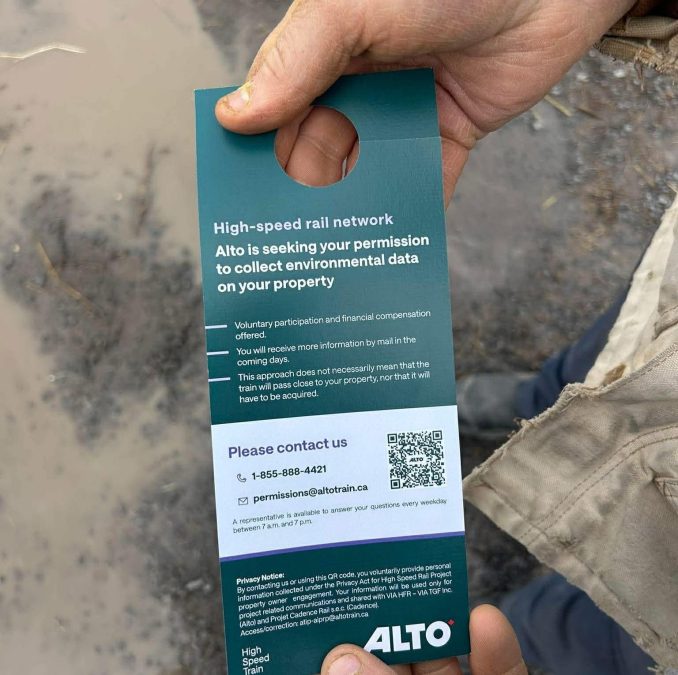
Property owners receive data request brochures from Alto
During the past two weeks, certain local property owners have begun receiving notices that Alto, the federal crown corporation, proposing to build a high-speed passenger rail link between Ottawa and Montréal, seeking permission to collect environmental data from their properties. The brochures...thereview.ca
And that is the baseline ticket price if you book on the day of travel, if you book 4+ days in advance it’s supposed to be a little bit cheaper
Under the original HFR, it was proposed to use that abandoned corridor. It is apparently railbanked and owned by VIA (?).That's not much of a data set. And ironically, what data is there seems to follow an existing (though apparently unused) rail corridor
At the centre of the campaign is something that won’t ever stop in Terrebonne: the proposed Alto project, a high-speed rail line between Toronto and Quebec City. By any measure, it is a nation-building endeavour. Canadians broadly support the $90-billion investment in the kind of infrastructure that countries like France, Japan and China built decades ago. Even Bloc Québécois leader Yves-François Blanchet has said his party wanted high-speed rail before the Liberals did.
The proposed route runs directly through Terrebonne at high speed, without stopping. It’s expected to bring noise, disruption, potential expropriations and what many voters view as zero direct benefit to the community it will split.
This is where the campaign gets interesting because, unlike the last election, this one is inherently local.
The Liberal candidate has taken a procedural position by calling for consultations and promising that residents’ concerns will be heard. She’s balancing support of the project and acknowledgment of the worry.
Meanwhile, the Bloc’s candidate and its leader have gone much further. They’ve accused the Carney government of using legislation to fast-track approvals and of ignoring the rights of property owners who face expropriation. They have even invoked the ghost of Mirabel, the airport that displaced thousands of families north of Montreal in the 1970s.
The difference between the two positions is the difference between saying we’re listening and we’re fighting. That distinction on a single local issue may well be everything for the voters in Terrebonne.
Terrebonne could be the canary in the coal mine for Carney, who has staked his government’s credibility on large-scale national infrastructure, energy, and defence projects as the path to building a stronger Canada to face a turbulent world. Canadians, rattled by trade threats and geopolitical uncertainty, have so far largely rallied behind that vision.
https://www.thestar.com/opinion/con...cle_de4528be-015c-4d34-b53b-b4b499956b8d.htmlBut nation-building has always had a local cost. Highways and pipelines displace homes and farms. And high-speed trains barrel through communities that never asked for them. What Terrebonne voters seem to be asking at the doorstep is the question that every ambitious infrastructure project eventually faces: Why should we be the ones bearing the burden?

I thought I saw a poll that ALTO had 60% approval amongst canadiansOpinion piece in the Star outlining how Alto is complicating the Liberals chances in the upcoming byelection in Terrebonne:
View attachment 727843
https://www.thestar.com/opinion/con...cle_de4528be-015c-4d34-b53b-b4b499956b8d.html