News   GLOBAL  |  Apr 02, 2020
 11K     0 
News   GLOBAL  |  Apr 01, 2020
 43K     0 
News   GLOBAL  |  Apr 01, 2020
 6.7K     0 
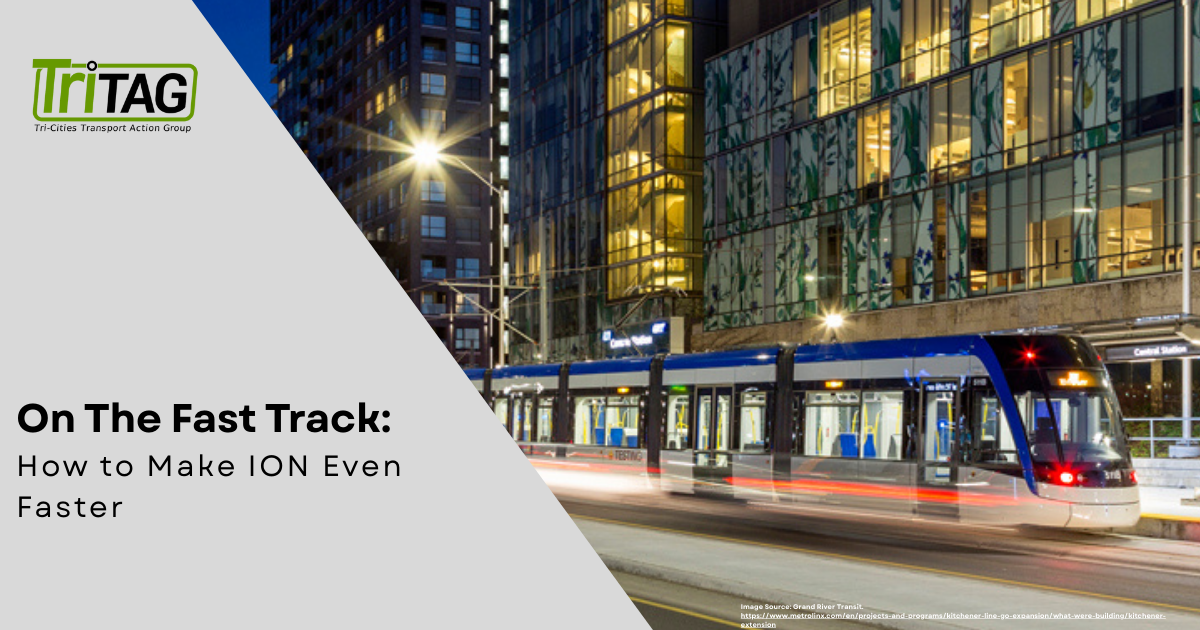
There's a new article by Tritag describing the changes needed to improve ION speeds. Seems topical given speed concerns of Lines 5 and 6:


Full disclosure: I donated my diagram describing ION speed concerns (shared a couple of pages ago) to Tritag
 
There's a new article by Tritag describing the changes needed to improve ION speeds. Seems topical given speed concerns of Lines 5 and 6:


Full disclosure: I donated my diagram describing ION speed concerns (shared a couple of pages ago) to Tritag

Thanks.

The Tri-tag article mentions beacons for the ATP system, but my understanding was that ours leverages the AC signals in the crossing prediction blocks. There certainly aren't any conspicuous fobs bolted between the rails like you see on Line 1, Line 5, or in Ottawa. I believe that's what it made it particularly finicky to tune initially, and why sections like southbound approaching Hayward got awkwardly slow once it was switched on, and have never been fixed.

If that's true, then I suspect there's no way to fix it without splitting some of the signaling blocks, a major infrastructure change that may not be feasible without renegotiation of the Design-Build-Finance-Operate-Maintain (DBFOM) contract, and would also require a (lengthy?) bustitution period.

I sincerely hope that my understanding is wrong.

At the very least, I wish they would tune the crossing predictors on Courtland and a few other notorious spots on the line. The gates go down far too early now and stay down far too long, but they weren't that bad when the system opened. The analog parameters of the track have changed as it's built up grime and worn in, but it seems like no one's ever gone back to tweak the programming to align with reality. Oh happy day when we finally see the clipboard and stopwatch crews out there again like they were during commissioning. (Although you'd think that just videoing the operations in various weather conditions and frame counting would be sufficient -- but I have no idea what the rules 'written in blood' actually are.)

 
Last edited:
Thanks.

The Tri-tag article mentions beacons for the ATP system, but my understanding was that ours leverages the AC signals in the crossing prediction blocks. There certainly aren't any conspicuous fobs bolted between the rails like you see on Line 1, Line 5, or in Ottawa. I believe that's what it made it particularly finicky to tune initially, and why sections like southbound approaching Hayward got awkwardly slow once it was switched on, and have never been fixed.

If that's true, then I suspect there's no way to fix it without splitting some of the signaling blocks, a major infrastructure change that may not be feasible without renegotiation of the Design-Build-Finance-Operate-Maintain (DBFOM) contract, and would also require a (lengthy?) bustitution period.

I sincerely hope that my understanding is wrong.

At the very least, I wish they would tune the crossing predictors on Courtland and a few other notorious spots on the line. The gates go down far too early now and stay down far too long, but they weren't that bad when the system opened. The analog parameters of the track have changed as it's built up grime and worn in, but it seems like no one's ever gone back to tweak the programming to align with reality. Oh happy day when we finally see the clipboard and stopwatch crews out there again like they were during commissioning. (Although you'd think that just videoing the operations in various weather conditions and frame counting would be sufficient -- but I have no idea what the rules 'written in blood' actually are.)
I believe its correct to say that ION uses track circuits (not tags). Although I've also seen control points referred to as "beacons". I'd assume whats more important is what type of control action is occurring at the point rather than the actual infrastructure. If hard "overspeed" directives are changed to "suggestions" then we could have the speed benefits without expensive infrastructure work (as the article suggests).
 
It's sad how there is a general ack of "future proofing" in Ontario's transit designs.

This stations should be built to accommodate a potential, future third track.

The original design was future-proofed for a third track. The north platform would become an island platform with an additional track on the north side, and an additional bridge would be added across King. The bridge abutment design leaves space for an additional bridge on the north side.
Screenshot 2026-02-26 at 15.39.44.png


However, ever since the design shifted the platforms eastward (such that they need to close or grade-separate Duke St) they don't seem to be displaying the future-proofing for the third track anymore.
 
They planned a ton of sprawl over an aquafier and now realized they actually will run out of potable water if they develop it...
Dumpster Fire forced a ton of sprawl over the aquifer. The region was holding tightly to the countryside line to limit development over sensitive recharge areas until planning was taken away from them by the PCs.
 
They planned a ton of sprawl over an aquafier and now realized they actually will run out of potable water if they develop it...

That's a severe over simplification of the actual problem that the Region ran themselves into.

The Region of Waterloo for the last 20+ years has had policies in place to protect the most critical recharge areas of the aquifer, it's also an over simplification to call it one aquifer since it is a rather complex system of aquifers and aquitards, see Figure 1 for the cross section. There are wells that are in the AFB1 and AFB2 aquifer and others in the AFD1. The AFD1 wells are not the problem wells its the AFB1/AFB2 wells that are having the issues but it's not inherently related to sprawl, its more so related to density. The Region implemented the countryside line to limit the amount of sprawl that can occur and turned most lands outside of KWC into protected countryside that prohibits development. Then they designed urban growth policies that promoted densification instead of sprawl which brought us the ION and ROPA 6 which further directed the area municipalities to densify. Kitchener is presently updating their Official Plan to reflect ROPA 6 now that the Province has stripped the RoW of their planning authority.

The countryside line and protected countryside roughly correspond to the boundary of the RRA (Regional Recharge Area), this is the area that has the largest impact on the Region's groundwater supply as the areas within them have the highest recharge rates, see Figure 2 for the boundary of the RRA with respect to the overall Region. Much of the sprawl that has occurred in Kitchener has been to the south (Doon) and to the East (Lackner) while there has been some to the west (Trussler) most sprawl has not happened within the RRA. The only areas within the RRA that are allowed to be developed are highlighted in green, but keep in mind much of that hasn't even been developed yet so that isn't where the issue developed (one can thank Premier Ford for half of that area even being included).

The larger problem has been the rapid population growth coupled with various systems within the Mannheim portion of the IUS being offline for extended periods of time which in turned caused over use of certain wells within the service area. The William Street wells were refurbished right when KWs population exploded (thanks to density along the ION and general densification) so those were offline, the Parkside plant and Greenbrook plant have also been undergoing refurbishment and haven't been at full capacity. This all combined to mean that wells at the Mannheim plant (the largest part of the IUS) were getting overused drawing down the aquifer to unsustainable levels to the point where wells had to be temporarily shut off or else the water table would fall under the well screen and nearby private wells would run dry. Given all of this the Region decided to switch how they looked at water and that's when they realized using peak system capacity wasn't the right approach for a groundwater system and switched to the sustainable one which in turn made them discover the lack of water.

The Region knew they needed to have more wells for the growth but they didn't expect to turn them on this quickly which is the other portion of the problem, they already have test wells drilled for a new set of wells, while also having a bunch of production wells offline that just need to be connected into the system. So to some degree it caught them off guard yes, but it wasn't anything to do with sprawl, it was simply over pumping bringing forward some critical issues within the system.

Figure 1: Geological Cross Section of the Waterloo Moraine
1775950757667.png


Figure 2: RRA with Respect to the Cities
Screenshot_11-4-2026_193426_www.regionofwaterloo.ca.jpeg
 

Back
Top