Limiting the number of stations early is another way to prevent scope creep. Once you start making changes and concessions on stations, every community within breathing distance of the corridor is going to try and lobby to get one, and adds significant uncertainty for design if the alignment keeps getting adjusted to accommodate community after community. What is most important right now is that we think of Alto as the base/backbone of something much larger that is going to evolve over time - once you have the fundamental aspects of the network in place (7 major stops over 1000km), any later phases or other HSR projects will be significantly easier to build. It is much easier to add infill stations, extensions, spurs, and lower-speed higher-frequency service to an existing corridor, rather than redesigning portions of the corridor over and over again to accommodate changes.
As valid as your concern for scope creep is, may I ask you where you and all the other ones suddenly voicing this concern were hiding when the scope was exploded by including Montreal-Quebec, going from 177 to 300+ km/h, going from electrification-ready to fully-electrified, going from sharing existing tracks and stations where feasible to a fully-segregated infrastructure? If there was one thing which defined the liberal government's handling (both, directly and indirectly through its agents CIB, ALTO and now Cadence) of what started 10 years ago as VIA's HFR proposal, it was relentless and completely unconstrained scope creep.
There are many reasons why this project might crumble and collapse under it's own weight, but it's certainly not the few hundred millions of taxpayer dollars required to ensure that this project with its price tag already racing towards the 100
billion Dollar mark (let that number sink for a moment: $100,000,000,000) might one day serve more citizens and taxpayers, by facilitating (rather than sabotaging) the possibility to add additional stations and train services (think: exo trains from Saint-Jerome to downtown Montreal) onto the infrastructure we hope to be building soon...
Is there anything to communicate at this point? A high speed train needing a corridor maybe 30m wide is planned for a corridor that ranges between 10km and 25km wide. People are complaining how the railway will impact their property but unless they have a 10km wide property they can't possibly know how they will be impacted at this point. Most complaints are (a) impacts of change to property and communities (NIMBY without any real facts when you consider the likelihood of being impacted by a train corridor 30m that is up to 25km away), (b) the government never gets good value and will overspend (look at California, look at Eglinton Line, look at insert failure here), and (c) people who believe the government should stay out of transportation (unless it is lanes on a road or a downtown airport expansion maybe). Without flying people to Japan and Europe to live a day in the life these people may always think like this.
You should never assume that other people are more naive than yourself: With ALTO stressing that they want to finalize the route within less than a year and the current solicitation of feedbacks suggesting that they are still quite a few months from revealing their preferred route, local residents with properties within the "danger zone" (i.e., anywhere within that ridiculously broad corridor drawn over these maps) are painfully aware that they won't be able to react effectively if they patiently wait until they finally find out that they are among the "unlucky winners" to be expropriated within a few months. That's the main reason they chose the only somewhat promising path of action and that is to seeking a wide front of opposition against the entire project - and I highly doubt anyone of us would react differently if we were in their shoes. It's as easy as it is cheap to shout at rural folks to stuff it up while residing in the comforts of a home situated (as in my case) less than 10 minutes walking distance from the next Subway station...
A play by play of Joe Public sticking a sticker on a map... do we need that?
We need a map with all plausible route variants, so that we can choose the variant which scores the best on a comprehensive multi-criteria analysis, while allowing the public to further tweak these variants! The best routings are rarely conceived in an office building hundreds of kilometers away, despite whatever unshakable levels of confidence the planners in these offices might have in their own abilities...
Any place a train would be going 300km/h on opening day would be an alignment straight enough to handle a station.
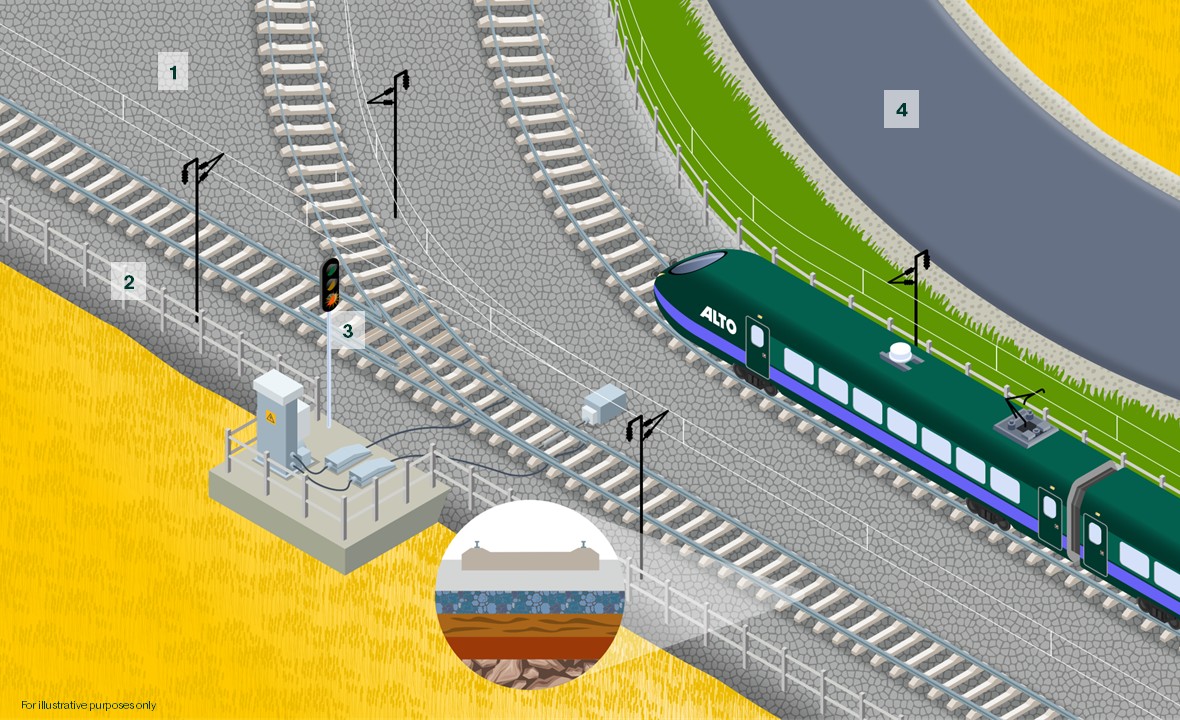
As someone who regularly works with track designers, I can assure you that you are as profoundly wrong as you are confident in the validity of your misconception: Trains sway laterally (horizontally) and even more so at high speeds and especially in curves. I recall that UP Express has a 10 mph speed restriction when passing through any of its high-level stations because of this issue. Now imagine high-speed trains whizzing at 300 km/h on a curve with 6-8 inches of superelevation (of which 2-3 inches might not be balanced). There is a good reason why the Japanese, the Germans and the French only build platforms on sidings rather than directly on the main tracks of high-speed rail lines and you certainly don't want to build switches into the curves of a High Speed Line.
Given that you need passing loops at reasonable intervals to allow slower or disabled trains to be overtaken by faster trains, it makes sense to plan them in a way that they can be later used as stations, by simply adding platforms and station infrastructure without requiring any modifications to any already existing track alignments. Have a look at "
Eischleben Überholbahnhof" (Eischleben overtaking station) at the
Erfurt-Nürnberg HSL and you will realize that this passing facility was deliberately placed so that it could one day serve as the HSR station for Arnstadt (pop. 27k) and its region:
Just a note about above maps: the intuitive station location for my tastes would have been where the HSL intersects with the
railway line Arnstadt-Saalfeld just west of Marlishausen, but I assume that that straight stretch was not long enough to accommodate passing loops, which underlines the massive constraint against retrofitting stations where they have not already been foreseen during the design of the initial HSL...