





M II A II R II K
Senior Member
Why Stations Designed for Non-Transit Users Are Most Successful
20 September 2012
By Peter David Cavaluzzi
Read More: http://www.planetizen.com/node/58529
.....
On any given day, Grand Central Terminal in midtown Manhattan, which opened almost 100 years ago, enjoys far more visitors drawn to its shopping, dining, and cultural events, than actual transit users. There are more than 750,000 people that pass below its vaulted astronomical ceiling every day. When the building was first designed, however, New York did not realize it was laying the foundation for the development of today’s most modern transit stations and public places. But as we return to the lessons learned at this project, in an era of revived interest in downtown living and car-less transit, we see how progressive yet timeless that approach really was.
- In addition to laying rail and passenger platforms, the architects and engineers of Grand Central emphasized real-estate development in designing one of New York City’s most iconic spaces. The developers coined the phrase â€taking wealth from the air†as the way to describe how they planned to make Grand Central much more than a place to board a train. They set out to design transit infrastructure so that it doesn’t look and feel like transit at all. The goal was to use transit as a way to design iconic spaces such as the great hall, the retail passages, and Park Avenue that embody the culture of the city and create enormous real-estate value at the same time.
- What we’re calling “Open Transit Design†is a new way to explain the concepts underlying some fairly long-established principles in station design that are re-emerging in an era of unprecedented interest in city living. Just as the name suggests Open Transit is an inclusive design point of view that incorporates a wider array of spaces and modes to create an iconic place. Great cities across the world are defined by great places. If we are to make cities more sustainable we need to create transit places that will also sustain and enhance urban life. For the first time in more than two decades, growth in town and city centers is outpacing suburban growth according to the U.S. Census (figures reported in July 2011).
- Our experiences in designing transit stations for cities hoping to fundamentally shift their transit attitudes helped shape the principles of Open Transit Design. At L.A.’s Gateway Center, for instance, America’s largest intermodal transportation facility links buses, long distance and commuter rail, light rail and the city’s subway system with a 3,000-car park-and-ride facility. Since Gateway Center’s completion in 2000, ridership on all modes of transit has increased from 7,000 people a month to 80,000. By providing a first-class environment for those taking advantage of the city’s expanded transit system, we believe the design of the station helped play a role in getting car-centric Angelenos to embrace transit, and buck the notion that public transit was not for everyone.
So what comprises Open Transit Design? There are five essential elements needed for this type of project:
1. Integration of all available transit modes
2. An orientation towards real estate development
3. Architecture that makes iconic spaces
4. Integration of culture with transit design
5. Appeal for non-transit users
.....
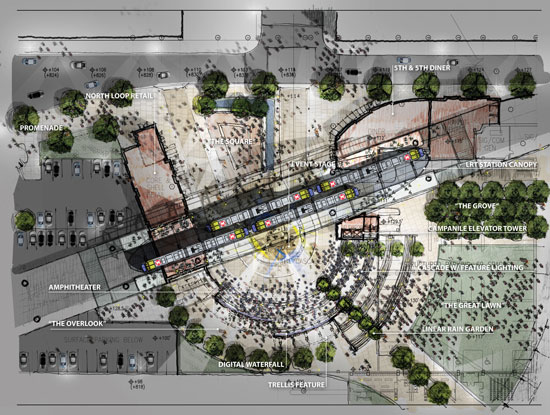
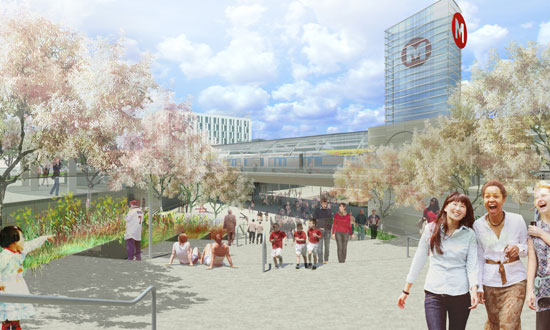
This is what the City of Minneapolis and surrounding Hennepin County was looking for when it came time to design what they are now calling The Interchange, a major transit hub at the edge of their downtown central business district.
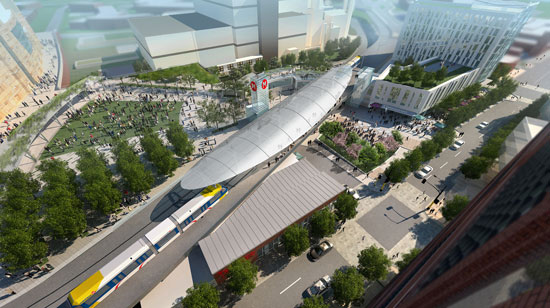
Cascade Section, Courtesy EE&K Knuston Construction
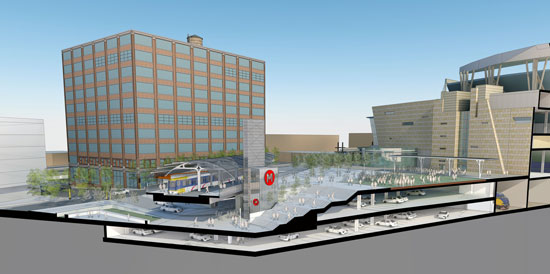
Key Places, Courtesy EE&K Knuston Construction
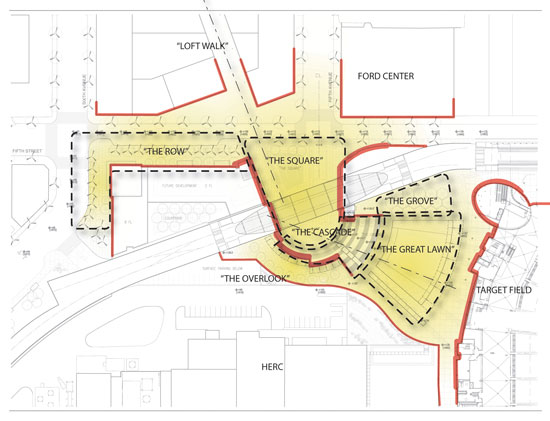
Overall Site, Courtesy EE&K Knuston Construction
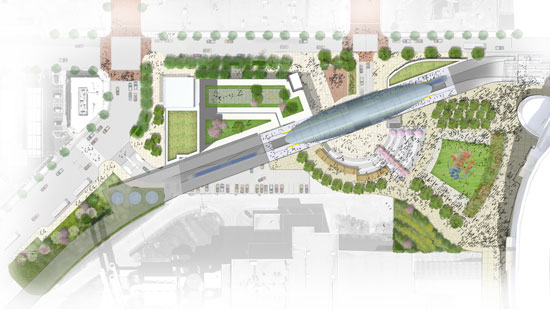
Activated Public Spaces, Courtesy EE&K Knuston Construction
Placemaking, Courtesy EE&K Knuston Construction
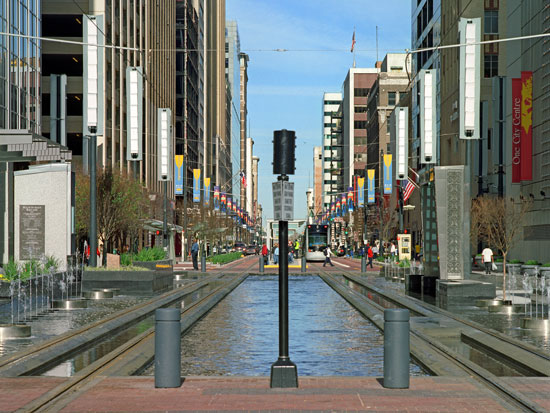
It worked well in the middle of downtown Houston, with our design of Houston Main Street Square. An area that was once a ghost town after 5:00 PM now has a sense of arrival and event that has spurred development for blocks.
20 September 2012
By Peter David Cavaluzzi
Read More: http://www.planetizen.com/node/58529
.....
On any given day, Grand Central Terminal in midtown Manhattan, which opened almost 100 years ago, enjoys far more visitors drawn to its shopping, dining, and cultural events, than actual transit users. There are more than 750,000 people that pass below its vaulted astronomical ceiling every day. When the building was first designed, however, New York did not realize it was laying the foundation for the development of today’s most modern transit stations and public places. But as we return to the lessons learned at this project, in an era of revived interest in downtown living and car-less transit, we see how progressive yet timeless that approach really was.
- In addition to laying rail and passenger platforms, the architects and engineers of Grand Central emphasized real-estate development in designing one of New York City’s most iconic spaces. The developers coined the phrase â€taking wealth from the air†as the way to describe how they planned to make Grand Central much more than a place to board a train. They set out to design transit infrastructure so that it doesn’t look and feel like transit at all. The goal was to use transit as a way to design iconic spaces such as the great hall, the retail passages, and Park Avenue that embody the culture of the city and create enormous real-estate value at the same time.
- What we’re calling “Open Transit Design†is a new way to explain the concepts underlying some fairly long-established principles in station design that are re-emerging in an era of unprecedented interest in city living. Just as the name suggests Open Transit is an inclusive design point of view that incorporates a wider array of spaces and modes to create an iconic place. Great cities across the world are defined by great places. If we are to make cities more sustainable we need to create transit places that will also sustain and enhance urban life. For the first time in more than two decades, growth in town and city centers is outpacing suburban growth according to the U.S. Census (figures reported in July 2011).
- Our experiences in designing transit stations for cities hoping to fundamentally shift their transit attitudes helped shape the principles of Open Transit Design. At L.A.’s Gateway Center, for instance, America’s largest intermodal transportation facility links buses, long distance and commuter rail, light rail and the city’s subway system with a 3,000-car park-and-ride facility. Since Gateway Center’s completion in 2000, ridership on all modes of transit has increased from 7,000 people a month to 80,000. By providing a first-class environment for those taking advantage of the city’s expanded transit system, we believe the design of the station helped play a role in getting car-centric Angelenos to embrace transit, and buck the notion that public transit was not for everyone.
So what comprises Open Transit Design? There are five essential elements needed for this type of project:
1. Integration of all available transit modes
2. An orientation towards real estate development
3. Architecture that makes iconic spaces
4. Integration of culture with transit design
5. Appeal for non-transit users
.....
This is what the City of Minneapolis and surrounding Hennepin County was looking for when it came time to design what they are now calling The Interchange, a major transit hub at the edge of their downtown central business district.
Cascade Section, Courtesy EE&K Knuston Construction
Key Places, Courtesy EE&K Knuston Construction
Overall Site, Courtesy EE&K Knuston Construction
Activated Public Spaces, Courtesy EE&K Knuston Construction
Placemaking, Courtesy EE&K Knuston Construction
It worked well in the middle of downtown Houston, with our design of Houston Main Street Square. An area that was once a ghost town after 5:00 PM now has a sense of arrival and event that has spurred development for blocks.
