News   GLOBAL  |  Apr 02, 2020
 11K     0 
News   GLOBAL  |  Apr 01, 2020
 43K     0 
News   GLOBAL  |  Apr 01, 2020
 6.7K     0 
Most people that work near a high-order transit line do not have free parking. I'm not talking about those people that work in a transit desert nor the bus operators who have to get to the bus depot. I'm talking about s0meone who has the ability to take a fairly efficient transit system 24/7 to work.

Is the system that effective 24/7? I mean, the system open at 6:00 am and shuts down at what, 1:30am - that's the worker demographic I am targeting. Unless they can travel by subway to open/close the subway...

How about out at Caledonia. 4 car sharing spots literally right next door to the subway. If I live downtown I can take the subway/LRT (or GO Train) to Caledonia, get off, grab a ZipCar/Cars2Go/AutoShare to go shopping in the Castlefield design district for some new lights, flooring, etc. Opens up a whole range of design options that are currently not available.

And makes the city more livable for all, not just a few entitled workers.

Let's not pretend we could have easily created space for zipcar or some form of autoshare in the station design process if that was the intent. The way you've presented the argument made it sound as if the presence of the TTC lot prevented that from happening.

AoD
 
Is the system that effective 24/7? I mean, the system open at 6:00 am and shuts down at what, 1:30am - that's the worker demographic I am targeting. Unless they can travel by subway to open/close the subway...
Shame there isn't a frequent night-bus that parallels most of the subway route.

I don't see the operating hours of the subway as a reason that TTC employees shouldn't see this a a taxable benefit; or instead that it be metered for use of TTC employees only.
 
I'm reading the rules again - I may have not been accurate he situation if not an industrial park.
...
So oddly enough, if not enough spots ... then non-taxable. If more than enough spots, taxable benefit. Though if anyone can park there because it's an industrial park - then not taxable. Perhaps this is why most companies don't have "No parking unless you work here or are visiting" up!

That's like the craziest rules - it basically creates a two-tiered system whereby tax-free parking is legitimized, for all intents and purposes for certain classes of properties/businesses and not others. Where is the fairness in that?

AoD
 
That's like the craziest rules - it basically creates a two-tiered system whereby tax-free parking is legitimized, for all intents and purposes for certain classes of properties/businesses and not others. Where is the fairness in that?
The rule basically is that if anyone and their dog can park for free, then there's no value. But if not, you have to pay, unless your employer has only a few spots, and it's first-come first-served, rather than reserved parking.
 
The rule basically is that if anyone and their dog can park for free, then there's no value. But if not, you have to pay, unless your employer has only a few spots, and it's first-come first-served, rather than reserved parking.

Yeah I know that's in theory - but from a benefits perspective (i.e. just being able to park) it's kind of problematical.

AoD
 
Correct, they do have some bloody deep stations and long escalators. The layer they've bored through isn't rock however, but a clay seam - which in many ways is better than rock. Easy to mine, under pressure, and extremely impermeable. The layer however changes depth south of the Thames, which is a reason their Tube hasn't extended as far south of there.

Worth noting to those that don't know, but London also uses two types of rolling stock: Subsurface and Deep Tube trains. Also that 55% of their Tube is actually on the surface.


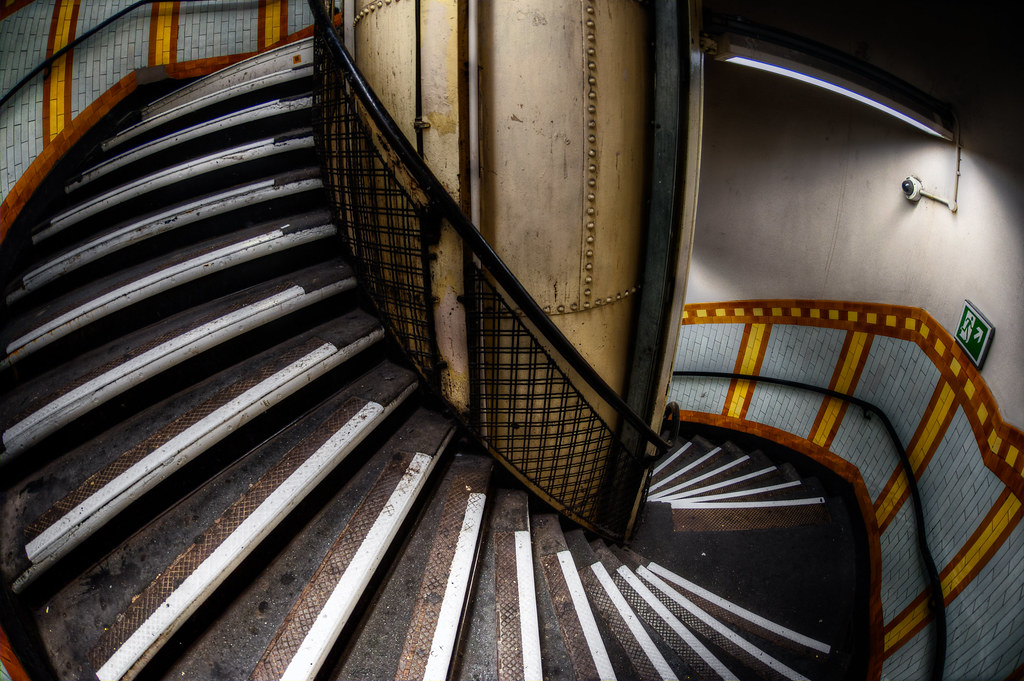
Some of the deeper stations like Covent Garden are only accessed by industrial sized elevators with a spiral staircase for emergencies only.

20120223075055-climb-the-covent-garden-station-staircase.jpg


6104000488_f6cb3c401f_b.jpg
 
Some of the deeper stations like Covent Garden are only accessed by industrial sized elevators with a spiral staircase for emergencies only.
The signage seems to be getting more dire. I haven't walked down that one, but I've walked down Russell Square where the sign says there's 175 steps rather than 193, and it was more a warning than a "do not use" back then. Still, those are pretty extreme examples on the system.
 
Most newer subway systems around the world have deep stations with machine-bored tunnels (eg. Montreal has some insanely deep ones). I personally don't think it's that bad with escalators.

However it's also that Eglinton itself is pretty hilly in places. Also this line has to go underneath the current subway lines and be constructed while line 1 is operational.

I'm aware that deep stations are inevitable with TBM construction. It doesn't mean I will be happy with the outcome (which is a dramatic departure from how subways used to be built in this city). It also doesn't excuse the abysmal transfer between the GO train and LRT that I pointed out, which so far no one has addressed. I understand there are arguments to be made against cut and cover construction on urban streets (too much underground infrastructure in the way, etc), but the Scarborough subway will be built by TBM as well. Even the Spadina extension is being tunnelled through the middle of nowhere, where perhaps it could have been at least partially above ground. I can't think of many cities in the world who are using the most expensive construction method even in the most far-flung suburban areas.
 
Even the Spadina extension is being tunnelled through the middle of nowhere, where perhaps it could have been at least partially above ground. I can't think of many cities in the world who are using the most expensive construction method even in the most far-flung suburban areas.

Exactly. It makes no sense. The area is mostly low density industrial, highway-like, and it's ugly as all hell. The Vaughan portion particularly. The section between Sheppard to north of Finch, and from Steeles to Hwy 7 should've been run in the open air (elev, trenched, etc). I'm quite confident no other city would ever consider building the costliest of all transit infrastructure in such an environment...Toronto really stands out in that regard.
 
Exactly. It makes no sense. The area is mostly low density industrial, highway-like, and it's ugly as all hell. The Vaughan portion particularly. The section between Sheppard to north of Finch, and from Steeles to Hwy 7 should've been run in the open air (elev, trenched, etc). I'm quite confident no other city would ever consider building the costliest of all transit infrastructure in such an environment...Toronto really stands out in that regard.

Montreal is the only example that I can think of (Laval extension), but they did that because they have to be underground because of the technology they chose. It's also a single tunnel bore instead of twin like Spadina.
 
Exactly. It makes no sense. The area is mostly low density industrial, highway-like, and it's ugly as all hell. The Vaughan portion particularly. The section between Sheppard to north of Finch, and from Steeles to Hwy 7 should've been run in the open air (elev, trenched, etc). I'm quite confident no other city would ever consider building the costliest of all transit infrastructure in such an environment...Toronto really stands out in that regard.

You do realize that what you're proposing would actually require more track than tunneling would? Not to mention widening Keel because you can't just have the subway fly over top of all the factories without having to do a BUNCH of work and purchase a bunch of land in that industrial park. If we were talking about the section north of Steeles West you may have a point but the section between Downsview and Finch West is more hassle having it above ground.
 
You do realize that what you're proposing would actually require more track than tunneling would? Not to mention widening Keel because you can't just have the subway fly over top of all the factories without having to do a BUNCH of work and purchase a bunch of land in that industrial park. If we were talking about the section north of Steeles West you may have a point but the section between Downsview and Finch West is more hassle having it above ground.


All of which would be pennies compared to tunneling.

Tunneling is without a doubt an extremely expensive practice and should only be done when absolutely necessary. It is 4-6 times more expensive than above ground.
 
Montreal is the only example that I can think of (Laval extension), but they did that because they have to be underground because of the technology they chose. It's also a single tunnel bore instead of twin like Spadina.

Good point. Though I personally wouldn't put the Orange Line extension in the same category. Between the Island and Montmorency, it's basically sleepy residential with little in the way of major public ROWs or highways that an open-air alignment could use. The TYSSE in North York and Vaughan however is hundreds of acres of warehouses, petroleum storage, highways, and scrubland.

You do realize that what you're proposing would actually require more track than tunneling would? Not to mention widening Keel because you can't just have the subway fly over top of all the factories without having to do a BUNCH of work and purchase a bunch of land in that industrial park. If we were talking about the section north of Steeles West you may have a point but the section between Downsview and Finch West is more hassle having it above ground.

Correct, and it is a bit brash of me to make a proclamation that 'it makes no sense'. But I don't think any open-air option was looked at, and that the project was all-underground right from the start. It's mostly speculation, but I personally think an alignment using some cut/cover, some trenched, some elevated, etc could've worked. I'm sure there'd be mild expropriation involved, but nothing too extreme. And plus, roads in that area have ample unused right-of-ways. North of Steeles I believe open-air would've been a no-brainer.
 
It also doesn't excuse the abysmal transfer between the GO train and LRT that I pointed out, which so far no one has addressed.

So what did you propose that they do instead? Dig a pair big pits ahead of time on either side of the rail line to run the TBMs into and start them up again?

Dan
Toronto, Ont.
 

Back
Top