News   GLOBAL  |  Apr 02, 2020
 11K     0 
News   GLOBAL  |  Apr 01, 2020
 43K     0 
News   GLOBAL  |  Apr 01, 2020
 6.7K     0 
2 speed and access balance please

That was sort of the choice Metrolinx was leaning for with this proposal. I really think it is the best mix of rapid frequency and station placement.

egwest_gradeseparations.jpg


However i feel like Islington and Royal York should be grade separated as well.

If you are going to spend the money to grade separate 80% of the line and major intersections, might as well do all of them.
 
Considering the 3 km gap between Martin Grove and Commerce Blvd (Renforth Stn), it's not that unreasonable to include a station at the The East Mall, especially if it's designed to have a grade-separated connection to the other side of the 427 for Rangoon area users.
My guess is most passengers boarding at East Mall are coming by bus. If you look at that intersection, there is a highway and a river taking up most of the land that would be within walking distance. If they are coming by bus, why not bus 1 extra stop to Martin Grove. (Same thing, I thing Rangoon will keep their bus and it would end at Commerce.
 
eglintonlrtoptions.jpg

From link. Which is why we are twiddling our thumbs waiting.

The stop spacing for the more grade-separated lines are a little silly... 3 stops at the airport and then just Kipling and Scarlett. Why would you need a stop between Pearson and Renforth, let alone 3? And the Islington bus is one of the busiest in the system with a weekday ridership of ~18 000, so it would make sense to at least have a stop there.

All these configurations seem a bit strange. I'd just expect Bloor-Danforth spacing (i.e. every arterial), or something speedier since this is nowhere near as dense as Bloor/Danforth. Not double the spacing. And certainly not the strange combination of several closely spaced stops then nothing for a few kilometers, passing over busy bus routes.

My preferred spacing would be:
Pearson -> Renforth Gateway -> Martin Grove -> Kipling -> Islington -> Royal York -> Scarlette -> Jane -> Mount Dennis (9 stops total)

But if you wanted to be extra speedy you could cut out Martin Grove, Islington and Jane (6 stops total), but you would miss out on some good connecting bus routes.
 
Last edited:
eglintonlrtoptions.jpg

From link. Which is why we are twiddling our thumbs waiting.

Perhaps the best option is a combination of 2 and 4. Reasonable number of stops, plus some grade separation to speed up the service and reduce the traffic backlogs.

But, we shouldn't make this line so expensive that we could as well build a subway. When the choice was made to build the central section of Eglinton as LRT, it was a trade-off to have medium capacity instead of high capacity, but allow for cheaper extensions at the edges. Hopefully that's the right choice, and the capacity won't be exceeded. However if we change the approach mid-way and start selecting the most expensive design for extensions, we will end up with a light rail line at a cost of full subway.
 
Perhaps the best option is a combination of 2 and 4. Reasonable number of stops, plus some grade separation to speed up the service and reduce the traffic backlogs.

But, we shouldn't make this line so expensive that we could as well build a subway. When the choice was made to build the central section of Eglinton as LRT, it was a trade-off to have medium capacity instead of high capacity, but allow for cheaper extensions at the edges. Hopefully that's the right choice, and the capacity won't be exceeded. However if we change the approach mid-way and start selecting the most expensive design for extensions, we will end up with a light rail line at a cost of full subway.

With it terminating at the proposed Pearson Transit Hub, the western LRT extension could be more used more than the eastern leg of the Crosstown LRT.
 
Perhaps the best option is a combination of 2 and 4. Reasonable number of stops, plus some grade separation to speed up the service and reduce the traffic backlogs.

But, we shouldn't make this line so expensive that we could as well build a subway. When the choice was made to build the central section of Eglinton as LRT, it was a trade-off to have medium capacity instead of high capacity, but allow for cheaper extensions at the edges. Hopefully that's the right choice, and the capacity won't be exceeded. However if we change the approach mid-way and start selecting the most expensive design for extensions, we will end up with a light rail line at a cost of full subway.

At $280 million/km, we already are getting a light rail line at the cost of a subway on Eglinton. LRT was an odd technology choice for this corridor; it made sense in the Transit City concept of LRT everywhere, where you could share carehouses, equipment, interline, etc. But by itself, with an airport at one end and the SRT at the other and no connecting lines, it would have made more sense as automated ICTS. It would have prevented the $3.5-billion 1-stop SSE from happening, Eglinton west could have been elevated (there is lots of ROW and most of the development there has its back to the road, as a legacy of the Richview expressway) and the 10 km central tunnel would have been cheaper to build because of the smaller cross-section.

I just want to point out in the EA that even the speediest option, which skips Islington, Jane, and every major cross-road, includes stops here at Silver dart, hedged in by the airport and two highways:
upload_2017-10-16_22-58-16.png


And another one here on Convair, also hedged in by highways and the airport:

upload_2017-10-16_23-0-38.png


So I am seriously questioning the judgement and the options decided by an EA which ignores its own business case and then produces this as the approved option:

upload_2017-10-16_23-3-54.png
 

Attachments

  • upload_2017-10-16_22-58-16.png
    upload_2017-10-16_22-58-16.png
    456.5 KB · Views: 604
  • upload_2017-10-16_23-0-38.png
    upload_2017-10-16_23-0-38.png
    734.3 KB · Views: 625
  • upload_2017-10-16_23-3-54.png
    upload_2017-10-16_23-3-54.png
    72.9 KB · Views: 624
Last edited:
The stop spacing for the more grade-separated lines are a little silly... 3 stops at the airport and then just Kipling and Scarlett. Why would you need a stop between Pearson and Renforth, let alone 3? And the Islington bus is one of the busiest in the system with a weekday ridership of ~18 000, so it would make sense to at least have a stop there.

All these configurations seem a bit strange. I'd just expect Bloor-Danforth spacing (i.e. every arterial), or something speedier since this is nowhere near as dense as Bloor/Danforth. Not double the spacing. And certainly not the strange combination of several closely spaced stops then nothing for a few kilometers, passing over busy bus routes.

My preferred spacing would be:
Pearson -> Renforth Gateway -> Martin Grove -> Kipling -> Islington -> Royal York -> Scarlette -> Jane -> Mount Dennis (9 stops total)

But if you wanted to be extra speedy you could cut out Martin Grove, Islington and Jane (6 stops total), but you would miss out on some good connecting bus routes.
If Jane is proposed for an LRT, it's ridership must be high enough to warrant a stop. 1 extra stop at the airport (Convair or Silver Dart) doesn't bother me that much - especially if the feds pay some. Maybe another stop at T3 is needed though - since the link train can't handle much more.
I think this list is pretty good though:
Pearson -> Renforth Gateway -> Martin Grove -> Kipling -> Islington -> Royal York -> Scarlette -> Jane -> Mount Dennis (9 stops total)
 
At $280 million/km, we already are getting a light rail line at the cost of a subway on Eglinton. LRT was an odd technology choice for this corridor; it made sense in the Transit City concept of LRT everywhere, where you could share carehouses, equipment, interline, etc. But by itself, with an airport at one end and the SRT at the other and no connecting lines, it would have made more sense as automated ICTS. It would have prevented the $3.5-billion 1-stop SSE from happening, Eglinton west could have been elevated (there is lots of ROW and most of the development there has its back to the road, as a legacy of the Richview expressway) and the 10 km central tunnel would have been cheaper to build because of the smaller cross-section.
Is $280M correct - maybe in 2008 dollars. I would have guessed it was well into the mid $350M's.
The only reason to spend $5+ Billion on a central core and use LRT is if multiple lines will share the tunnel. Transit City consider a full build-out of many LRT lines - but in no location was branching (interlining) even considered). In the West, maybe 1 branch could have been along Dixon and the other along Eglinton West. In the East, maybe 1 branch up to STC and another along Eglinton and Kingston Road. But since the grade-separation ended at Brentcliffe, I guess 1 branch would have to be Eglinton and other through Edwards Gardens park and along Lawrence? There is no doubt this was poorly thought out.
I just want to point out in the EA that even the speediest option, which skips Islington, Jane, and every major cross-road, includes stops here at Silver dart, hedged in by the airport and two highways:
View attachment 124315

And another one here on Convair, also hedged in by highways and the airport:

View attachment 124316

So I am seriously questioning the judgement and the options decided by an EA which ignores its own business case and then produces this as the approved option:

View attachment 124317
It's hard to argue with this. Not sure if any more buildings are planned. Maybe the Airport Link train needs be extended to serve these more minor stops (and also change to self-propelled trains so more than 2 can fit.
 
I am a component of longer spaces between stops as I had mentioned many times that when I used to live in the suburbs I would walk quite a distance to get to the finch express bus versus taking the midland bus which was slower. However a few years ago when I kept on harping on that people kept bringing up how much wheel trans costs and why was I not thinking of elderly people and that if it was too far apart parallel bus service would be needed which costs the city money. Basically as much as I argued for only stops at major intersections there was a large group that would vilify that request and point out that extra stops are not really adding that much time. perhaps times have changed. I have always been pro lrt and on the surface since I would like to see as much transit be built as possible for the least amount. Where my problems were are the stop spacing. It is quite a walk if you are between say kipling and islington but on the other hand I drive that stretch all the time and 99% of the people are getting on at kipling or islington, not in between. The same can be said between islington and royal york.
 
Do not forget that the mid arterial stops could be a upon request stop. If no one requests a stop, the light rail vehicle may not stop, unless there is someone waiting at the stop. The mid arterial stop would be at grade, reducing the cost to just the concrete and shelters.
 
Do not forget that the mid arterial stops could be a upon request stop. If no one requests a stop, the light rail vehicle may not stop, unless there is someone waiting at the stop. The mid arterial stop would be at grade, reducing the cost to just the concrete and shelters.
I can't stand stop request especially when you stop on one side of the intersection and then the bell rings for someone to get off on the other side of the intersection. When I lived at midland and finch originally the bus would take 30 mins basically stopping only at major intersections. By the time I moved away that same trip was about a hour because the bus stopped at every stop for one or two people.
 
I can't stand stop request especially when you stop on one side of the intersection and then the bell rings for someone to get off on the other side of the intersection. When I lived at midland and finch originally the bus would take 30 mins basically stopping only at major intersections. By the time I moved away that same trip was about a hour because the bus stopped at every stop for one or two people.

Which is why the TTC is slowly removing redundant stops. Unless some single person (NIMBY) objects, and they leave it in.
 
If Jane is proposed for an LRT, it's ridership must be high enough to warrant a stop. 1 extra stop at the airport (Convair or Silver Dart) doesn't bother me that much - especially if the feds pay some. Maybe another stop at T3 is needed though - since the link train can't handle much more.
I think this list is pretty good though:
Pearson -> Renforth Gateway -> Martin Grove -> Kipling -> Islington -> Royal York -> Scarlette -> Jane -> Mount Dennis (9 stops total)

I was okay with eliminating Jane on the basis that it is very close to Mount Dennis, and it's not that much of a jaunt for the Jane bus to go on Weston then back to Jane. Also on the basis that this is what Jane/Eglinton looks like, surrounded by nothing but park space:
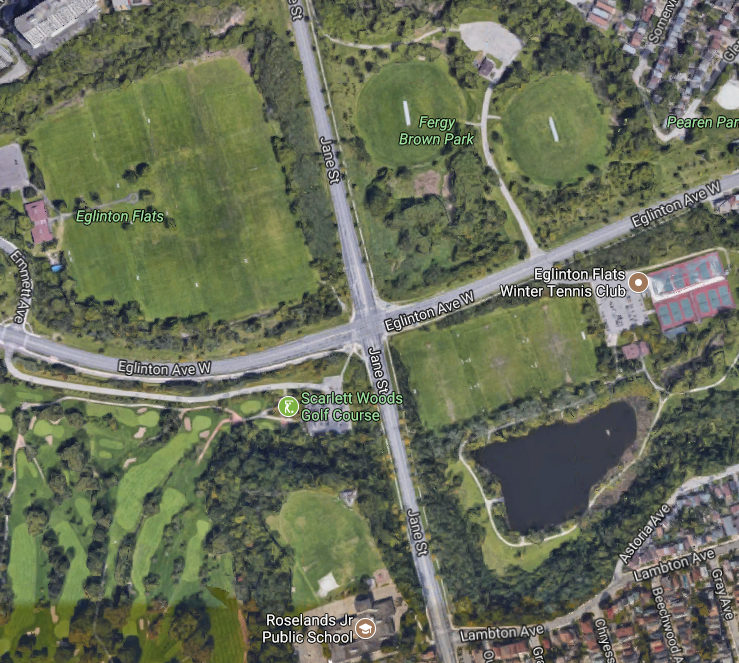
upload_2017-10-17_8-35-14.png


Is $280M correct - maybe in 2008 dollars. I would have guessed it was well into the mid $350M's.
The only reason to spend $5+ Billion on a central core and use LRT is if multiple lines will share the tunnel. Transit City consider a full build-out of many LRT lines - but in no location was branching (interlining) even considered). In the West, maybe 1 branch could have been along Dixon and the other along Eglinton West. In the East, maybe 1 branch up to STC and another along Eglinton and Kingston Road. But since the grade-separation ended at Brentcliffe, I guess 1 branch would have to be Eglinton and other through Edwards Gardens park and along Lawrence? There is no doubt this was poorly thought out.

It's hard to argue with this. Not sure if any more buildings are planned. Maybe the Airport Link train needs be extended to serve these more minor stops (and also change to self-propelled trains so more than 2 can fit.

Some of my favourite fantasy schemes have a branch going up Jane or Don Mills. But considering the failure of the TTC's interlining experiment with the 100% grade-separated subway lines in the 1960s, I wonder how well this could actually be pulled off, operationally. Metrolinx had announced that the tunnel section would be running on ATC but the surface sections would be human-driven.

I don't think you would see many more buildings for the section near the airport, and generally you wouldn't want too much development near the airport because of the airplane noise, tall buildings in the flight paths, etc. There's a reason that the current area is all car rentals, airport hotels, and parking lots. I think it would make more sense to serve those by the Link train if needed: we don't need our $10 billion rapid transit line to function as a shuttle for the airport rent-a-cars. But there are also some low-density office parks north of the 401 that could maybe be better serviced by buses that stop at International instead of at Renforth, so I would accept one intermediate stop (but certainly not 3).

Do not forget that the mid arterial stops could be a upon request stop. If no one requests a stop, the light rail vehicle may not stop, unless there is someone waiting at the stop. The mid arterial stop would be at grade, reducing the cost to just the concrete and shelters.

The problem with request stops is that they introduce a certain amount of uncertainty into the schedule and increase the potential for bunching. And the fact that stops are easy to add causes them to multiply since everyone wants a stop at their front door, which is what happened when the Spadina streetcar was introduced.

In general, in a lot of these debates about stop spacing (and the problem with this EA is that) we are looking at a single trunk of a single line at a time. So in this EA, it may look like 17 stops between Jane and the airport is reasonable. But in the context of the entire Eglinton line, and in the context of Toronto's entire rapid transit system where people may want to be able to travel to point B on Eglinton from point A (say at Yonge/St. Clair), the cumulative additional time from the stops is much greater than the time saved by the local who has to walk an additional 5 minutes. Additional stops may make the line more useful for someone living near the new stop but reduces the effectiveness of the transit system as a whole.

Ideally, we want to be maximizing the number of jobs and people within a 45-minute "isochrone" map of public transit - a map of where it is possible to travel to within 45 minutes by public transit.

 

Attachments

  • upload_2017-10-17_8-35-14.png
    upload_2017-10-17_8-35-14.png
    1 MB · Views: 528

Back
Top

