News   GLOBAL  |  Apr 02, 2020
 11K     0 
News   GLOBAL  |  Apr 01, 2020
 43K     0 
News   GLOBAL  |  Apr 01, 2020
 6.7K     0 
(almost) Everyone here agrees that it was a colossal mistake that Eglinton was no made fully grade-separated. Shouldn't the new government explore the cost of correcting that mistake?

No. I don't see what major transportation objectives will be achieved by "fixing" this mistake.

The problematic portion of the line is between Don Mills and Kennedy. Burying that section will only save four minutes in travel time. I don't think that's worth spending several billions of dollars to achieve.

Downtown-bound Crosstown LRT passengers will soon have the Downtown Relief Line to wisk them Downtown. The travel times between Eglinton and Downtown will be significantly faster on the DRL than it presently is on the Yonge Line. Yes, burying the Crosstown will get people Downtown even faster, but there's a point where investments in speed enhancements have diminishing returns for quality of life. Reducing the Kennedy to Downtown travel time to 31 mins from 35 mins won't be life changing.
 
If any "mistake" should be fixed it should be Sheppard converted to a LRT... but I know some people on here hate that idea so forget about it. Subways Subways Subways.
 
Should have had an option for underground lrt in center section with less surface lrt stops. As a lrt supporter I don't even like the surface sections.
 
If any "mistake" should be fixed it should be Sheppard converted to a LRT... but I know some people on here hate that idea so forget about it. Subways Subways Subways.


Subways are objectively better than LRT. Not that I necessarily have anything against LRT, but it would be stupid to replace a perfectly good subway with something worse. Not to mention that it would be a crazy amount of expenditure to implement a worse solution than is currently in place. You could argue that future extensions should be LRT, but replacing the actual subway is silly and would get sillier as the years pass.
 
If any "mistake" should be fixed it should be Sheppard converted to a LRT... but I know some people on here hate that idea so forget about it. Subways Subways Subways.

There needs to be a fully grade separated subway line that parallels B-D line. Sheppard if extended east and west would do that. The problem is, it really wasn't built long enough in the first place. To now convert it to LRT is just wasting money.
 
Okay, but why? What objective do you anticipate it meeting that the current ECLRT and broader transit network (especially DRL and RER) cannot effectively meet?

There is a high demand to cross the city, not just going to downtown. If that weren't the case, the 401 would be empty, since you have the Gardiner.

By the time DRL meets the current Sheppard line, it will be jammed packed and need a relief. RER, with this current provincial government is laughable.

The reality is, Toronto, and the GTA on a whole need a lot more grade separated transit that we can afford to build in the next 10 years.
 
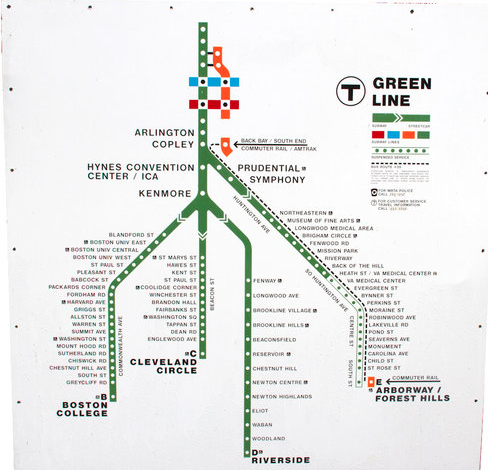
Maybe we should have a look at the Green Line in Boston, Massachusetts for comparison purposes. Keeping in mind that it is the oldest "subway" line in North America, opening in 1897. See link.

The Green Line is a light rail system run by the Massachusetts Bay Transportation Authority (MBTA) in the Boston, Massachusetts, metropolitan area. It is the oldest Boston subway line, and with tunnel sections dating from 1897, the oldest in America. It runs underground through downtown Boston, and on the surface on several radial boulevards and into inner suburbs. With an average daily weekday ridership of over 204,000 in 2017, it is the second most heavily used light rail system in the country.

The four branches are the remnants of a large streetcar system, which began in 1856 with the Cambridge Horse Railroad and was consolidated into the Boston Elevated Railway several decades later. The Tremont Street Subway – the oldest subway tunnel in North America – opened its first section on September 1, 1897, to take streetcars off overcrowded downtown streets; it was extended five times over the next five decades. The streetcar system peaked in size around 1930 and was gradually replaced with trackless trolleys and buses, with cuts as late as 1985. A new branch opened on a converted commuter rail line in 1959; the Green Line Extension project will add two new branches into Somerville and Medford in 2021.

It includes underground subway stations.
800px-Haymarket_Green_westbound.jpg

and surface stops.
800px-Pleasant_Street_MBTA_station%2C_Boston_MA.jpg


The big difference is that it includes branches that go in different directions. We transfer.
5145122.png
 
Maybe we should have a look at the Green Line in Boston, Massachusetts for comparison purposes. Keeping in mind that it is the oldest "subway" line in North America, opening in 1897. See link.


It includes underground subway stations.
800px-Haymarket_Green_westbound.jpg

and surface stops.
800px-Pleasant_Street_MBTA_station%2C_Boston_MA.jpg


The big difference is that it includes branches that go in different directions. We transfer.
5145122.png
I assume its the branches that have the on-street portion.
If Eglinton would have had branches, people could have understood a central underground portion with at-grade branches.
For the Eglinton design, there was no talk of branches, and no way to really implement them in the future.
 
Should have had an option for underground lrt in center section with less surface lrt stops. As a lrt supporter I don't even like the surface sections.
I voted "Light tunneled subway or metro", although good parts of it would have been elevated.
 
Maybe we should have a look at the Green Line in Boston, Massachusetts for comparison purposes. Keeping in mind that it is the oldest "subway" line in North America, opening in 1897. See link.


It includes underground subway stations.
800px-Haymarket_Green_westbound.jpg

and surface stops.
800px-Pleasant_Street_MBTA_station%2C_Boston_MA.jpg


The big difference is that it includes branches that go in different directions. We transfer.
5145122.png
Does it have to wait at traffic lights?
 
Does it have to wait at traffic lights?
Looking at that map - it has four branches. Assuming 2 minute frequency at the centre, that means 8 minutes on the branches. At 8 minute frequency, it can likely run on-street like a streetcar.
 

Back
Top