News   GLOBAL  |  Apr 02, 2020
 11K     0 
News   GLOBAL  |  Apr 01, 2020
 43K     0 
News   GLOBAL  |  Apr 01, 2020
 6.7K     0 
And cities, such as LA, Boston, Denver, Philadelphia, and Newark don't exist? Because those cities also have either electrified regional rail, a subway system, or both.

And yet Wilson, Yorkdale, Sheppard West, Eglinton West, and Lawrence West still get great ridership.

You can very easily build a subway/rapid transit in a freeway median/hydro corridor and make it work — You just need to integrate it with your local surface network, and ensure your line's frequency isn't 3 TPH.

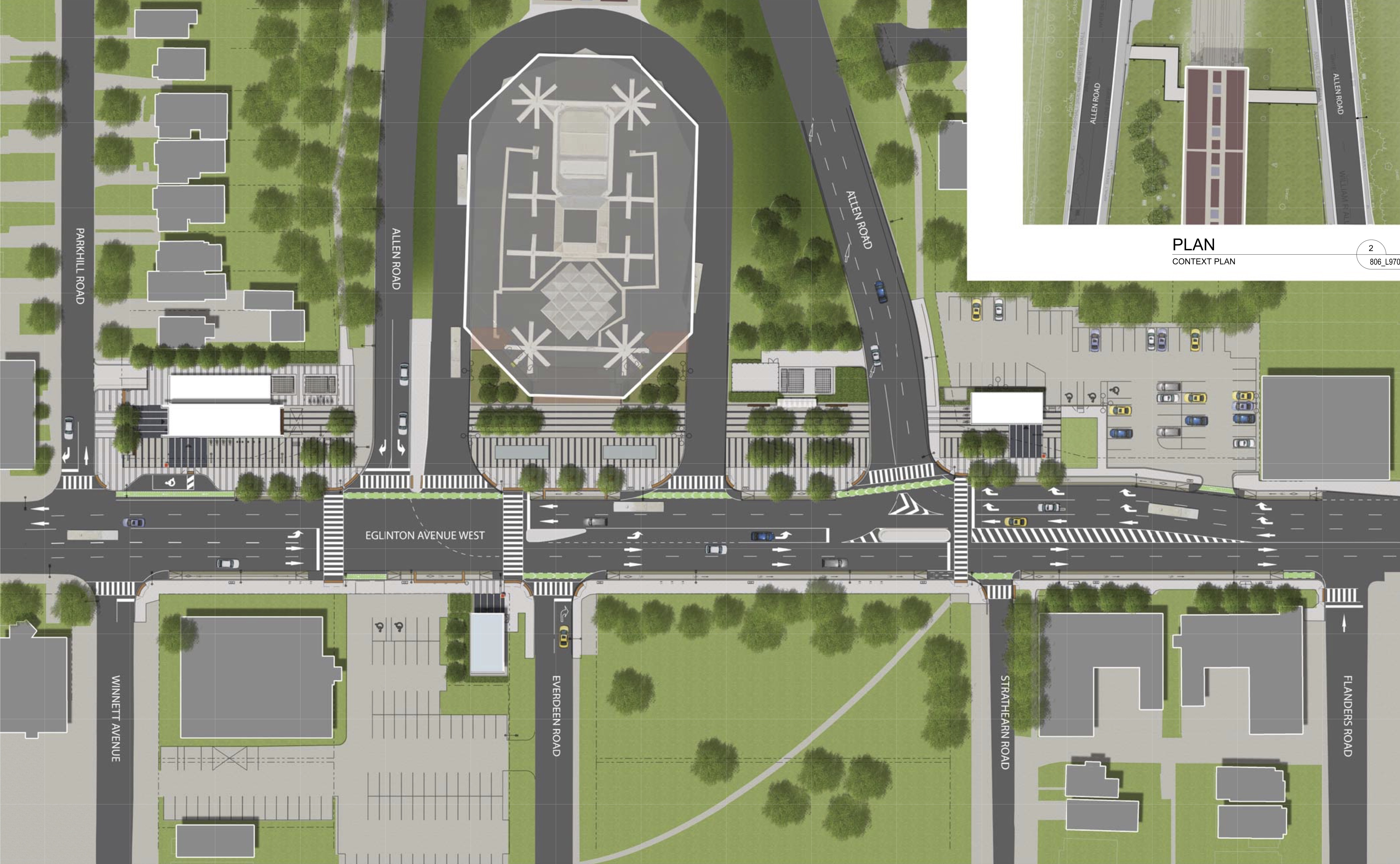
The old Eglinton West Station was built in the median of the "Allen Expressway" (now "Allen Road"). Patrons had to cross the on or off ramps of the Allen to get to or from the entrance of the Station.

With the revised Cedarvale Station, there are now entrances to the station without having to cross the on or off ramps. And an entrance on the south side of Eglinton. These improvements would benefit the patrons who use the station.

34797-117806.jpg

From link.
 
I don think anyone is stating that Toronto is not getting a better standard of service than they have now. The portion underground will be reasonable fast even if it has too many stations, and the eastern portion will still offer a more comfortable and pleasant ride which should not be discounted. This however is not the point.

The point is that Toronto is getting an LRT at subway prices. If you are spending a fortune you should be getting the gold standard. It not so much that they built LRT as it is that they are not getting value for the dollar.

It's a relatively long line. As a subway you're probably looking at double the cost, minimum.

Ford's plan to bury the whole thing and take it to STC doubled the cost, and that was a decade ago.
 
People who have the will and means to drive downtown or across the city were probably not going to take transit anyways - even if it was a full-fledged subway.
That is a generalization. Me and most of my friends who live around/north of the 401 will choose transit when it suits them (park and ride at a suburban station), and drive to almost everywhere else not downtown. Even if they are to drive downtown, it's mostly a full carpool or the entire family.
 
People who have the will and means to drive downtown or across the city were probably not going to take transit anyways - even if it was a full-fledged subway.
This thinking creates a vicious cycle of poor transit service and low ridership. This is why the US has awful transit--only poor people take the bus.

People will use the transport mode that creates the most value for them, where value is a combination of speed, convenience, cost and comfort. It is plainly wrong that people who own cars will use only them for the trips they make. Speed is critical in increasing transit ridership as many people will only consider switching from driving when it is faster.
 
That is a generalization. Me and most of my friends who live around/north of the 401 will choose transit when it suits them (park and ride at a suburban station), and drive to almost everywhere else not downtown. Even if they are to drive downtown, it's mostly a full carpool or the entire family.

That was my point.

I'm not saying everyone with a car will drive. I was questioning the idea that the Eglinton LRT will provide such poor service that people will choose to drive instead.


This thinking creates a vicious cycle of poor transit service and low ridership. This is why the US has awful transit--only poor people take the bus.

People will use the transport mode that creates the most value for them, where value is a combination of speed, convenience, cost and comfort. It is plainly wrong that people who own cars will use only them for the trips they make. Speed is critical in increasing transit ridership as many people will only consider switching from driving when it is faster.

That's not what I'm suggesting at all.

The US has awful transit for reasons that go beyond attitudes. I'd argue a consistent lack of investment in transit helps to foster such negative attitudes. It's certainly not true in areas of the US where transit sees heavy investments.

That isn't what's happening here. The Eglinton LRT certainly isn't perfect but I think terming it 'poor transit service' is extreme.

I asked:

"Are you telling me Scarborough residents won't use the Eglinton LRT because they'll deem it beneath them?

It's an essential service. What will they use instead? "


Your answer was "Cars".

Perhaps I'm misunderstanding. Are you really suggesting the Eglinton LRT will be so far below an acceptable level of service that people will be compelled to drive instead?
 
This thinking creates a vicious cycle of poor transit service and low ridership. This is why the US has awful transit--only poor people take the bus.

People will use the transport mode that creates the most value for them, where value is a combination of speed, convenience, cost and comfort. It is plainly wrong that people who own cars will use only them for the trips they make. Speed is critical in increasing transit ridership as many people will only consider switching from driving when it is faster.
I think another thing that needs to be understood about getting people out of cars and onto transit isn't just the transit line itself but the convenience of driving. I know over here in North America it is a sacrilegious idea but one of the things that needs to be accepted is the fact that building transit alone won't get people out of their cars. You also need to make driving itself less desirable. This is one of the less talked about reasons for why transit usage is so high over in Europe and East Asia, its because driving over there comes with more "baggage" then over here. Planners over there have absolutely no qualms with taking away driving lanes for things like Bike Lanes, pedestrian space, or transit lanes whereas over here its like pulling teeth from a dog. You also have things like congestion charges like in London, streets being closed to car traffic entirely like in Madrid, or the incredible expense of owning a car in Japan. Then of course there is the question of our atrocious urban planning practises that also lends itself to the car culture we have over here and further hurts the ability of public transit to be used and be built.
 
I think another thing that needs to be understood about getting people out of cars and onto transit isn't just the transit line itself but the convenience of driving. I know over here in North America it is a sacrilegious idea but one of the things that needs to be accepted is the fact that building transit alone won't get people out of their cars. You also need to make driving itself less desirable. This is one of the less talked about reasons for why transit usage is so high over in Europe and East Asia, its because driving over there comes with more "baggage" then over here. Planners over there have absolutely no qualms with taking away driving lanes for things like Bike Lanes, pedestrian space, or transit lanes whereas over here its like pulling teeth from a dog, and in Japan for example owing a car is incredibly expensive with both the insurance and the many taxes imposed upon car owners (not to mention every national highway is tolled).
Definitely agree about this. However, I don't think making driving more expensive would be the solution. It would make more sense to readapt our cities for people, rather than taxing drivers. There will always be drivers (although hopefully in the minority), so there's no point to make their lives more expensive if the real issue (car-oriented cities and bad infrastructure) isn't solved.
 
Some will, because it is slower than it could have been.

Some may - but that's what I was getting at.

@superelevation wrote:

"build low quality transit and nobody will ride it and it will confirm your belief that demand could never have been high."

Whatever our qualms over the ELRT, calling it 'low quality transit' seems completely unreasonable to me.

It's difficult to imagine a significant number of riders choosing their car over this line because a portion of it isn't underground. Especially with a connection to the OL.
 
I think another thing that needs to be understood about getting people out of cars and onto transit isn't just the transit line itself but the convenience of driving. I know over here in North America it is a sacrilegious idea but one of the things that needs to be accepted is the fact that building transit alone won't get people out of their cars. You also need to make driving itself less desirable. This is one of the less talked about reasons for why transit usage is so high over in Europe and East Asia, its because driving over there comes with more "baggage" then over here. Planners over there have absolutely no qualms with taking away driving lanes for things like Bike Lanes, pedestrian space, or transit lanes whereas over here its like pulling teeth from a dog. You also have things like congestion charges like in London, streets being closed to car traffic entirely like in Madrid, or the incredible expense of owning a car in Japan. Then of course there is the question of our atrocious urban planning practises that also lends itself to the car culture we have over here and further hurts the ability of public transit to be used and be built.
Except that's not how it works in Europe. You go to cities like Berlin, Tokyo, Madrid, and even Sydney , and they have extensive highway networks, even moreso than what we have here in Toronto. The reason why Transit has such a high marketshare then is because transit in these cities IS COMPETITIVE WITH THE CAR. I can take the U-Bahn in Berlin, and comfortably get from one side of the city to the next with barely any issues. Meanwhile in Toronto we're building subpar Light Rail lines that stop at every red light, and that ultimately don't show any advantage over the car. People don't take the car because they're stubborn, people take the car because most of the time its the best and most convenient option.
 
Except that's not how it works in Europe. You go to cities like Berlin, Tokyo, Madrid, and even Sydney , and they have extensive highway networks, even moreso than what we have here in Toronto. The reason why Transit has such a high marketshare then is because transit in these cities IS COMPETITIVE WITH THE CAR. I can take the U-Bahn in Berlin, and comfortably get from one side of the city to the next with barely any issues. Meanwhile in Toronto we're building subpar Light Rail lines that stop at every red light, and that ultimately don't show any advantage over the car. People don't take the car because they're stubborn, people take the car because most of the time its the best and most convenient option.
Yes and transit is competitive with the Car because those cities don't put the car on a pedestal like we do. As I said if any one of those cities wanted to do something like tare up a car lane to install a bike lane they would do it. If they wanted to build a streetcar line at the expense of 2 lanes of car traffic they would do it. Those cities have absolutely no issue making driving more inconvenient if it means making public transit more convenient. Those cities also have far better urban planning principles which ensures public transit is always available. As for highways do they really? Most Eurpean cities keep their Highways to the outer peripheries of there cities since they didn't fall for the "blasting a highway through your downtown core" joke like we and American cities did. This itself lends itself to greater transit usage since driving from the suburbs into the downtown core is hard due to the lack of direct highway access. Most Londoners have no problem taking the train when the alternative is sitting on the M25 for 2 hours. Tokyo isn't even an exception since while it has an extensive urban freeway network, all those highways are tolled so this adds a further expense the vehicle ownership in Japan. Transit is competitive in Europe and East Asia because either by the nature of the cities and urban planning or by intentional design (i.e. Toll roads or congestion charges) driving is simply an investment many aren't willing to make either due to time or cost. Then of course once you have this large captive market, expansion of the transit system becomes even easier. Transit shouldn't have to compete with the car, the car should have to compete with transit.
 
Last edited:
Except that's not how it works in Europe. You go to cities like Berlin, Tokyo, Madrid, and even Sydney , and they have extensive highway networks, even moreso than what we have here in Toronto. The reason why Transit has such a high marketshare then is because transit in these cities IS COMPETITIVE WITH THE CAR. I can take the U-Bahn in Berlin, and comfortably get from one side of the city to the next with barely any issues. Meanwhile in Toronto we're building subpar Light Rail lines that stop at every red light, and that ultimately don't show any advantage over the car. People don't take the car because they're stubborn, people take the car because most of the time its the best and most convenient option.

I believe public transit is popular in Europe due to a combination of factors. Good price / high subsidy level ceratinly plays a role. And, many old capitals have extensive subway networks, built at the times when construction was cheaper. Plus, the built form: if driving the car is easy, but parking the car at both your destination and at you home in the historical part of the city is a chore, then you are less likely to drive.

European cities often have good highway networks; attacking the cars with artificial traffic jams is not the strategy they use. They do restrict or close certain areas for cars, that applies more to the final destinations than to roads leading there.

Though, I would not call the Eglinton LRT design "subpar". That on-street eastern section will have minimal effect on the line's performance, because it is short. That 9 km stretch can be travelled in 24 min at 23 kph (surface LRT speed), or in 17 min at 32 kph (subway speed with a wide stop spacing). So, we are looking at a ~ 7 min diff in the travel time. Maybe some people who can take either Line 2 or the LRT, will opt for Line 2 because of that extra travel time on LRT. So what, the eastern sections of both Line 2 and the LRT will not be close to full capacity for a long time, if the Ontario Line is built.

Yes, it will be slightly odd to have the lightly used western section all grade-separated, while in the east, the grade separation only reaching Laird and not even Don Mills. And, knowing before hand that the west will end up being grade-separated, it would make most sense to do the same in the east.

But I prefer to look at the situation this way. Going from the mixed-traffic buses that always get stuck, to the hybrid LRT design (partly tunnel and partly street median), delivers ~ 80% of benefits. Going from the hybrid LRT to full grade separation, would deliver the remaining 20% of benefits. So, the proverbial glass is certainly more than half full.

 
Yes and transit is competitive with the Car because those cities don't put the car on a pedestal like we do. As I said if any one of those cities wanted to do something like tare up a car lane to install a bike lane they would do it. If they wanted to build a streetcar line at the expense of 2 lanes of car traffic they would do it. Those cities have absolutely no issue making driving more inconvenient if it means making public transit more convenient. Those cities also have far better urban planning principles which ensures public transit is always available. As for highways do they really? Most Eurpean cities keep their Highways to the outer peripheries of there cities since they didn't fall for the "blasting a highway through your downtown core" joke like we and American cities did. This itself lends itself to greater transit usage since driving from the suburbs into the downtown core is hard due to the lack of direct highway access. Most Londoners have no problem taking the train when the alternative is sitting on the M25 for 2 hours. Tokyo isn't even an exception since while it has an extensive urban freeway network, all those highways are tolled so this adds a further expense the vehicle ownership in Japan. Transit is competitive in Europe and East Asia because either by the nature of the cities and urban planning or by intentional design (i.e. Toll roads or congestion charges) driving is simply an investment many aren't willing to make either due to time or cost. Then of course once you have this large captive market, expansion of the transit system becomes even easier. Transit shouldn't have to compete with the car, the car should have to compete with transit.
Those cities don't put cars on a pedestal? I'd like you to find a point in Amsterdam where you're not at least 5km away from a motorway. I'll wait.
 
Yes and transit is competitive with the Car because those cities don't put the car on a pedestal like we do. As I said if any one of those cities wanted to do something like tare up a car lane to install a bike lane they would do it. If they wanted to build a streetcar line at the expense of 2 lanes of car traffic they would do it. Those cities have absolutely no issue making driving more inconvenient if it means making public transit more convenient. Those cities also have far better urban planning principles which ensures public transit is always available. As for highways do they really? Most Eurpean cities keep their Highways to the outer peripheries of there cities since they didn't fall for the "blasting a highway through your downtown core" joke like we and American cities did. This itself lends itself to greater transit usage since driving from the suburbs into the downtown core is hard due to the lack of direct highway access. Most Londoners have no problem taking the train when the alternative is sitting on the M25 for 2 hours. Tokyo isn't even an exception since while it has an extensive urban freeway network, all those highways are tolled so this adds a further expense the vehicle ownership in Japan. Transit is competitive in Europe and East Asia because either by the nature of the cities and urban planning or by intentional design (i.e. Toll roads or congestion charges) driving is simply an investment many aren't willing to make either due to time or cost. Then of course once you have this large captive market, expansion of the transit system becomes even easier. Transit shouldn't have to compete with the car, the car should have to compete with transit.
Agreed.

Let's not forget that Ford's problem with Transit City in 2010 wasn't that it was poor transit, but rather that it was part of the "War On The Car". His entire transit platform was about appealing to car culture.

For the past while our transit philosophy has been about projects that don't make things anymore difficult for drivers.
 

Back
Top