





nfitz
Superstar
Only 2-3 times? Given how low land values are there, I'd have thought more. They must pay a lot less property tax than we do!IIRC, property taxes in Chicago are 2-3x our rates.
|
|
|
Only 2-3 times? Given how low land values are there, I'd have thought more. They must pay a lot less property tax than we do!IIRC, property taxes in Chicago are 2-3x our rates.
I think you’ve kind of answered where the problem is. If additional oversight seems to be so helpful, and the electronic means are there, it seems like the issue is the drivers are not following that digital information the TTC has paid for. Somehow after all this digitization, the TTC that is so sorely underfunded it has to pay someone to stand at a street corner manually recording the streetcar times on a notebook.They've done several experiments deploying additional management/oversight to a line, and service (particularly bunching, on-time departures, etc.) noticeably improves every time. It's not a cheap solution but it's one of the few experiments that's been reliably successful.
You might argue automated electronic oversight can do the same thing but when you look closer you find they already have that; every driver already regularly gets information telling them whether they ahead or behind schedule.
You've captured what I think will happen. The province says it will fund 30% of the TTC operating subsidy and the City will cut their funding of the subsidy by 30% because "we can barely afford it" and "taxes are too high already". It's a net zero gain in funds and invites a whole host of problems, unless the province makes the City to agree to some kind of "guaranteed minimum funding," but we've already seen those guarantees can be torn up on a whim any time some Ontario government politicians feel like it because "we can barely afford it" and "taxes are too high already."The problem is the City alone as it currently is can barely afford to pay for the TTC. Sure its not getting worse (usually) but it hasn't exactly got better either. Unless the City were to increase taxes which is a poison pill to any political campaign nothing will get better. Farebox revenue as well isn't a stable source of income either, yet the TTC is expected to make up a disproportionately large portion of its operating budget using it. Sure the current system more "stable" but the status quo is not helping either, it's more or less just causing us to kick many cans down the road.

The bad news is that the users from the 905 only pay the TTC fare, which is 68.0% (2018) of the cost. The remaining 32% of covered by the people and businesses of Toronto. From link.As long as people keep electing politicians whose main campaign plank is no property tax increases higher than the rate of inflation, that's how it's going to be done.
Of course, they did add an "additional levy" (which is not to be referred to as a property tax increase!) a few years ago, which was a good step.

Wouldn't this end up shifting higher taxes to renters? I thought this was an issue that people already complain about (though I don't really know the details myself).Primary residences should be taxed at their realistic value but those investment residences should face more heavy property tax.

One of the many reasons for closing Line 1 on weekends was because of the construction of the new station under the Eglinton Station for Line 5. However, there was also construction on the Line 1's Eglinton Station box itself. Unless changed from the original plans, they were planning to extend the station box on Line 1 northward.
See link, dated November 17, 2013.
I haven't heard of any plans to shift the station boxes for any interchange stations for the Ontario Line.
I think this was canned, I dont think they are going this anymore. From what I recall, the platform is simply being extended a little bit, and thats it.
Someone correct me if im wrong.
In November 2013, the TTC originally proposed to shift the current Line 1 platform approximately 70 m northward of its current location. Such a change would have allowed smoother flows of passenger traffic between the platforms for Lines 1 and 5, and avoided a situation where all transferring passengers are bottlenecked by only one transfer path, similar to the busy Bloor–Yonge station. The pocket track at the north end of the station would have had to be abandoned. However, this proposal was modified by March 2018 to shift the Line 1 platform north by only 24 m, allowing the pocket track to be retained. In the new area there will be an elevator and escalators down to the Line 5 concourse. At the south end of the platform, the elevator and stairs to the south station entrance will be retained but the platform edge will be walled off in this area.






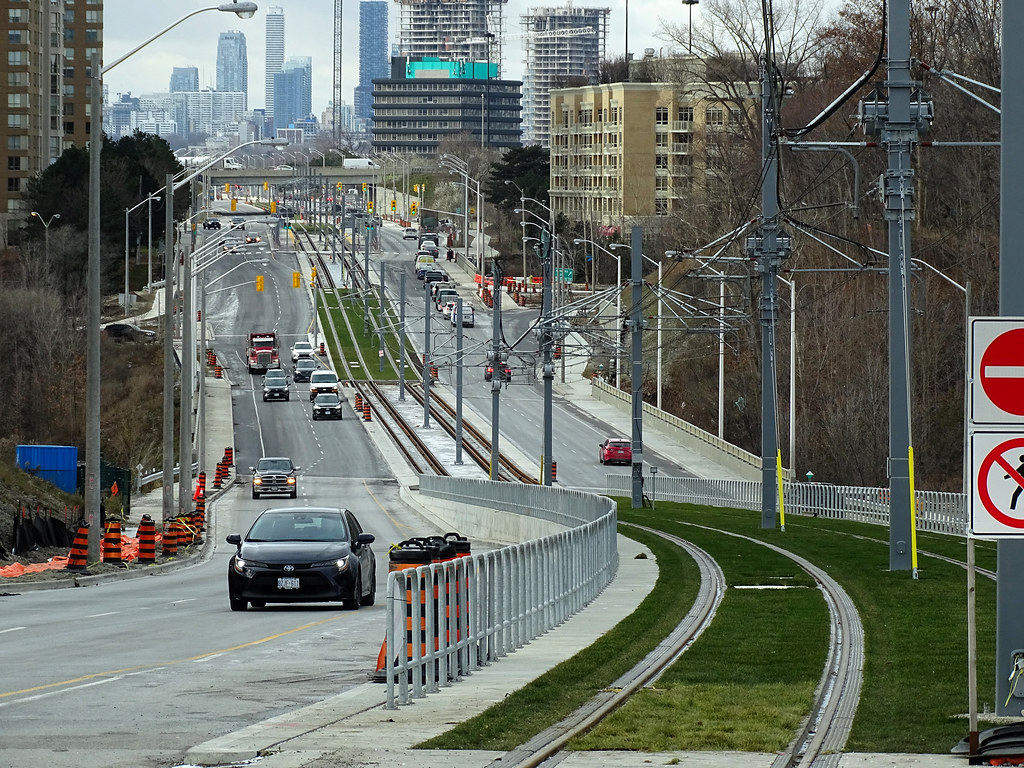
Shifting the platform north would have some impact on the crossover/pocket track from what I was seeing years ago as well the tunnels.

Shifting the platform north would have some impact on the crossover/pocket track from what I was seeing years ago as well the tunnels.
There is a new stair being put in at the north end of Line 1 platform to the Line 5.
If Line 1 platform was being extended, it would started a few years ago. To late to do it now without major shut down not only on weekend but a week at times or more.