News   GLOBAL  |  Apr 02, 2020
 11K     0 
News   GLOBAL  |  Apr 01, 2020
 43K     0 
News   GLOBAL  |  Apr 01, 2020
 6.6K     0 
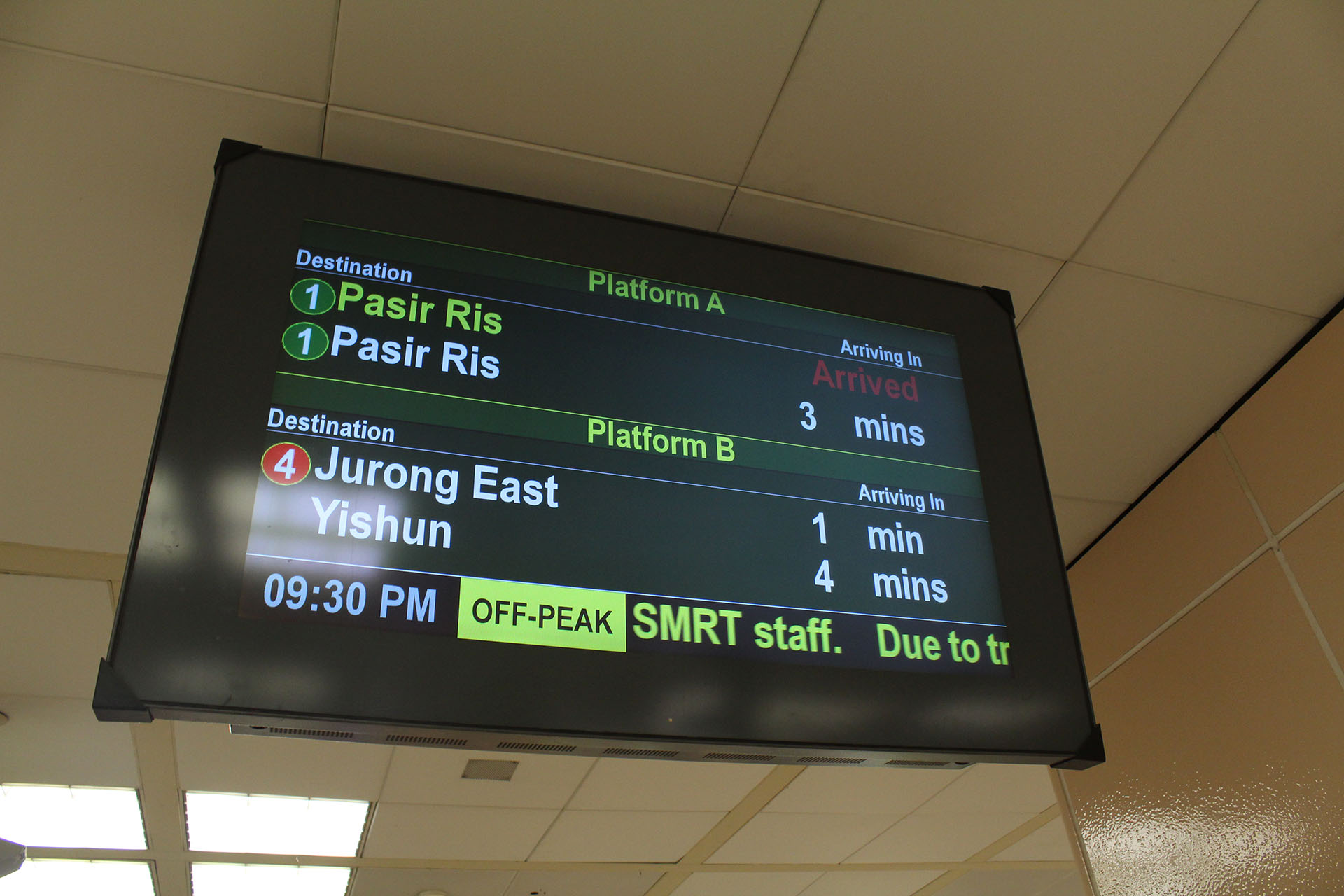
Guessing there will be "Next Train" display screens at each station and stop.

How about showing the arrival date and time of the first light rail vehicle at each stop display? Like a countdown.

"Next train 3 Months 14 Days 3 hours 10 minutes"?

We can ignore the seconds.

infosys-nsewl-plasma-concourse.jpg

From link.
 
Nice straw man.

GO and VIA (and CN and CP) operate on tracks that have a long history of existing usage. People have learned to expect that they will be passing by at great speed.

There is no history of rapid transit on Eglinton

Dan
I'm not sure why it would matter that there's no history of rapid transit on Eglinton. Are we asking so much for people to be aware of their surroundings and not blindly dart into traffic? Do brand new European tram lines have speed limits instituted? And people can jaywalk midblock too, so if you want to be really safe, you'd probably want to lower the speed limit to 25 (or slower) along the entire outdoor portion of the line.

After 5, 10 years of the existence of the Crosstown, will the TTC relent and let the cars run faster? Considering that the Spadina line is pushing 30 and it seems to have only gotten slower as it's aged, I shouldn't hedge my bets on it. There doesn't seem to be any danger of speedy operation on St. Clair anytime soon, either. And that's why I made the comparison to the railway - do the "safety considerations" referred in the post I was quoting stop mattering if the line has existed for a long enough time? Or will it be that as the line ages, there will still be inane safety rules, only this time without the TTC being able to hide behind the novelty of the line?

 
I'm not sure why it would matter that there's no history of rapid transit on Eglinton. Are we asking so much for people to be aware of their surroundings and not blindly dart into traffic? Do brand new European tram lines have speed limits instituted? And people can jaywalk midblock too, so if you want to be really safe, you'd probably want to lower the speed limit to 25 (or slower) along the entire outdoor portion of the line.

After 5, 10 years of the existence of the Crosstown, will the TTC relent and let the cars run faster? Considering that the Spadina line is pushing 30 and it seems to have only gotten slower as it's aged, I shouldn't hedge my bets on it. There doesn't seem to be any danger of speedy operation on St. Clair anytime soon, either. And that's why I made the comparison to the railway - do the "safety considerations" referred in the post I was quoting stop mattering if the line has existed for a long enough time? Or will it be that as the line ages, there will still be inane safety rules, only this time without the TTC being able to hide behind the novelty of the line?
"History of rapid transit on Eglinton" should include the Eglinton West subway.

From link.

It was first planned for in 1985, as a busway, not a subway. By 1986, the 2011 Network plan was initiated, with the Eglinton West corridor as a subway. In 1994, when Premier Bob Rae agreed to fund the subway project and construction started. The line was cancelled upon the election of Progressive Conservative Mike Harris in 1995.

The TTC's Transit City plan, which was announced in 2007, included a light rail transit line across Eglinton called the Eglinton Crosstown LRT. This line would be built underground between approximately Keele Street and Laird Drive, which would effectively create an Eglinton West "subway", but would use LRT vehicles rather than the subway trains. Mayor Rob Ford announced the cancellation of Transit City on the day he took office in 2010. It was then reinstated along with a Finch LRT line by Toronto City Council, over Mayor Rob Ford's objections.

38+ years to get rapid transit along Eglinton.
 
GO and VIA (and CN and CP) operate on tracks that have a long history of existing usage. People have learned to expect that they will be passing by at great speed.

There is no history of rapid transit on Eglinton

Dan

Eglinton (through the Golden Mile) is a 6-lanes arterial, with 60 kph speed limit before the construction started. Gazillions of cars, and a frequent bus route. Pedestrians probably have learned that they need to be careful when crossing.
 
Let's remember what the real problem is here.

Even with priority signalling, I would not expect LRT to blaze through major intersections at "track speed".

Slowing to, say, 40 km/h only adds seconds to the trip time. Whereas, stopping for a red signal and waiting through a full light cycle can cost a minute or two.

The underlying travesty is that the system does not give priority to transit vehicles whenever possible. If they have to slow a little, so be it.

- Paul
 
One final email response from Ivan regarding this issue.

View attachment 498748

It's disappointing that not only is there a 50 km/h speed limit on the LRV's in the above ground sections and a lack of true signal priority, but also that the LRV's will be forced to slow down to 25 km/h at intersections. This further gimps the speed on the surface section.

All this because the City of Toronto wants to prioritize single occupancy cars over 150 occupancy LRTs.

I can't seem to stop asking questions to Ivan. Here are the next couple of responses from him.

Screenshot_20230811-094938.png


No specific person for me to reach out to. Just general info on Toronto Transportation Services.

Screenshot_20230811-094753.png


Basically just PR speak for when the line is scheduled to open and what issues they're facing in the interchange station.
 
I can't seem to stop asking questions to Ivan. Here are the next couple of responses from him.

View attachment 499244

No specific person for me to reach out to. Just general info on Toronto Transportation Services.

View attachment 499245

Basically just PR speak for when the line is scheduled to open and what issues they're facing in the interchange station.
Well I presume this Ivan guy doesn't really have someone to send you to, its a completely different organization with its own people and characters. If you want to find who to talk to at the Toronto Transportation Services, you'll have to contact the city directly.
 
Let's remember what the real problem is here.

Even with priority signalling, I would not expect LRT to blaze through major intersections at "track speed".

Slowing to, say, 40 km/h only adds seconds to the trip time. Whereas, stopping for a red signal and waiting through a full light cycle can cost a minute or two.

The underlying travesty is that the system does not give priority to transit vehicles whenever possible. If they have to slow a little, so be it.

- Paul
Why shouldn't they travel through the intersections at track speed? Trams do that in many cities. Why not in Toronto?
 
Why shouldn't they travel through the intersections at track speed? Trams do that in many cities. Why not in Toronto?
I'm not sure which cities you're referring to, but it does slow down in many cities, even european ones. I watched the cab ride for the Belgium Coast tram a few months ago, and it absolutely slowed down when it got to areas with many intersections. The thing is in most cities, trams that run in urban areas with lots of intersections don't run that quickly to begin with. The Belgian Coast tram runs at like 70-80km/h outside the cities where its basically in a dedicated railway ROW in the middle of nowhere, meanwhile the moment it enters a somewhat urban section with crossings and intersections, it slows down to 30-40km/h at all times.
 
A not very exhaustive list:

Prague:


Bratislava:


Brno:


Hannover:


I looked up the Belgian Coastal Tram and it didn't slow down at random crossings either.


https://youtu.be/aVtETZ2zOUg?t=5374

https://youtu.be/aVtETZ2zOUg?t=5389
Again I want you to be careful, because I brought up the fact that the tram could also be naturally travelling slowly. In that clip of the Belgian Coastal Tram you sent for instance, its literally travelling at 40km/h on that beachfront section. It might not look that slow in the footage, but that's because it was filmed using a wide lens that distorts the perspective to make the tram look like its running faster than it actually is. Feel free to open GMaps, measure the distance between the pantograph poles, and time how long it takes the tram to travel between them (Its around 55m between the poles, and a little under 5s between each pole)
1691773630873.png
 
Again I want you to be careful, because I brought up the fact that the tram could also be naturally travelling slowly. In that clip of the Belgian Coastal Tram you sent for instance, its literally travelling at 40km/h on that beachfront section.
That's shifting the goal posts. The discussion was not of the maximum speed that the vehicle achieves, but whether the vehicle is required to slow down for intersections, as they will be on the Crosstown, or not. If a Crosstown tram is doing 40 km/h between sections, it will still be required to slow down to 25 at intersections, which the Belgian tram manifestly did not.

None of the trams in the videos I linked are great speedsters compared to the high speed sections of the Belgian Coast Tram, but each of them were permitted to enter an intersection at their present speed, or even speeding up. Why, therefore, not Toronto?
 

Back
Top