




Steve X
Senior Member
Let's hope they were just installed incorrectly and not cause the rail moved after a bunch of test trains went by.Yea there were several sections that were a couple mm off
|
|
|
Let's hope they were just installed incorrectly and not cause the rail moved after a bunch of test trains went by.Yea there were several sections that were a couple mm off

I wonder why they don't paint the turn path guides (lines) across the track bed?Yesterday I was riding the motorcycle eastbound along Eglinton. At Leslie St., a southbound car turned left into the Crosstown tracks, coming to a stop before the road surface fell away to bare tracks. The car then reversed out of the tracks and carried on east on Eglinton. I was immediately reminded of both: Queens Quay where car drivers were turning left onto the ROW or going down the tunnel to Union Station; and of Murphy’s Law, where if we enable the wrong choice it will be taken by some car drivers.
Maybe they will when they finish and open the Crosstown in 2025. But paint didn't stop drivers entered the Queen Quay tunnel. Instead we needed hardened barriers.I wonder why they don't paint the turn path guides (lines) across the track bed?
View attachment 559984

Sunnybrook Park station should never have happened. The track should have had a short tunnel under the intersection and the CP bridge. This would also have mitigated the amount of up down up down between Brentcliffe Portal and Don Mills Portal, eliminated wait times for signals at Leslie, and would have allowed for a longer bus/HOV approach to Leslie on Eglinton westbound rather than the short queue jump after the bridge. The CP bridge is a real pinch point now westbound as there are long peak time signal times to bring traffic down Leslie onto Eglinton. I have to bring my kid to Don Mills MS some mornings and sometimes on the way back I will go around via Overlea because the Eglinton backup is so acute.I wonder why they don't paint the turn path guides (lines) across the track bed?

Was the reason for the portal east of Laird rather than only having a Don Mills East portal to prevent tunnelling under the Don River to keep costs down? Assuming no Sunnybrook Park stop nor station would exist of course.mitigated the amount of up down up down between Brentcliffe Portal and Don Mills Portal
Yes. I think there was a possibility at one point of the line running on the south side of the street from Brentcliffe to Don Mills West portal, which would have eliminated the conflict at Leslie but retained the CP bridge pinch point, but I don’t recall why that was excluded from consideration - maybe structural considerations for the two bridges in between?Was the reason for the portal east of Laird rather than only having a Don Mills East portal to prevent tunnelling under the Don River to keep costs down? Assuming no Sunnybrook Park stop nor station would exist of course.

They started a process in 2012 about revising the EA, but the plan 1included eliminating the station at Leslie - which caused a community uproar. However no one was willing to pay the extra $100+ million station at Leslie.... but I don’t recall why that was excluded from consideration - maybe structural considerations for the two bridges in between?
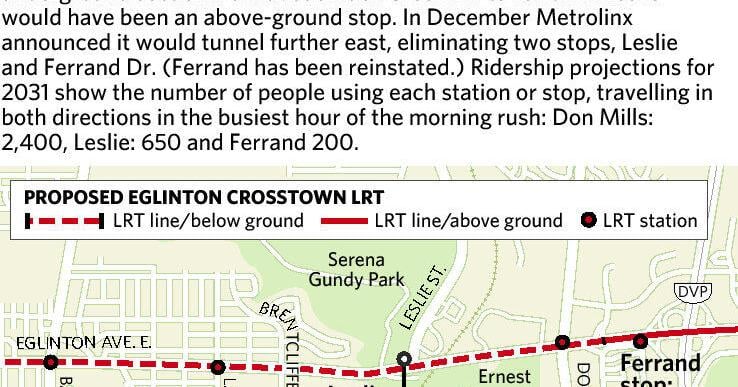
 www.thestar.com
No, not if I say so; if all the traffic impact studies submitted with the associated development along the Golden Mile say so, which they do, and those have been published here, along with the Golden Mile Transportation Masterplan.
Red is over capacity, in the preferred build-out scenario:
(two variations)
View attachment 561219
View attachment 561220
Source: https://www.toronto.ca/wp-content/uploads/2019/11/97a2-CityPlanning_GoldenMile_TMPDraft_Part3.pdf
Further, from the above:
View attachment 561221
* before you say...... but we can have shorter headways.............. Nope, we can't, because the service has to interleave w/the short-turning service.
Ah, but you say, we can run ALL the service out to Kennedy. Nope, can't do that either as this would reduce the headway in the central section of the line.
****
Same thing I have had to say to a lot of posters today. I don't guess much. Its not a hunch, its not an intuition. I do my homework. If I'm guessing, I'll say so.
Wait, who said the current platforms don't fit 3-car trains? All platforms (surface and underground) are around 95 metres long and there will be a 1/3 unused. It's not even walled off unlike Line 4. Hope people don't stand in the wrong place.From another thread ..
The problem is greater than I thought. However, can think of a few ways to meet the demand, short of stopping the LRT service for several years in order to build a new tunnel.
1. The report mentions that "the current plan for 2-car trainsets on 5-min headways may not be sufficient", and "it may be necessary to plan for 3-min headways and/or 3-car trainsets".
Which means, 3-car trainsets might be sufficient to handle the demand, without changing the headways.
All underground ECLRT stations are built to be easily convertible for 3-car trains. For the surface section, there may be some challenges, particularly fitting the platforms for 3-car trains. But if there is a pressing need, then it should be doable, for a small cost and relatively quickly.
2. The 4 major N-S bus routes through the area are shown to be near or above capacity north of Eglinton, but below 85% south of Eglinton. Looks like an opportunity to run more buses during the peak, between Eglinton and the closest Line 2 station, to divert some of the demand there.
3. The Eglinton bus. Could run a short-turn peak-period branch #34 between the Science Centre and Kennedy, stopping more frequently than the LRT, and thus diverting some of the riders. Obviously, the bus capacity is a fraction of LRT's. But if the LRT on its own is only 10% above capacity, not 50% above, then the bus can help bring the demand just below the limit.
Wait, who said the current platforms don't fit 3-car trains? All platforms (surface and underground) are around 95 metres long and there will be a 1/3 unused. It's not even walled off unlike Line 4. Hope people don't stand in the wrong place.
 I wasn't sure.
I highly doubt people will prefer to transfer to Line 5 over Line 2 unless buses terminated at Eglinton. Unless line 5 has significant travel time savings. They won't likely get a seat in rush hour if they transfer from Line 5 to the bus. So downtown to Scarborough trips will default on Line 2.
As traffic worsens from intensification, you'll have to pay people to take the local bus to get stuck in traffic.
Once they extend Sheppard deep into Scarborough, I don't think Eglinton will suffer that much. I think forecasting is too optimistic as subway ridership is nowhere near pre-covid.
Why would you need to stop it? There's no reason why the line could not continue to run with only a couple of minor stoppages to handle the cutting in of temporary reroutes to handle localized construction.From another thread ..
The problem is greater than I thought. However, can think of a few ways to meet the demand, short of stopping the LRT service for several years in order to build a new tunnel.
This has always been the plan, well before this came about.1. The report mentions that "the current plan for 2-car trainsets on 5-min headways may not be sufficient", and "it may be necessary to plan for 3-min headways and/or 3-car trainsets".
Yes. See above.Which means, 3-car trainsets might be sufficient to handle the demand, without changing the headways.
All stations and platforms have been built to operate 3-car trains from day one should the need arise. No additional work - save for perhaps training - would be necessary.All underground ECLRT stations are built to be easily convertible for 3-car trains. For the surface section, there may be some challenges, particularly fitting the platforms for 3-car trains. But if there is a pressing need, then it should be doable, for a small cost and relatively quickly.
There are many ways to do this, and yes short-turning select vehicles is one way.2. The 4 major N-S bus routes through the area are shown to be near or above capacity north of Eglinton, but below 85% south of Eglinton. Looks like an opportunity to run more buses during the peak, between Eglinton and the closest Line 2 station, to divert some of the demand there.
This is already happening to a degree, but the reality is that a bus would have to run at an incredibly high frequency to reach even a fraction of the LRT's capacity. Counting on a paralleling bus service is not really feasible.3. The Eglinton bus. Could run a short-turn peak-period branch #34 between the Science Centre and Kennedy, stopping more frequently than the LRT, and thus diverting some of the riders. Obviously, the bus capacity is a fraction of LRT's. But if the LRT on its own is only 10% above capacity, not 50% above, then the bus can help bring the demand just below the limit.

Is that about as fast as they'll go once the line opens? Or is that just testing speed? A lot of the cars looked like they were passing the trains.May 2024 Crosstown testing.