Some commentary on the state of the retail scene in the Beaches:
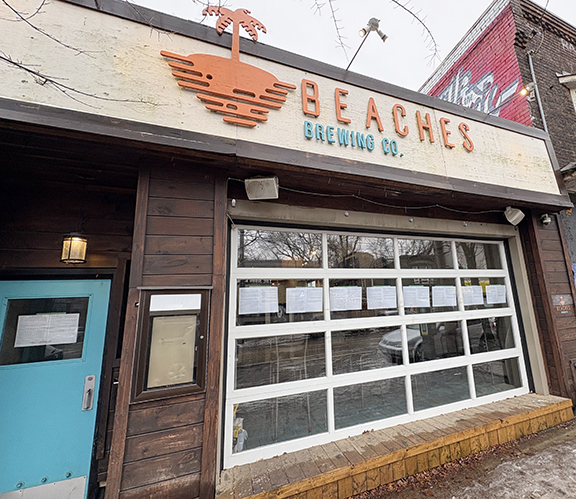
The Beaches Brewing Company on Queen Street East, which opened in 2019, closed its doors late last year and is now up for sale. Photo by Matthew Stephens.

beachmetro.com
The New Year will bring changes to East Toronto as a number of well-known local businesses have been put on the market for sale.
The reasons for the sales vary, but for some the challenges have included not being able to have the revenue keep up with the high rents business owners have to pay.
“Why my specific business went under, it’s a combination of factors for sure,” Carl Pratt, owner of Beaches Brewing Company at 1953 Queen St. E., told Beach Metro Community News in a recent interview.
“The neighbourhood doesn’t have enough people within our target demographic to sustain the size of operation we have.”
Beaches Brewing Company is one of five local businesses currently being sold on the market. Others include Bad Egg (2214 Queen St. E), Burrito Bandidos (1614 Queen St. E.), Beacher Café (2162 Queen St. E.), and Feathers Pub (962 Kingston Rd.).
Pratt listed several reasons as to why he believes Beaches Brewing Company ultimately failed to survive in the area, including rental costs not keeping up with revenue, the area’s “overstated” rental prices, an oversaturated restaurant market in the area, limitations associated with the COVID-19 pandemic, labour shortages, inflation, and difficulties applying for government subsidies.
Although rental costs for retail spaces vary across the city, commercial real estate marketplace
LoopNet reports leasing prices for retail spaces in the Beach area ranging roughly between $2,333 and $3,250 per month, before factoring in considerable additional costs for property taxes, maintenance, and utility fees.
Mark Richards is the founder and team lead of The Richards Group, a real estate agency in East Toronto. He told Beach Metro Community News that the issues impacting local commercial businesses are based on “a number of converging factors that make it tough for some small businesses to thrive here, especially on commercial strips like Queen Street and Kingston Road.”
Those issues include many of the concerns raised by Pratt.
“Commercial retail rents across Toronto have escalated rapidly in recent years, making it difficult for locally owned businesses which don’t have the same margins as large chains to absorb sharp increases when leases are up for renewal,” said Richards.
“In addition, commercial property taxes have also increased, which is always passed onto the commercial tenant.”
He also cited “ballooning” operating costs for insurance, utilities, and labour, which he said have “climbed meaningfully in recent years.”
In their 2025
Canada Real Estate Market Outlook, CBRE described Canada’s retail landscape as “supply-constrained” with “low vacancy and rising rents” – a fact which will see a “increasing number of brands modify the scale of their typical store,” in the years to come.
For Pratt, operating his business in a large 2,400 square foot building that required consistent foot-traffic and abundant staffing was something that proved to be a challenge after he first started leasing the property back in 2019, just months before the COVID-19 pandemic hit.
“For that building, the property tax is $4,000 per month. Paying this much doesn’t yield us any magical benefits, we just get to pay ten times the property tax rate compared to a resident for the privilege of losing money while trying to make the neighbourhood more vibrant,” said Pratt.
“The building is too big, and I think if I had gone with a smaller space then it would have massively reduced my overhead and staffing requirements.”
Pratt said his gross total payout per month (including property tax and utilities) was approximately $13,000, which he described as “not a terrible deal in the Beach, but nowhere close to the suggested occupancy metrics for a restaurant.”
Beach-based businesses weren’t the only ones to take a hit during the early stages of the pandemic, but restaurants and pubs such as the Beaches Brewing Company were particularly hard hit by lockdowns with the impacts carrying on for years afterwards.
Statistics Canada reported that roughly 100,000 businesses operating in February 2020 had closed by September and remained closed as of November 2020 – many of which were younger businesses with fewer employees, less assets, more debt, less liquidity, and were less profitable than their longer-running counterparts.
For Pratt, failing to generate sustainable foot-traffic was bad for business, and worse for the business’ image – contributing to a narrative he believes had negatively impacted public perception of the restaurant’s quality.
“When 1953 Queen St. E. had two or three tables of customers, it felt empty, which affects how people view the space, how good they think it is, how much they enjoy themselves (believe it or not),” said Pratt. “What’s the point in paying for a space with a license of 118 people when you really only ever get 30 or 40.”
He said a persistent lack of customers was due in part to an oversaturated market in the surrounding area, and a strong dependency on securing customers during the warmer spring and summer months, when foot traffic is at a high in the Beach.
“At present, there are six pubs within spitting distance of 1953; that’s too many for the number of available customers,” said Pratt. “Additionally, because we were a new business in a highly seasonal neighbourhood, it negatively affected how we were able to acquire government subsidies.”
Applying for government subsidies such as
loans, wage subsidies, or grants, require businesses to report their minimum annual income, a stable cash flow, and proof of financial viability – all of which can directly impact eligibility for businesses with fluctuating seasonal incomes.
Being located in a quieter neighbourhood outside the downtown core, Richards said local businesses in the area have little to fall back on when the weather gets cold and locals stop leaving their homes to shop or dine.
“Unlike busy downtown corridors, some local retailers and restaurants rely heavily on local residents rather than destination visitors, making winter months or quieter periods tougher for consistent sales,” said Richards.
Even during summer months, he said the city’s CafeTO program actually makes the situation even worse for some businesses. While the program allows restaurants to expand their dining spaces outdoors, that often results in a reduction of available street parking, which in turn motivates some local shoppers to travel to locations that allow space for vehicle parking.
“CafeTO in the summer months limits parking for retail stores, pushing non-locals to more convenient shopping plazas with parking,” said Richards. “Although a benefit for restaurants, it definitely creates additional challenges for other storefronts which don’t have parking for their customers.”
With a lack of support from the community and government, the challenges of the pandemic – and other issues – Pratt said he’s come to terms with the underlying reasons behind the closure of Beaches Brewing Company.
“If you’re behind to begin with you always end up having to play catch up, which is not how you want to run a business,” said Pratt. “In addition, craft beer doesn’t have the draw that it used to. We missed the boom by about five years.”
In a note posted on the door of the Beaches Brewing Company announcing the closure, Pratt wrote more about the craft brewing industry in Canada and the competition it faces from international brewing companies.
“We certainly had a time when a great proportion of the general population was excited about having fresh, local beer in their mug,” he wrote.
“The macro brands even started buying craft breweries to get in on it, but I think they ultimately found it cheaper to just throw more ad dollars at the problem and recondition people to their cheaper products. We’ll never have the resources that they have, so the best we can do is to remind our locals that we keep all our dollars in our neighbourhoods. I’d urge the local population to think of their breweries the same way they think of their local bakeries.”






-- but I digress). They commute by bike, TTC and/or GO regularly, just using their one car per family for out-of-town travel. I take the GO when I go there. They love it over the car-centric suburbs. It appears that my Beachy family are outliers.