News   GLOBAL  |  Apr 02, 2020
 11K     0 
News   GLOBAL  |  Apr 01, 2020
 43K     0 
News   GLOBAL  |  Apr 01, 2020
 6.7K     0 
I think the cost of burying wires on St. Clair, really contributed to them not burying the wires on Roncy and now we're seeing the same thing on Eglinton. I just hope that if they do decide to do it, that they don't wait until the last minute and end up delaying the opening of the line because of hydro work. Things like that happen far too much in our city.

Burying the wires on Roncy was a time frame that never fit into the timetable for doing the rebuilding.

A good part of St Clair already had underground service, but the poles/wires where still in place due to the cost to removed them.

Toronto Hydro has a guideline to follow when it comes to replacing equipment set by the Energy Board not the city of Toronto. Because of these guidelines, Toronto Hydro was not allow to removed and bury parts of St Clair as well past the cost on the the residents. City Council order Toronto Hydro to do the work with the city picking up the cost. Same thing happen for the Fleet ROW.

I have stated a number of times that developers should pickup the cost to bury the overhead when they are redeveloping or building a new project. Ends up being a win win for everyone.
 
Looking through the Functional Design Presentation At-Grade Section: Don Mills to Ionview, I noticed that around many of the LRT stops were vast expanses of asphalt desert:

attachment.php


All that is missing are cacti and tumbleweed plants, and maybe a coyote chasing a roadrunner.

Coyote_GRRO3.jpg


A light rail surface stop is definitely more appropriate to this scene than an underground station.

Hopefully, there will be appropriate medium density development around those stops.
 
Last edited:
Thx for that. It reminded me just how ugly that stretch of Eglinton from Vic Park east really is. Is there no thoughts about changing the Vic Park/Eglinton/O'Connor intersection while adding the LRT?
 
Thx for that. It reminded me just how ugly that stretch of Eglinton from Vic Park east really is. Is there no thoughts about changing the Vic Park/Eglinton/O'Connor intersection while adding the LRT?

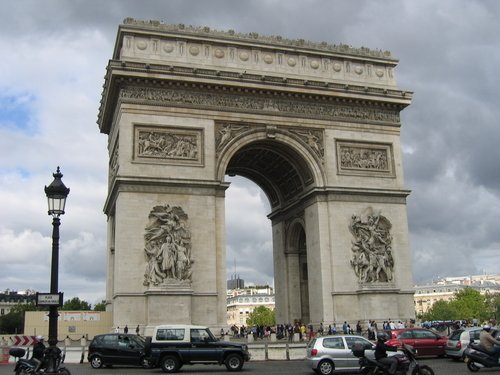
They could always build a triumphal arch there.

triumphal-arch-paris-prarctr1.jpg

To the glory of our city.
 
Why do the renderings show bus stops for bus routes 34 and 305? These will presumably cease to exist when the LRT opens.
 
Also, no consideration whatsoever to using high capacity light rail stations like Calgary and Edmonton, and bridges/tunnels across the road, which means reduced capacity due to delays from pedestrians crossing the street, and small far-side platforms with low passenger capacity. See this LRT station in Edmonton: <http://goo.gl/maps/Vm1Zz>. The design looks like the St. Clair streetcar with longer platforms, which is fine for a low-capacity tram line, but not for a light rail line that is 2/3 underground with 3 car light rail trains.

Also the Ferrand station needs to be removed. It is too close to Don Mills.
 
I hope that there will be some kind of physical barrier to separate LRT rails from regular traffic. If there isn't, idiot drivers surely will block the and delay the LRVs.
 
Why do the renderings show bus stops for bus routes 34 and 305? These will presumably cease to exist when the LRT opens.

The 305 will likely still operate, since its a night bus. The 34, I'm not so sure why its needed, but if it continues, it will likely be a minimal 30 minute service to make all stops that the LRT will miss.
 
I would have preferred elevated. For some reason, looking at the surface route with all those arrows for pedestrians (and most likely cyclists as well) interacting with the traffic and the LRT makes me nervous in terms of efficiency of the line and it's reliability. Using the 512 all the time, that's one of the reason why most of the time, it always slows down. The driver must always lookout for cars, pedestrians and cyclist that might cross the intersection thus slowing them down.

I hope they will choose shelters like the VIVA exemple. I live at the corner of Bathurst and St.Clair. and when the weather gets bad, the streetcar is very unattractive for bus riders travelling north-south. St.Clair West Station is less than a 2 minute walk from Bathurst and the amount of people transferring to the streetcar is very marginal, and that's on a warm sunny day. They prefer to stay on the bus until Bloor which makes the service south of St.Clair (Bathurst buses are usually full by Eglinton) pretty bad.

I just don't trust the city in regards to priority traffic lights for the LRT...
 
Last edited:
The 305 will likely still operate, since its a night bus. The 34, I'm not so sure why its needed, but if it continues, it will likely be a minimal 30 minute service to make all stops that the LRT will miss.

I guess the final decision on whether to run a parallel bus depends on the final list of stations.

A case can be made for a surface bus between Mt Dennis and Don Mills, as some stations will be 1 km or more apart.

Also, the branch of Sheppard East bus between Yonge and Don Mills runs on 20 min headways; I think it is more reasonable then 30 min. If a bus comes every 20 min, it makes sense to wait for the next bus unless you just missed the previous.
 
Also, no consideration whatsoever to using high capacity light rail stations like Calgary and Edmonton, and bridges/tunnels across the road, which means reduced capacity due to delays from pedestrians crossing the street, and small far-side platforms with low passenger capacity. See this LRT station in Edmonton: <http://goo.gl/maps/Vm1Zz>. The design looks like the St. Clair streetcar with longer platforms, which is fine for a low-capacity tram line, but not for a light rail line that is 2/3 underground with 3 car light rail trains.

That massive station in Edmonton is connected to a bus terminal, and the structure would be a bit excessive for any location along that part of Eglinton East.

If Kennedy or Don Mills stations were above ground, the design you mentioned would be suitable for them. But they will be underground.

The capacity issue can be solved by short-turning 1/2 of trains at Don Mills, where the tunneled section ends.

Also the Ferrand station needs to be removed. It is too close to Don Mills.

Ferrand is close to Don Mills. But the next stop to the east (Wynford) is very far, 1.1 km from Don Mills, and is practically inaccessible for anyone living west of DVP. For people living in the residential area west of DVP and south of Eglinton, Ferrand stop will be quite handy.

I would support removing minor stops on a route that connects a remote part of the city (Sheppard East?), so that people living there can get to the rest of the city faster. Eglinton won't have such function, so why cut stops. Furthermore, Eglinton will be reasonably fast overall because of the tunneled section; it can afford a few closely spaced stops in the east.
 
That massive station in Edmonton is connected to a bus terminal, and the structure would be a bit excessive for any location along that part of Eglinton East.

If Kennedy or Don Mills stations were above ground, the design you mentioned would be suitable for them. But they will be underground.

The capacity issue can be solved by short-turning 1/2 of trains at Don Mills, where the tunneled section ends.


Ferrand is close to Don Mills. But the next stop to the east (Wynford) is very far, 1.1 km from Don Mills, and is practically inaccessible for anyone living west of DVP. For people living in the residential area west of DVP and south of Eglinton, Ferrand stop will be quite handy.

I would support removing minor stops on a route that connects a remote part of the city (Sheppard East?), so that people living there can get to the rest of the city faster. Eglinton won't have such function, so why cut stops. Furthermore, Eglinton will be reasonably fast overall because of the tunneled section; it can afford a few closely spaced stops in the east.

The Eglinton surface stops (9 in total) actually makes sense. I hope they re-evaluate the Sheppard LRT soon too and remove some of the stops (especially those that are less than 300-400 m apart). Some of the spacing on the Sheppard line resemble streetcar stops rather than LRT stops. Eglinton surface stops look more like LRT stops.
 
In terms of burying overhead wires, it might have looked expensive given the relatively small original budget for the ROW project on St. Clair, but it isn't that much on top of a multi-billion dollar project that is envisioned to have a transformational effect on the street with an overhauled public realm and a lot of new development. Like I said at the meeting, it was always done with subway construction projects, so why not now? We shouldn't step backwards, especially if we have plans to overhaul the public realm.
 

Back
Top