

News   GLOBAL  |  Apr 02, 2020
 11K     0 
News   GLOBAL  |  Apr 01, 2020
 43K     0 
News   GLOBAL  |  Apr 01, 2020
 6.7K     0 
B

boiler2000

Guest
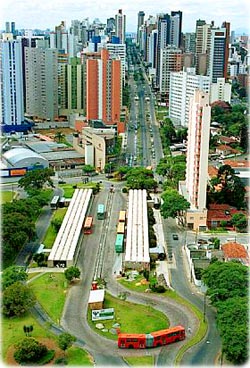
There's been a lot of talk about BRT as a cheaper alternative to subways and LRT, and there's probably no more efficient and user-friendly BRT-type system than the one in Curitiba, Brazil.

image014.gif


The "tube" stations are fare-paid zones (one has to pay by token in order to enter the tube stop), meaning that buses can quickly load/unload on all doors, and proceed along their ROW without delay, mimicking subway-type efficiency.

Here's a wiki about it: Curitiba transport

Not to mention that such more enclosed stations would help the comfort level in our cold climate.

Has this type of system been implemented or considered somewhere in the GTA? It seems to me such a thing would radically increase the efficiency of our LRT lines like Spadina and St. Clair, as well as increasingly the potential of future BRT and LRT lines.

Thoughts?
 
I agree, it would probably be quite a helpful tool for transit here, not to mention what it could do to help improve efficiency of LRT lines like Spadina.
 
The Curitiba BRT goes beyond just transit planning. The land along the BRT lines are zoned for higher density than in the surrounding areas to allow more people to live a short distance from the stops.

urbanismo-curitiba.jpg


I guess that's the stuff you get when you elect an architect/urban planner to become mayor of your city. (Jaime Lerner)
 
Such a system would require a lot of space though, so it would probably only work in the suburbs where the avenues are wide.
 
It helped that while Curitba's system was still introduced, Brazil was not yet democratic.

Sure it can work with low space - just close the street, like Curitiba did in its downtown core.
 
The "tube" stations are fare-paid zones (one has to pay by token in order to enter the tube stop), meaning that buses can quickly load/unload on all doors, and proceed along their ROW without delay, mimicking subway-type efficiency.

Thats the way that StreetCar ROW should work. When I mentioned previously about maybe the DRL being a streetcar ROW with their own stations, this is the same concept.
 
Not cost (and space) effective for the cash-strapped (and space limited) TTC.
Dreams are great, but....
 
It seems like this type of system would have 'overcrowding' written all over it.
 
It looks pretty interesting. I wonder if they've examined it (TTC) for streetcars.
 
How would this increase overcrowding if it increases capacity/efficiency?

Also, I don't get the argument about cost limitations - the TTC is currently only considering a subway extension to Vaughan, the funds for which could probably pay for lots of these types of lines. Maybe there's a reverse cost limitation - this sort of thing is too affordable?
 
With the TTC/City overwhelming apt at supporting streetcar ROWs, this would be a major efficency allowing the fare paid zone to possible allow entry to both front and back. Busier stations could possibly allow for 2 mini stops within each station, one to let people off, and the next next (a streetcar length away) within the same station, let people on.

Though I predict overall costs would go up as the stations would add significant cost to the upgraded ROW line, as well as operating costs.

The opposite side is that they are cheaper than subways, which is a mixed blessing. Cheaper to build means the city could fund it themselves, if they go line by line over a lot of years, but, the photo opps that are required to get sr level funding is basically none.
 
Also, I don't get the argument about cost limitations - the TTC is currently only considering a subway extension to Vaughan, the funds for which could probably pay for lots of these types of lines. Maybe there's a reverse cost limitation - this sort of thing is too affordable?
As stupid as it is, this is the only extension for which they only have to pay 1/6 of the total cost. If it doesn't go to Vaughan, Ontario nor York would be paying up.
 
This could work on a streetcar line like Spadina, with the current length of the platforms they could add ramps for wheelchairs which is part of the TTC's mandate of making the routes accessible. It would be better and faster than those dumb kneeling busses even for elderly passengers.
 
I still dont buy it.

Retro-fitting the Spadina line with this would cost a lot of money, and not accomplish anything. I ride the Spadina Street Car every day and it isnt busy enough to warrant neding faster boarding/deboarding. What is needed is better spacing of the streetcars along the route, and possible double length cars during peak hours.

In terms of bus tube (or streetcar tube) vs subway for new built lines - sure the bus (or streetcar) tube is cheaper to build than a subway, but it will still be seen as just a bus (or streetcar). Building the current style Streetcar in its own ROW is cheaper than a streetcar tube. Why spend more money for something that looks cool, but doesnt really accomplish much. 1 line would be built with a fare-paid station for the same price that 2 lines could be built without.

The routes I see needing faster boarding/deboarding are along King and Queen Streets. These routes are too space limited for a fare-paid loading tube.

Perhaps a better option to speed up boarding/deboarding times would be to have on-board turnstlyes at both the front and back doors. the turn styles move freely on exit, but require payment, tickets or swiping of a metrocard to board.
 
What is needed is better spacing of the streetcars along the route, and possible double length cars during peak hours.

Streetcars bunch up because of bottle necks, partly created by boarding delays. By adding a second streetcar, you are still going to have the same issue of bunching.

Perhaps a better option to speed up boarding/deboarding times would be to have on-board turnstlyes at both the front and back doors. the turn styles move freely on exit, but require payment, tickets or swiping of a metrocard to board.

Are you trying to speed up boarding? Part of the issue is the paying of fare/transfer on board, vs. having a fare paid zone. The most extreme example is the GO train, how slow would the boardings be if there was no fare paid zone (or honor system) and commutters had to pay upon entry of the train. The better amendment to your solution to see the most gains is to have an honor system. Though I would prefer streetcar stations were available.
 

Back
Top