News   GLOBAL  |  Apr 02, 2020
 11K     0 
News   GLOBAL  |  Apr 01, 2020
 43K     0 
News   GLOBAL  |  Apr 01, 2020
 6.5K     0 

Rail service returning to Iroquois Falls.

For a couple of years anyway while it serves the construction of the new Moosonee hospital. Hopefully, they can massage that into more permanent work.
 
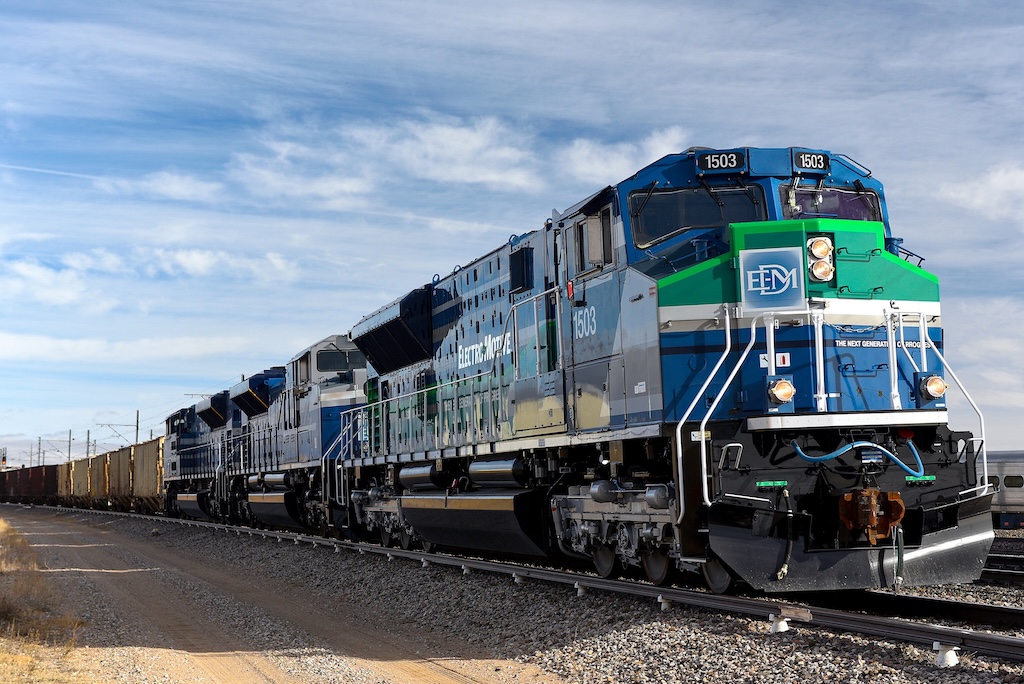
CPKC is purchasing 135 new locomotives.

Interesting that they split the order in half.
 
CPKC is purchasing 135 new locomotives.


Maybe I'm not understanding the railway lingo here but what's a "break-in-two"? Is that a breakdown? cc @smallspy @crs1026

The locomotives will feature Progress Rail’s Talos energy management system, certified by the EPA to deliver a 12.3% efficiency gain, which Progress said is industry-leading benchmark for fuel savings and reduced emissions. Powered by artificial intelligence, Talos optimizes in-train forces and has logged over four million miles without a break-in-two.
 
Maybe I'm not understanding the railway lingo here but what's a "break-in-two"? Is that a breakdown? cc @smallspy @crs1026

A break-in-two means the train has broken into two (or maybe more) sections, usually because a coupler knuckle breaks -or more dramatically, the entire drawbar pulls out of one end of a car.

This happens as the result of slack running in and out as the train accelerates, decelerates, and travels over changes in gradient. As trains get longer, the slack action is more pronounced. It's a major concern with trains now approaching three miles in length. There is a small amount of slack between each car, so when the trains are longer the cumulative slack action is greater. It's quite common for one end of the train to be speeding up while the other end is slowing down.

Primitive automatic locomotive "cruise control" systems may control speed as measured by the locomotive, but it takes considerable intelligence to be aware of the gradients and brake action and anticipate what the slack is doing throughout the train. No two consists will behave identically, because the brake and draft gear performance on different trains made up of different types and numbers of cars of varying weight will vary every time. Application of throttle and brake has to consider the slack and potential run in/out.

The point made in the article is that the newer systems are capable of more of this this. Without this intelligence, a human engineer is likely to run trains more safely than the computer - but it's a very mentally tiring task and requires constant concentration, so it's desirable to automate if it can be done reliably..

By the way, when a break in two does happen, the air brake hoses separate between the cars and this throws the train into an emergency brake application. Not only is this a mechanical breakdown that immobilises the train, but the emergency stop will create its own slack action that can jackknife or derail cars, or break additional knuckles. So, an event to be avoided at all costs.

- Paul

PS - why does the knuckle break? It's designed as the weakest link in the train's draft gear. Better a broken knuckle than damage to the draft gear or main spines of the cars themselves. Even so, a knuckle weighs up to 100 lbs, and getting a spare from the locomotive (they carry spares) to the broken coupler, and hoisting it into place, in the middle of nowhere, is a slow and quite unpleasant task - especially in rain or snow.

 
Last edited:
Interesting that they split the order in half.

A commentator in the comment section for the article appears to explain CPKC's reasoning;
CPKC is playing it smart. For the regular stuff and the auto rack trains power of choice is a Wabtech Dash 9 E Series They are fast and they are reliable perfect for pulling a container train over 12 mountain passes or through the Mexican desert. For the heavy stuff which is the coal, the ore trains, the grain, or the soda ash You need something heavier and with a lot more tractive power that is where the EMD SD70 comes in. Those engines are used to get the heavy stuff over the hill. They know what they are doing because they move a lot of heavy stuff.

Amusing how the EMD SD70's are typically used for heavy duty hauling, and yet you got Metra over in Chicago utilizing them for commuter rail. 😆
 
Interesting that they split the order in half.

Opinions vary on which locos perform better and in what service. It's interesting to note where certain models actually end up.

The other rationale is simple - overdependence on a single supplier is fatal. The second supplier needs enough business to stay in operation. So balancing needs for certain service types and keeping suppliers healthy both factor on the decision.

And, of course, there is pricing. For both purchase and maintenance.

- Paul
 
A break-in-two means the train has broken into two (or maybe more) sections, usually because a coupler knuckle breaks -or more dramatically, the entire drawbar pulls out of one end of a car.

This happens as the result of slack running in and out as the train accelerates, decelerates, and travels over changes in gradient. As trains get longer, the slack action is more pronounced. It's a major concern with trains now approaching three miles in length. There is a small amount of slack between each car, so when the trains are longer the cumulative slack action is greater. It's quite common for one end of the train to be speeding up while the other end is slowing down.

Primitive automatic locomotive "cruise control" systems may control speed as measured by the locomotive, but it takes considerable intelligence to be aware of the gradients and brake action and anticipate what the slack is doing throughout the train. No two consists will behave identically, because the brake and draft gear performance on different trains made up of different types and numbers of cars of varying weight will vary every time. Application of throttle and brake has to consider the slack and potential run in/out.

The point made in the article is that the newer systems are capable of more of this this. Without this intelligence, a human engineer is likely to run trains more safely than the computer - but it's a very mentally tiring task and requires constant concentration, so it's desirable to automate if it can be done reliably..

By the way, when a break in two does happen, the air brake hoses separate between the cars and this throws the train into an emergency brake application. Not only is this a mechanical breakdown that immobilises the train, but the emergency stop will create its own slack action that can jackknife or derail cars, or break additional knuckles. So, an event to be avoided at all costs.

- Paul

PS - why does the knuckle break? It's designed as the weakest link in the train's draft gear. Better a broken knuckle than damage to the draft gear or main spines of the cars themselves. Even so, a knuckle weighs up to 100 lbs, and getting a spare from the locomotive (they carry spares) to the broken coupler, and hoisting it into place, in the middle of nowhere, is a slow and quite unpleasant task - especially in rain or snow.
As a bit of an addendum to this....

Modern locos can develop in excess of 150,000 pounds of drawbar pull on the first knuckle - each.

Type E knuckles are rated for a minimum of 350k pounds of force, type F for 400k pounds of force. (And of course they can sometimes handle more than this, but this is the minimum that they have to be rated for.)

So looking at the numbers you can see that 3 modern locos located at the head end of a train can easily develop enough force to rip a train in half. This is a large reason why DPUs have become so prevalent - longer trains means more weight. The locos have kept up with the size trend, but the couplers have not.

And one of the advantages of DPUs is a reduction in slack action because you now have a loco in the middle of the train adding its propulsive and braking forces to the whole. Slack doesn't pull out like it used to with all of the locos at the front, and it doesn't bunch in under (dynamic) braking, either.

Dan
 
DPU trains (remotes in middle & tail) are Ferrari's compared to a conventional train (all locomotives on head end). As engineer, it's important to know the make up of your train, and when and where to manage your slack carefully. There are certain well known locations where dips in the sub are located. You want to approach those below track speed and accelerate so you stretch your train out, pulling out the slack and pull it through the dip. You can bet your conductor will be giving you the eyes if he feels rough handling and will start putting on his outdoor gear (lol).

You need to think miles ahead, especially for temporary slow orders, which can appear anywhere and are identified on train docs. The last thing you want to do is forget about one and have to go heavy on the brake. All control inputs need to gradual to avoid excessive force. It might sound easy but factor in different train make ups, power configurations, weather conditions, mechanical issues, sleep patterns, radio clutter, poor planning and the job gets intense.
 

Back
Top