News   GLOBAL  |  Apr 02, 2020
 10K     0 
News   GLOBAL  |  Apr 01, 2020
 42K     0 
News   GLOBAL  |  Apr 01, 2020
 6.3K     0 

The Liberal reign is responsible for most of the initiatives we are seeing worked on today. I've been happy mostly with Doug Ford keeping money flowing to transit, and with his Covid response, but it is too early on most items to give him a prize because he actually reset the clock on projects that had made significant progress on design and assessment. If he keeps things on track I will have eaten my words on what I expected him to do after Rob Ford managed to cancel more and promise more than he actually delivered (which was pretty much nothing). For me Ford's continued transit spending (crossing fingers it keeps going) and Covid responses are the big surprises and pluses. The other things he was doing before the Covid distraction were a little more problematic.
 
The OPC has asked its members in a survey what their priorities are. I worry that transit and its funding won’t be a focus. At this point I’m just hoping that whatever government is in place keeps GO RER, the OL, EWLRT and the SSE going. And of course, the elephant in the room: the giant hole in operational funding caused by the collapse in TTC ridership :(
 
We needn't go over every item.

But suffice to say, I find your take here .........to be a bit off.

I may have been overly kind to Ford, in the sense that I am giving him credit for not killing Liberal-planned initiatives as if that made them a Conservative action item. Merely letting work proceed is less remarkable than getting something off the ground, I agree. Similarly, tearing the cover off the RER plan and rebranding as GO Expansion doesn’t make it a new plan.

On Ford’s election day, I would have bet money that he was about to cancel all three LRT projects - notwithstanding that Finch already had contracts signed. There were other projects especially RER that were procurement ready that the Ford gov’t has also approved and are now in progress.

However, I challenge you to identify an item on my Liberal list of “promised, celebrated as a victory but essentially vapourware” projects that didn’t sit unactioned exactly as I described.

I cast my vote based on who signs the cheques, not on who wrote the study. The Liberals were performance artists running a carney show.... lots of pizzaz, but only occasional efforts to get shovels moving. For a tax-cutting streetcar-hating guy in a huge black SUV, Ford is the one who made the money flow. I think his government is toxic overall, but I would never have predicted so much action (and so many less gratuitous photo ops) on transit.

Underpromise, overdeliver works...

- Paul
 
During Ford’s tenure, the Cons have
- Confirmed and begun execution of the Stoney Creek GO extension This still isn't under construction as of last week when I drove by, and has been severely delayed as the PCs tried to find a private developer to build it for them before giving up and deciding to build it themselves.
- Restarted and completed the West Harbour track signal and station project This never really stopped between governments from my understanding.
- Confirmed and initiated extension to Bowmanville The Liberals initiated this and the PCs delayed it for years to search for a cheaper option
- Confirmed and initiated the rest of the GTS project including the 409 tunnel The winning bidder was selected in 2017, well before the PCs took power.
- Confirmed and begun construction of the Finch and Hurontario LRT lines This is true. These projects continued more or less on track, but I wouldn't say the PCs did anything different here than the liberals would have.
- Confirmed and continued double tracking of the Stouffville line to Unionville This contract was issued and construction began prior to the election.
- Funded and initiated track improvements Georgetown- Kitchener I believe this one is correct, yes.
- Confirmed and initiated the Davenport Diamond flyover and some double tracking on the Barrie line Yes.
- Confirmed and continued signal and track improvements in the USRC Yes, though the signalling work is from the liberal era. The new south platform which is going to start soon is a PC project though.
See notes in bold. most of these projects aren't really attributable to the PCs.

The PCs have actually delayed many projects for years as they paused most of them and reviewed them for ways to cut costs.

That said, the list of legitimate PC construction starts will be much bigger by the time the next election rolls around. A few of their subway projects will be underway as well as many more GO projects.
 
That said, the list of legitimate PC construction starts will be much bigger by the time the next election rolls around. A few of their subway projects will be underway as well as many more GO projects.
Even I have to admit, that if they pull it off, the big 4 Toronto transit projects is an impressive achievement, even if I disagree with some of the surface vs underground options.

The phasing itself seems brilliant. Prioritizing getting TBMs in the ground to make them relatively cancel-proof. Starting to dig Ontario Line at Exhibition, but putting the yard at the far north end makes it difficult to shorten once they start digging. And doing the most obviously needed and least controversial piece (Yonge North) last make it more likely that all 4 get built.
 

The myth of Hitler's role in building the autobahn


Many people still believe that the Nazis invented the famous German autobahn, and that the construction work helped eradicate mass unemployment in Germany. But this is a historical fiction.

From link.

16126852_403.jpg

4206036_404.jpg

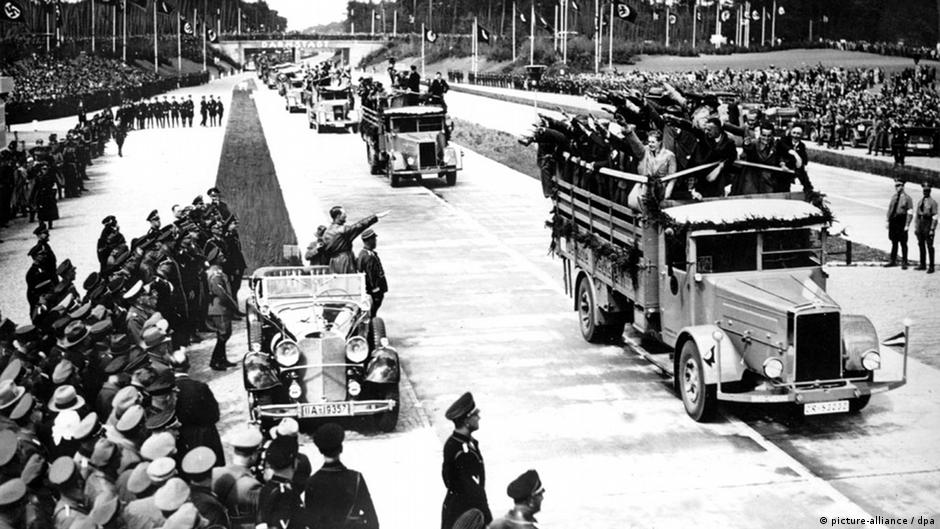
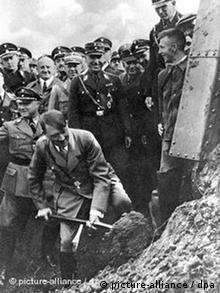
Adolf Hitler inaugurates work on a stretch of road in a carefully staged propaganda shot

Adolf Hitler takes a spade and sticks it firmly into a heap of sand. One of the soldiers standing around him photographs the Führer, documenting the start of work on another stretch of the famous German autobahn. The image, typical of its time, was circulated nationwide, especially in the regions where little stretches of the "Reichsautobahn" were being built.

The sole aim of all this carefully manufactured propaganda was to make sure that citizens throughout the Reich knew that the building work was going on. Whenever construction started on a new section the event was always meticulously documented and publicized, and big inaugural celebrations marked the opening of every stretch of road.

Hitler makes the autobahn his own

This was quite a turnaround. Only a few years earlier, many members of the National Socialist German Workers' Party (NSDAP) - the Nazis - collaborated with the German Communist Party in sabotaging the construction of ‘car-only roads', as these concrete runways were initially called. The Nazis' argument was that the roads would "only benefit rich aristocrats and Jewish big capitalists and their interests." The Nazis stayed well clear of the political negotiations on financing the motorways. It was only when Adolf Hitler came to power in 1933 that the Nazis realized they could use the autobahn for their own ends.
Until 1929, the economic crisis and the lack of capital meant that it was impossible to build motorways in Germany. The country was struggling with mass unemployment, hyper-inflation and the payment of reparations for the First World War. It was the mayor of Cologne, Konrad Adenauer, who managed to finance and construct the first crossroads-free motorway in 1932 - now the A555 between Cologne and Bonn. The road was 20 kilometers long, and the speed limit was 120 kilometers per hour, though at the time most cars could only manage 60. The Cologne region was said to have the highest volume of traffic in the country. Shortly afterwards, however, the Nazis came to power, and the motorway had only been open a few months when it was downgraded to the status of "country road". The Nazis decided they wanted to take the credit for building the first autobahn.

Yet as early as 1909 a group of automobile enthusiasts, consisting of wealthy industrialists and influential citizens, had already formed a pressure group for the building of a road that would enable cars to drive without interruption - unimpeded by dust or mud, or by horse carriages or pedestrians blocking the way. Work began in 1913 on the so-called "Automobile Traffic and Practice Road" on the outskirts of Berlin. The intention was to construct a 17-kilometer stretch, but in the end the city could only afford to build 10 kilometers. Construction was interrupted by the First World War, and after 1921 the road was mainly used for testing fast sports cars and for motor sports races.
An association was founded in 1926 to push for a transnational road linking Hamburg with Basel in Switzerland via Frankfurt am Main. The Nazis initially rejected the so-called "HaFraBa" initiative. However, after Hitler came to power they appropriated elements of the plan, and the name of the association was changed to the "Association for the Preparation of Reichsautobahns."

Increasing people's mobility

Historians now say that Adolf Hitler simply jumped on the bandwagon of increasing mobility that was already gathering momentum across the world. He certainly recognized the potential for securing his own power and seducing an entire nation with what looked at first like a crazy enterprise. At the time, it seemed clear that very few Germans would be able to afford their own car in order to drive on the new motorways. So Nazi propaganda promised the people full mobility. The idea was to enable everybody to travel - not just the rich. This was how the idea of the Volkswagen - the "people's car" - was born. Hitler also made the German national rail company introduce omnibus transport on the first sections of the new autobahns.
The goal was to complete some 1000 kilometers of autobahn every year. These were the Führer's orders. In 1934, he spoke of the "work battle" that lay ahead, and promised that it would reduce the high number of unemployed. Autobahn construction works were supposed to create at least 600,000 jobs. In fact, even when construction was at its height there were never more than 120,000 people at work. The construction itself was marked by sickness, death, hunger and misery. There were strikes, and the strike leaders were sent to concentration camps. The public, of course, were told none of this.

The autobahn myth

Over the years, an increasing number of Germans found jobs in the booming arms industry. That was what reduced unemployment - not the autobahn construction. During the war years, more and more prisoners and Jewish forced laborers were sent to work in autobahn construction because the regular workers were fighting in the war. By 1941, a mere 3,800 kilometers of autobahn had been completed - half the projected amount. Between 1941 and 1942, construction almost ground to a halt. From 1943 onwards, the autobahns were opened up to cyclists because of the low volume of vehicle traffic..

Yet the Nazis continued to circulate films and photos of workers on autobahn building sites, long after work itself had stopped. This is why the image of colonies of autobahn workersis ingrained in the memories of an entire generation. The Nazis were successful in propagating their image as creators of the German autobahn: it's a myth that often still requires debunking today.
 
Thanks, but I don't think we have any clear info on an opening date just yet. Metrolinx is being tight lipped about when in 2022 it will open. That article only says that the contractor was trying to push back on work deadlines for Eglinton station while opening the rest of the line in Q1 2022. In response, Metrolinx has publicly said that they expect the line to be opened only with Eglinton completed (which implies the opening of the whole line could be delayed). As far as the TTC knows (or at least what we know publicly), is that the opening date is scheduled for April 2022.

View attachment 302074
Black Creek LRT? That's an interesting one.
 
Black Creek LRT? That's an interesting one.
It's actually Black Creek LRT Division which I guess is what the TTC is calling the ESMF. So guess the question now for us transit nerds is, is it Black Creek Yard or Black Creek Carhouse.
 
It's actually Black Creek LRT Division which I guess is what the TTC is calling the ESMF. So guess the question now for us transit nerds is, is it Black Creek Yard or Black Creek Carhouse.

Black Creek Barns, please!

- Paul
 
Toronto transit users will be looking for the white and red signs of the TTC. Expect "lost" users.

existingstoppoles.jpg

From link.
Strange. Why not stick with red and white?

As someone who has lived in cities other than Toronto (outside the GTHA), it still boggles my mind that anyone thinks sticking the the TTC standard for design is a good idea - these poles are indeed quite standard and they really don't hold up against best practices in other cities - they look bad and give you very little information.
 
As someone who has lived in cities other than Toronto (outside the GTHA), it still boggles my mind that anyone thinks sticking the the TTC standard for design is a good idea - these poles are indeed quite standard and they really don't hold up against best practices in other cities - they look bad and give you very little information.
Which is why none of them are used any more. I'm not sure what you are suggesting.
 
The current TTC poles are only slightly better. Now you know the routes, full or limited service and the stop ID to text for the next vehicle but without a data plan on your phone, you'll have no idea of the direction or destination of the routes. Without any posted schedules either, now they expect everyone to be in the digital age.
 
The current TTC poles are only slightly better. Now you know the routes, full or limited service and the stop ID to text for the next vehicle but without a data plan on your phone, you'll have no idea of the direction or destination of the routes. Without any posted schedules either, now they expect everyone to be in the digital age.
Other cities are just as bad and many of the signs just look like a no-parking sign as they are put up on a non-discript post mounted fairly high up and hard to read from a distance or spot amongst other signs in the area.

Unfortunately for the people who don't have data plans or smartphones that's the way the world, in general, is moving it's just like how less and less businesses want to take cash anymore.
 

Back
Top