News   GLOBAL  |  Apr 02, 2020
 10K     0 
News   GLOBAL  |  Apr 01, 2020
 42K     0 
News   GLOBAL  |  Apr 01, 2020
 6.1K     0 

Here’s about 10 mins of Line 5 testing from this past week I stumbled upon on YouTube. Trains seem to be moving at a decent clip in the Golden Mile.

Noticed at the 5:15 mark, at the traffic signals, NO TRANSIT PRIORITY. OK, the trains did not have 200 to 400 people onboard, but still if they were "testing", they should assume there were people onboard. The single-occupant autos turning left went ahead of the waiting light rail trains. Just like on the streetcar right-of-ways, no real transit priority. The single-occupant SUV's in Toronto get priority over the 200+ people onboard streetcars and light rail vehicles.
 
Noticed at the 5:15 mark, at the traffic signals, NO TRANSIT PRIORITY. OK, the trains did not have 200 to 400 people onboard, but still if they were "testing", they should assume there were people onboard. The single-occupant autos turning left went ahead of the waiting light rail trains.
I have no doubt that it's been cocked up. But I don't know if they've turned everything on yet. Also, in this case, had there been passengers aboard, the first train would have gotten to the platform earlier - but the second train in the opposite direction would have missed the light, because it was still at ths stop. Also a function of where the trains are at relative to schedule, and what lights they are going to hit next.

Optimizing this stuff - even with a huge priority for rail - isn't simple.
 
Noticed at the 5:15 mark, at the traffic signals, NO TRANSIT PRIORITY. OK, the trains did not have 200 to 400 people onboard, but still if they were "testing", they should assume there were people onboard. The single-occupant autos turning left went ahead of the waiting light rail trains. Just like on the streetcar right-of-ways, no real transit priority. The single-occupant SUV's in Toronto get priority over the 200+ people onboard streetcars and light rail vehicles.


Maybe that is the "software" problem? They can't give light rail vehicles the priority because they don't know how to code it with a different priority. Can't override or change the code, so they're giving up. No "real" transit priority in Toronto.
 
Maybe that is the "software" problem? They can't give light rail vehicles the priority because they don't know how to code it with a different priority. Can't override or change the code, so they're giving up. No "real" transit priority in Toronto.
Do you have any proof?
 
Noticed at the 5:15 mark, at the traffic signals, NO TRANSIT PRIORITY. OK, the trains did not have 200 to 400 people onboard, but still if they were "testing", they should assume there were people onboard. The single-occupant autos turning left went ahead of the waiting light rail trains. Just like on the streetcar right-of-ways, no real transit priority. The single-occupant SUV's in Toronto get priority over the 200+ people onboard streetcars and light rail vehicles.
This isn't a conspiracy, the TSP only kicks in if the trains are behind schedule. In other words, there is a certain "acceptable" amount of waiting at red lights built into the schedule.
 
Noticed at the 5:15 mark, at the traffic signals, NO TRANSIT PRIORITY. OK, the trains did not have 200 to 400 people onboard, but still if they were "testing", they should assume there were people onboard. The single-occupant autos turning left went ahead of the waiting light rail trains. Just like on the streetcar right-of-ways, no real transit priority. The single-occupant SUV's in Toronto get priority over the 200+ people onboard streetcars and light rail vehicles.
I'm just glad they got the clearance to go line speed now so people can stop claiming they're going to be just as slow as the legacy streetcar network.
 
Toronto Star flagged this concern as well citing concerns over route management and lack of transit signal priority using the 512 St. Clair as an example.

Eglinton Crosstown LRT finally has an opening date — but the TTC’s service on the line may fall short for these two reasons​


"Even on other routes where streetcars have been given some dedicated road space, like King Street, Spadina Avenue and Queens Quay, service speed and reliability have generally been getting worse, not better.

There are plenty of reasons for this, but let’s focus on two of the big ones: bad route management and a near-total absence of transit signal priority at intersections.
Let’s start with the route management. According to the metrics reported monthly by interim CEO Greg Percy, TTC surface vehicles are considered “on-time” if they enter service anywhere between one minute early and five minutes late. As a result, GPS maps will often show streetcars and buses roving the city in packs as if there’s strength in numbers, but because the vehicles were technically on-time when they started, little is done to fix it.

Maybe that wouldn’t matter as much if transit vehicles were guaranteed a quick green light at intersections, so they could travel fast. But this kind of technology — dubbed transit signal priority — has long been promised but never really delivered at Toronto city hall, despite some big talk. City hall’s transportation department seems allergic to really giving transit vehicles priority over single occupant vehicles, so real priority has been very limited.
Together, these two failures — poor route management and bad or non-existent transit priority — could easily spell disaster for the Eglinton LRT once it starts service. I hope I’m wrong. Especially because better management and signal priority on the surface section of the Eglinton line would likely translate to better management of other surface routes."

 
Toronto Star flagged this concern as well citing concerns over route management and lack of transit signal priority using the 512 St. Clair as an example.

Eglinton Crosstown LRT finally has an opening date — but the TTC’s service on the line may fall short for these two reasons​


"Even on other routes where streetcars have been given some dedicated road space, like King Street, Spadina Avenue and Queens Quay, service speed and reliability have generally been getting worse, not better.

There are plenty of reasons for this, but let’s focus on two of the big ones: bad route management and a near-total absence of transit signal priority at intersections.
Let’s start with the route management. According to the metrics reported monthly by interim CEO Greg Percy, TTC surface vehicles are considered “on-time” if they enter service anywhere between one minute early and five minutes late. As a result, GPS maps will often show streetcars and buses roving the city in packs as if there’s strength in numbers, but because the vehicles were technically on-time when they started, little is done to fix it.

Maybe that wouldn’t matter as much if transit vehicles were guaranteed a quick green light at intersections, so they could travel fast. But this kind of technology — dubbed transit signal priority — has long been promised but never really delivered at Toronto city hall, despite some big talk. City hall’s transportation department seems allergic to really giving transit vehicles priority over single occupant vehicles, so real priority has been very limited.
Together, these two failures — poor route management and bad or non-existent transit priority — could easily spell disaster for the Eglinton LRT once it starts service. I hope I’m wrong. Especially because better management and signal priority on the surface section of the Eglinton line would likely translate to better management of other surface routes."
Toronto's Transportation Services refuses or is unable to ask, beg, request, or teach MTO (Ontario government) to update their traffic sign regulations. Ontario refuses to even look to Europe to see how to improve traffic regulations at all.

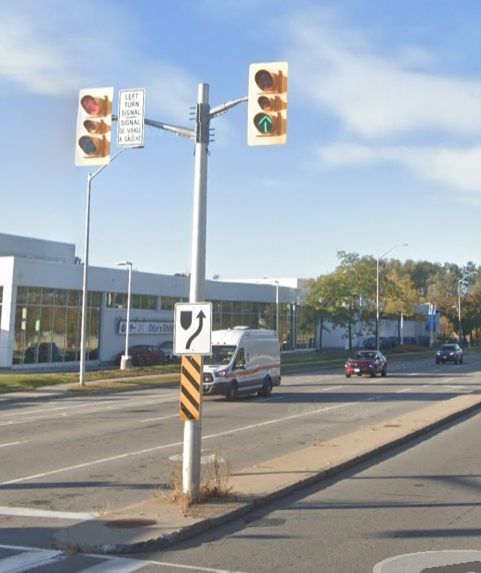
At the Eglinton Avenue West and Weston Road intersection, next to the Mount Dennis Station, they added "left turn" signals. Along with "signage clutter". "Signage clutter" that other jurisdiction go without. Why? Just look...

The left turn green arrows...
1742921350328.png


The left turn yellow arrows. Oops, I mean the left turn yellow signal...
1742921643174.png


And the left turn red arrows. Oops, I mean the left turn red signal, since "red arrows" are illegal in Ontario...
1742921807984.png


Wouldn't it be better if we used red turn signals? Maybe black arrows on a red background for the colour blind folks, to tell the difference between the other colour arrows?
1742922062480.png

Other jurisdictions use the red arrow WITHOUT signage clutter.
 
I thought maybe those "Left Turn" signs are a provincial rule thing, as they started appearing in Ottawa too in recent years, although we never used to have them before with protected lefts. But really they are a rare case of signage with writing, most signs are iconographic, and they are just informational, not regulatory.


I think transit signals though might be more of an issue. I'm not sure why the crosstown doesn't use the white transit signals used in other cities to avoid confusion with car drivers. I can see potential collisions in the future due to drivers misinterpreting a signal.


Screenshot-2025-03-25-at-4-11-09-PM.png
 
I think transit signals though might be more of an issue. I'm not sure why the crosstown doesn't use the white transit signals used in other cities to avoid confusion with car drivers. I can see potential collisions in the future due to drivers misinterpreting a signal.

I'm hoping it's something they'll consider in the future, because the transit signals are already in use along the route (kinda). Here's Eglinton and Duplex looking west, just north of the bus terminal entrance.

1000076167.jpg
1000076168.jpg


The top light is a transit signal installed late last year; it lights up when buses are waiting in the left turn lane.
 

Back
Top