News   GLOBAL  |  Apr 02, 2020
 11K     0 
News   GLOBAL  |  Apr 01, 2020
 43K     0 
News   GLOBAL  |  Apr 01, 2020
 6.7K     0 
To introduce a variable to the conversation.

- Has anyone heard anything about the new trainsets that they purchased from Siemens? Are they still on the same timeline for deployment or has COVID caused development and deployment delays?

- From a hypothetical perspective. Do you guys feel that there would be a market for a regular route from London to Kingston? Essentially, the same business model that GO transit ran 5-8 years ago where they do a couple of runs to Toronto in the morning/afternoons with business traffic. Continue on to Kingston and turn around to Toronto to open up both communities along the route to more viable housing markets for Toronto businesses and provide extra commuter opportunities with fewer trainsets?

i.e London: Toronto: Kingston:
04:30 06:50 09:20
05:30 07:50 10:20
06:30 08:50 11:20

Kingston: Toronto: London:
04:40 07:10 09:30
05:40 08:10 10:30
06:40 09:10 11:30

Similar start times starting in Kingston heading to London in the mornings with 3 trains each direction at the end of the day as well.

London: Toronto: London:
13:30 15:50 18:10
14:30 16:50 19:10
15:30 17:50 20:10

Running a couple trains from Toronto to London only since Kingston has a number of trains already servicing it in the afternoons.

During VIA's recent public meeting, they did mention the fleet replacement (Siemens train set), and that they aren't aware of any delays and that there is no impact on the fleet replacement program due to Covid-19.
 
- From a hypothetical perspective. Do you guys feel that there would be a market for a regular route from London to Kingston?

Only in a situation where the network is developed enough to allow for through service at Union. Otherwise, it's going to be a nightmare for guys like @Urban Sky with scheduling and all the delays.
 
Once Union's platform configuration is reworked, one would hope there could be across-the-platform transfers at Union that would remove the necessity to go downstairs. But as @kEiThZ notes, there are risks in through operation that would need a lot of work to ensure reliable timekeeping.

- Paul
 
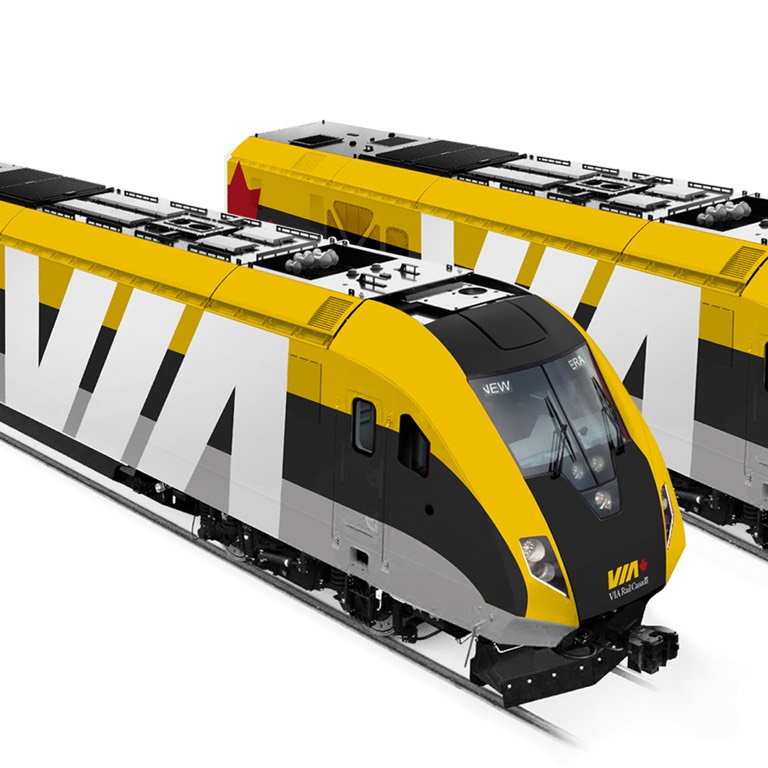
On a different note, everytime I see a picture of Brightline's trains, I kinda wish VIA bought the streamlined version, just for the PR value....
 
Only in a situation where the network is developed enough to allow for through service at Union. Otherwise, it's going to be a nightmare for guys like @Urban Sky with scheduling and all the delays.

The other big issue is VIA is limited by CN as to how many trains it can run along the lakeshore. While there is enough demand for VIA to run one train a day each way with Kingston as a terminus, the vast majority of the trains continue on to either Ottawa or Montreal. The only ways to have trains from Kingston to London would be to either reduce the number of trains continuing to/from either Ottawa or Montreal. or have trains to/from Ottawa or Montreal continue on to/from London. The consequences of the former is obvious and for the latter, because of the reliability issues VIA has on shared tracks, extending the routes would compound those issues.

This could be much easier after HFR, as it would be much easier to have more trains terminate in Kingston.
 
On a different note, everytime I see a picture of Brightline's trains, I kinda wish VIA bought the streamlined version, just for the PR value....

We will have to see what the real locomotives look like but from the sketches, the only significant differences I see is that VIA has a snowplow and the coupler is exposed (where as Brightline has a cowling over it). The snowplow is an obvious requirement for VIA and since VIA does operate some split services, having a cowling could be problematic and it would likely be kept off all the time.

25311129_1765348203771041_9105514118714188386_o.jpg

GoBrightline/Facebook

01_benefits.jpg

VIA Rail / Website
 
Whenever I find myself traveling between Montreal and Kitchener (by train the whole way, if GO is running a train at an agreeable time), I dream of how much GO expansion and HFR will improve that trip. It essentially takes up a full day's energy to do that trip today. HFR with a painless transfer could have you make the trip over an evening (albeit a long one).
This may be a pipe dream, but with the occasional through train to Saint-Lambert...
 
The other big issue is VIA is limited by CN as to how many trains it can run along the lakeshore. While there is enough demand for VIA to run one train a day each way with Kingston as a terminus, the vast majority of the trains continue on to either Ottawa or Montreal. The only ways to have trains from Kingston to London would be to either reduce the number of trains continuing to/from either Ottawa or Montreal. or have trains to/from Ottawa or Montreal continue on to/from London. The consequences of the former is obvious and for the latter, because of the reliability issues VIA has on shared tracks, extending the routes would compound those issues.

This could be much easier after HFR, as it would be much easier to have more trains terminate in Kingston.

There is massive demand Montreal-Ottawa-Toronto.
 
We will have to see what the real locomotives look like but from the sketches, the only significant differences I see is that VIA has a snowplow and the coupler is exposed (where as Brightline has a cowling over it). The snowplow is an obvious requirement for VIA and since VIA does operate some split services, having a cowling could be problematic and it would likely be kept off all the time.

25311129_1765348203771041_9105514118714188386_o.jpg

GoBrightline/Facebook

01_benefits.jpg

VIA Rail / Website
Honestly though I think our version looks better as the brightline head looks like it melted
 
Last edited:
We will have to see what the real locomotives look like but from the sketches, the only significant differences I see is that VIA has a snowplow and the coupler is exposed (where as Brightline has a cowling over it). The snowplow is an obvious requirement for VIA and since VIA does operate some split services, having a cowling could be problematic and it would likely be kept off all the time.

25311129_1765348203771041_9105514118714188386_o.jpg

GoBrightline/Facebook

01_benefits.jpg

VIA Rail / Website

Quick question on level boarding with regards to the new train sets. In Montreal and Quebec City there'd be level boarding just like today, but what about Union and other stations? Are there plans to raise platforms at Union or other corridor stations to accommodate the new fleet? I feel like that alone (raised platform) would be "transformative" in terms of smoothing out the customer experience + a whole train set = PR win.
 
Whenever I find myself traveling between Montreal and Kitchener (by train the whole way, if GO is running a train at an agreeable time), I dream of how much GO expansion and HFR will improve that trip. It essentially takes up a full day's energy to do that trip today. HFR with a painless transfer could have you make the trip over an evening (albeit a long one).
This may be a pipe dream, but with the occasional through train to Saint-Lambert...

Ideally, the second phase of HFR is a through service at Union, to Pearson-Kitchener-London, the proposed Ontario High Speed Rail route. They would enable travel from Kitchener to Montreal in 6 hrs with no transfers.
 
Quick question on level boarding with regards to the new train sets. In Montreal and Quebec City there'd be level boarding just like today, but what about Union and other stations? Are there plans to raise platforms at Union or other corridor stations to accommodate the new fleet? I feel like that alone (raised platform) would be "transformative" in terms of smoothing out the customer experience + a whole train set = PR win.

VIA has been raising the platforms in their Ottawa station. They are doing it in 3 stages with the first stage complete and the platforms for the track closest to the station already raised.
 
Ideally, the second phase of HFR is a through service at Union, to Pearson-Kitchener-London, the proposed Ontario High Speed Rail route. They would enable travel from Kitchener to Montreal in 6 hrs with no transfers.

I was really hoping VIA would snag the GEXR line from Kitchener to London when it went up for sale, but I think CN got it. Would have made converting it to HFR possible (a large section of Kitchener to Union is Metrolinx owned, which, while not dedicated VIA track, they are much more accommodating to VIA, since other passenger rail traffic is less of an issue than freight, it can co-exist better.

That being said the line from Kitchener to London is in terrible shape, it would need a complete retracking.
 
Quick question on level boarding with regards to the new train sets. In Montreal and Quebec City there'd be level boarding just like today, but what about Union and other stations? Are there plans to raise platforms at Union or other corridor stations to accommodate the new fleet? I feel like that alone (raised platform) would be "transformative" in terms of smoothing out the customer experience + a whole train set = PR win.

At many intermediate stations, the presence of freight creates a challenge, because they require a larger clearance envelope than the platform would allow. But thankfully most of VIA's busiest stations are on tracks not traversed by freight trains, including:
- Québec du Palais (already high-platform)
- Montréal Centrale (already high-platform)
- Ottawa (already partly high-platform)
- Toronto Union
- London
- Windsor

At the rest of the stations, high-platforms would necessitate some way of moving freight trains away from the platform edge, typically a gantlet track or siding. In some cases this would be fairly straightforward, but in others it could be challenging due space constraints and/or to the need to move infrastructure such bridges and staircases (e.g. to/from an existing platform).

In a VIA Q&A a while ago their response to this question was that they'd really like to raise some more platforms like they did recently in Ottawa, but that they currently didn't have any funding to do so.

I was really hoping VIA would snag the GEXR line from Kitchener to London when it went up for sale, but I think CN got it. Would have made converting it to HFR possible (a large section of Kitchener to Union is Metrolinx owned, which, while not dedicated VIA track, they are much more accommodating to VIA, since other passenger rail traffic is less of an issue than freight, it can co-exist better.

That being said the line from Kitchener to London is in terrible shape, it would need a complete retracking.

Yeah I too was disappointed that VIA didn't end up buying it, but in retrospect they made the right decision from their perspective. With the Missing Link now cancelled, it's really uncertain how many trains VIA will be able to run between Kitchener and Toronto, and there's not enough demand to justify standalone London-Kitchener service should CN be disagreeable with their segment through Brampton. It's hard to justify the big expenditure of buying and upgrading a railway without knowing how many trains we'd be allowed to run on it.

Now what I'm hoping for is that once hourly regional GO service is running to Kitchener, we start looking to extend that hourly service westward, purchasing and upgrading the line as we go. In this scenario, CN is less of an issue because they've already agreed to hourly service through their segment. It makes no difference to them whether the train terminates in Kitchener, Stratford or London.

London may sound like a ridiculously far-flung destination for GO service, but with the railways upgraded to typical Ontarian mainline standards (80-100mph / 130-160 km/h), a GO train would be able to do the Toronto-London trip in about 2h20-2h30 with a regional stopping pattern. And anyway the point would not be to serve Toronto-London journeys (obviously VIA would be a faster and more comfortable alternative), but rather the intermediate journeys like London-Kitchener and Stratford-Toronto.
 
Last edited:
Okay, here is finally Part 3 of my "modelling travel times for the Havelock alignment" exercise (refer back to Post #7,315 for Part 2):


4. Model Solving
4.1 Ignoring s-curves


There is actually not that much left to say, apart from that the train movement is modelled in a way where the train stays to the applicable speed limits (and within its dynamic capabilities), which results in a speed profile similar to this one:

1601858723060.png

Quoted from: my Master Thesis (p. 76)


Just like in my Master Thesis, my modelling will be based on the following parameters:

1601858741740.png


Design speed (as quoted numerous times by VIA) and acceleration/deceleration capabilities (discussed in Part 1 of this series) are relatively straight forward and the recovery margins are taken straight from UIC recommendations (note that I had to change the distance-based recovery margin from 60 to 90 seconds compared to my Master Thesis, as VIA's future fleet will still be locomotive-hauled, but a "percentage running time supplement" of 5% still applies, as a 5-car trainset should fall into the 301-500 tons weight category):

1601858751428.png

Quoted from: my Master Thesis (p. 34)


But why would the train length matter? Well, unlike speed limits for cars (or at least how motorists like to interpret them), a more permissive speed limit only takes effect after the whole train has passed the point where the higher speed limit applies. Therefore, the train is only allowed to accelerate once the last axle has left the zone in which the last (more restrictive) speed limit remained valid. I kept the value of 680 feet I used in my Master Thesis, as it represents 3 block lengths, which equals 241 meters (0.15 miles), thus enough to fit a 7-car train hauled by a locomotive (like the "Extra long trainset" representing the longest-possible trainset configuration of VIA's future fleet) in its entirety.


4.2 Respecting s-curves

Even though I never rode a motorcycle, I've been told that taking a right curve followed immediately by a left curve gives you a good chance of finding yourself lying with your motorcycle on the side of the road and it is not much different with trains, as the superelevation applied to the track has the same function of a motorcyclist tilting his bike into a curve and it therefore takes a moment to transition from one curve in one direction into a curve in the opposing direction. The same issue arose to me when playing the game "Rollercoaster Tycoon 2" and where the virtual visitors of my park would refuse to board attractions which would expose them to too extreme lateral forces.

However, first we have to talk about transition curves: as we have seen in previous posts, the equilibrium superelevation is dependent on basically two variables: the radius of the curve and the banking of the track. This necessitates that in order for the outer (i.e. the "superelevated") rail to gently reach the same vertical level as the inner rail, the radius has to increase just as gently so that the track becomes straight again at exactly the point where the outer rail reaches the vertical level of the inner rail. Unfortunately, I'm no railway engineer and I never took any courses talking about the science of track alignments, but I found this highly interesting presentation which provides formulae for the easement (i.e. transition curve) length for both, the actual superelevation applied to the track (E_a) and the underbalance (E_u), of which of course the greater value applies as minimum value for a given curve:
1601863914308.png

Quoted from: Lautala et Dick (2010, Slide 9)


Additionally, the same source describes the need a tangent (i.e. straight) track, with a minimum length of the greater of the distance covered in 3 seconds at the maximum applicable speed or (for very low speeds) 100 ft:
1601864284176.png

Quoted from: Lautala et Dick (2010, Slide 11)


I would have liked to present the slides here, but got discouraged by the disclaimer on the final slide of the presentation. Nevertheless, I've linked the source and the presentation is easily accessible and - I repeat myself - highly interesting!


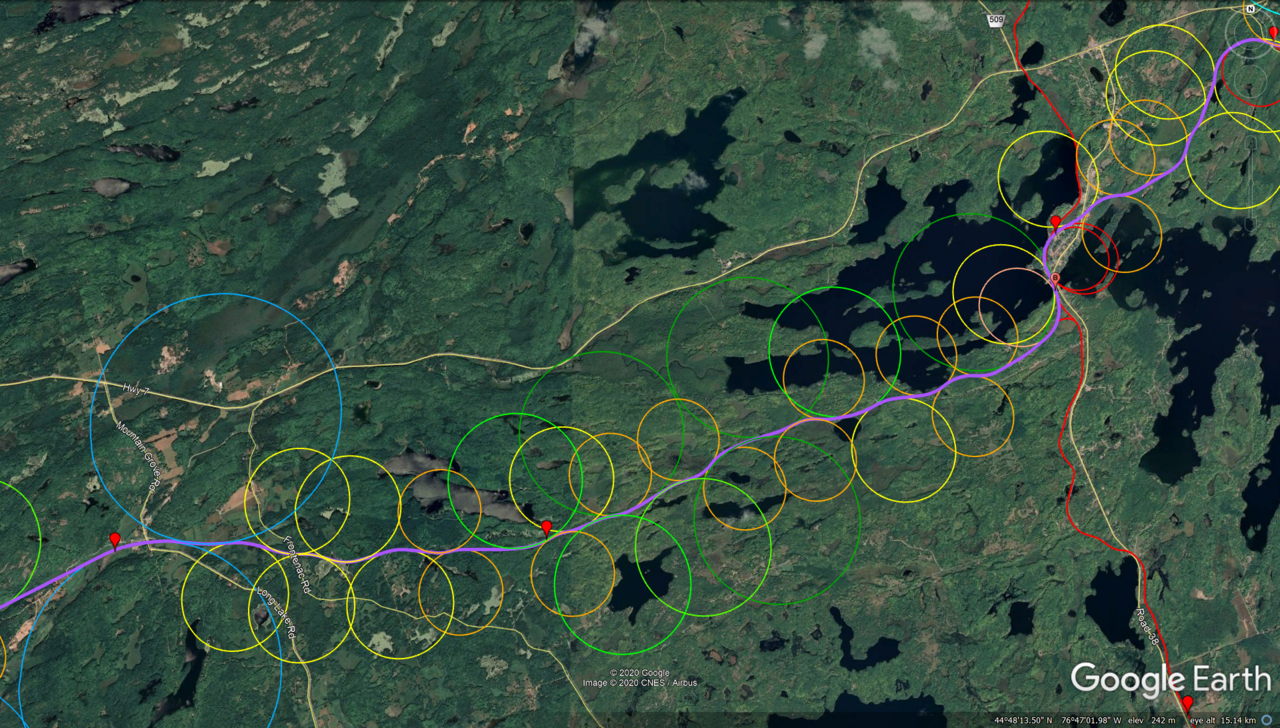
That said, I'm still trying to get my head around the specificities of s-curves (or reverse curves) I outlined above, but it becomes clear that there are painful trade-offs between the amount of superelevation applied to curves and the maximum speed which can be achieved on the tangent between these curves (if the two curves form a reverse curve) and this means that achieving aggressive superelevations (like 8 or 10 inches) might be unrealistic on segments riddled with reverse curves (like this segment between Sharbot Lake and Mountain Grove) - a problem which (as a side note) tilting trains would not solve, as the extra banking needs to be treated the same way in the formulae presented above as the actual elevation applied to the tracks:
1601866234874.png


I hope you found this 3-part excurse into railway travel time modelling as instructive as I found it (I never thought that I would delve even deeper into this matter than I already did for my Master Thesis - but reverse curves really weren't that much of an issue on the Kitchener Corridor than they are on the Havelock Subdivision) and I will try to get my head around these pesky reverse curves and model travel times for the existing/former Havelock alignment, so that @reaperexpress and @crs1026 can take control of my spreadsheet and see what kinds of realignments may or may not be required to achieve a travel time of 3:15 hours between Toronto and Ottawa...

In the meanwhile, I wish you all a good night and have a great start into the new week!

 
Last edited:

Back
Top