


News   GLOBAL  |  Apr 02, 2020
 11K     0 
News   GLOBAL  |  Apr 01, 2020
 43K     0 
News   GLOBAL  |  Apr 01, 2020
 6.7K     0 
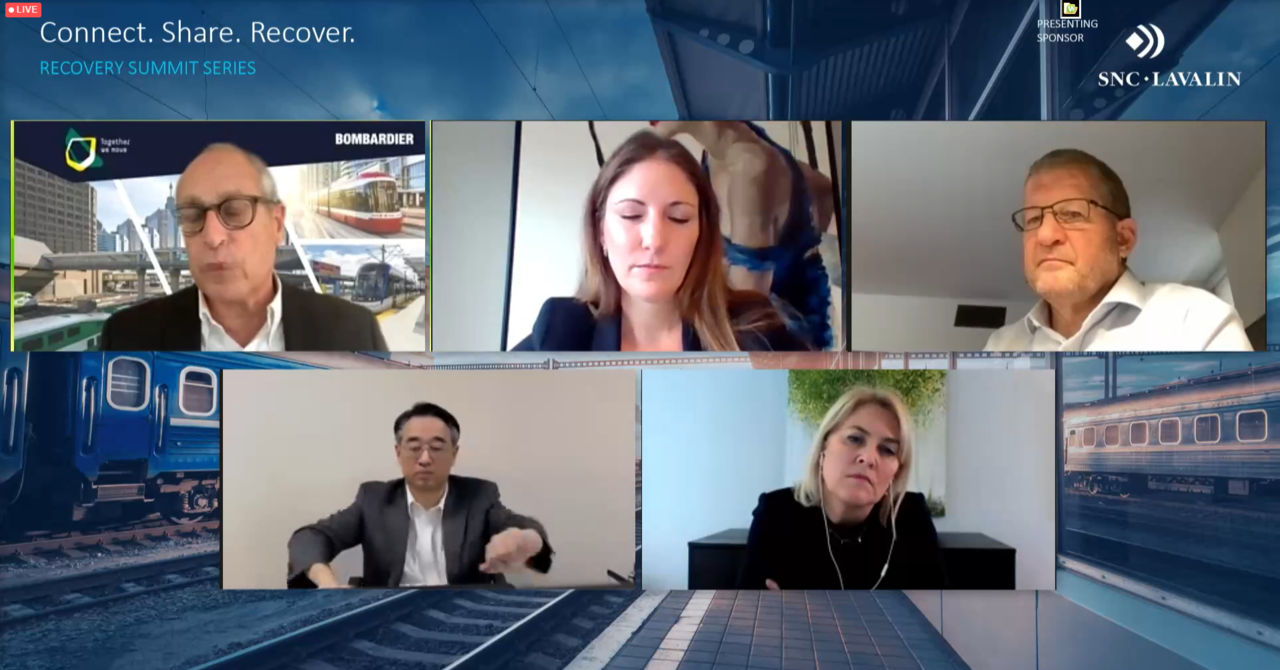
At today's Toronto Region Board of Trade Recovery Summit Series on transportation, on a panel (screenshot below) the President and CEO of VIA Rail provided some remarks that touched on HFR.

Here is the audio: https://drive.google.com/file/d/1x_Da_AQ4NYMwOCS_MOfr6x6uzrB37q62/view?usp=sharing

Quick summary (my paraphrasing):
  • VIA had its best year in 2019 and hit a revenue high and experienced 5 years of ridership growth leading up to 2019;
  • Despite the challenges of the blockade and COVID-19, we can't lose sight of modernization;
  • VIA is reaching the limit of its potential and frequency potential, and needs modernization;
  • Modernization includes: 1) new reservation system; 2) refurbishment of the existing fleet; 3) the new fleet coming online in 2022; and 4) HFR is the "flagship" and the "heart of the future";
  • $71 million was allocated by the feds in 2019 to study 2019. The Joint Project Office (JPO) report should be available "shortly" and they hope for a decision by the end of the year [it wasn't clear who is making the decision but I assume the Minister];
  • HFR: it's about frequency and connectivity, creating service for new places, improving reliability/on-time performance, getting passenger trains away from freight trains, environmental sustainability, and there is an opportunity to electrify the network [route]. It was noted that it's a large-scale project that aligns with the government's goals on job creation and aligns with green goals; and
  • SW Ontario - there was a question on more SW Ontario service. Here is the audio of the response: https://drive.google.com/file/d/1yhOz5jJ1-oKlQ607wswoMMuB4sbLotVx/view?usp=sharing
1606316963801.png
 
Last edited:
I think this is at Brockville.


Thanks for posting. It certainly does look like Brockville. VIA also posted another video and a couple days ago and I wasn't sure where it was, but I am now wondering if it is also the nearby bridge in Brockville. It certainly looks similar and both could be part of an upgrade to the Brockville Sub.

 
^Many people seem to be fixated on those old Budd built RDC carbodies, largely (I guess) because they are still out there and therefore (seemingly) quicker to access than new stock. I would question whether they are really the optimal purchase, considering a) they would have to be rehabbed, and b) they will only last so much longer.

The cost difference between a 2, 3, or 4-car Budd RDC train and a conventional train is a spreadsheet exercise, and only VIA knows those exact numbers. And even that is likely a guesstimate, because the current White River operation has sufficient differences from Corridor service that the numbers may not be generalizable. I can't ever remember a VIA or CN RDC consist exceeding 4 cars, nor did CN routinely run 3-car conventional trains.....maybe that gives a hint. But that's very old data.

In any event, the big advantage of DMU is probably not cost, it's quick convenient turnability. VIA's current fleet doesn't have a good solution for that except where longer consists justify push-pull configuration. However, VIA has addressed that issue by ordering cab cars and by configuring its fleet to provide some short push-pull consists.

With VIA having options for more equipment, I would argue that it would be as quick, and no more expensive, to just order more 3-car Challenger trainsets for any low-volume service.

There is a romantic attachment to the railways' old branch line RDC service, where on many routes a single car (or maybe two) plied a lightly used line to smaller communities. That was fine once, I guess, although those branch lines were uneconomical for decades and the tracks are mostly gone. The RDC's advantage as a light, quickfooted railcar is likely lost to current track and speed regulations. I'm old enough to have ridden a few branch line RDC's, and they were great fun. But..... this is 2020, and a single partial carload of passengers is not going to approach the minimum "break-even" threshold to justify service by today's yardstick. Let's face it, it takes 2 or 3 carloads of passengers to justify a VIA train anymore.

Likewise, there may be a romantic attraction to the likes of DMU services in, say, the UK. Also great fun to ride, but we just aren't going to see a St Ives branch in Canada anytime soon.....while these may return some day if the country moves away from road transportation, the capital cost of restoring the tracks and adding signalling and maintenance infrastructure will be so substantial that the choice of rail vehicle will not be a consideration. And again, that's so many years down the road that clinging to RDC's seems a very poor strategy.

VIA's attempts to buy back RDC's is as much a matter of desperation as anything. Government is certainly not encouraging a light-load rail passenger service. I commend VIA's intentions, but let's not pretend that buying back these old veterans is a sound fleet acquisition strategy.

- Paul

The attachment to the RDCs, I feel, has less to do with them,but more to do with what they can do. By having a self propelled passenger car in it's fleet, it can run a single car to meet demand. Right now, that is all via has in it's fleet. For the modernization, Via should look for a modern replacement for it. Then, they should look for modern replacements for the rest of the fleet. This can help with expansion without a shortage of rolling stock.
 
At today's Toronto Region Board of Trade Recovery Summit Series on transportation, on a panel (screenshot below) the President and CEO of VIA Rail provided some remarks that touched on HFR.

Here is the audio: https://drive.google.com/file/d/1x_Da_AQ4NYMwOCS_MOfr6x6uzrB37q62/view?usp=sharing

Quick summary (my paraphrasing):
  • VIA had its best year in 2019 and hit a revenue high and experienced 5 years of ridership growth leading up to 2019;
  • Despite the challenges of the blockade and COVID-19, we can't lose sight of modernization;
  • VIA is reaching the limit of its potential and frequency potential, and needs modernization;
  • Modernization includes: 1) new reservation system; 2) refurbishment of the existing fleet; 3) the new fleet coming online in 2022; and 4) HFR is the "flagship" and the "heart of the future";
  • $71 million was allocated by the feds in 2019 to study 2019. The Joint Project Office (JPO) report should be available "shortly" and they hope for a decision by the end of the year [it wasn't clear who is making the decision but I assume the Minister];
  • HFR: it's about frequency and connectivity, creating service for new places, improving reliability/on-time performance, getting passenger trains away from freight trains, environmental sustainability, and there is an opportunity to electrify the network [route]. It was noted that it's a large-scale project that aligns with the government's goals on job creation and aligns with green goals; and
  • SW Ontario - there was a question on more SW Ontario service. Here is the audio of the response: https://drive.google.com/file/d/1yhOz5jJ1-oKlQ607wswoMMuB4sbLotVx/view?usp=sharing
View attachment 285018

This is great. Is the whole presentation online? Thanks for posting.
 
^Many people seem to be fixated on those old Budd built RDC carbodies, largely (I guess) because they are still out there and therefore (seemingly) quicker to access than new stock. I would question whether they are really the optimal purchase, considering a) they would have to be rehabbed, and b) they will only last so much longer.

I agree, given that VIA is already purchasing Challenger trainsets to standardize the corridor operations, I really do not see why they would purchase a separate DMU fleet and undo the efficiencies that come from standardization.

Short 1 or 2 car DMUs have been used for some of my most memorable train journeys, but I understand that they do not really make sense if they are not operating over what would otherwise be underutilized infrastructure.
 
The attachment to the RDCs, I feel, has less to do with them,but more to do with what they can do. By having a self propelled passenger car in it's fleet, it can run a single car to meet demand. Right now, that is all via has in it's fleet. For the modernization, Via should look for a modern replacement for it. Then, they should look for modern replacements for the rest of the fleet. This can help with expansion without a shortage of rolling stock.

Are there any routes where VIA currently operates that would be better severed by single cars? I suppose they could be deployed on the Montreal-Senneterre and Montreal-Jonquière lines?
 
A single car route should be replaced with a bus. Having any route less than daily and/or with insufficient demand to fill 2-3 car DMUs, should be replaced with daily or twice daily buses.

Everyone understands the value of frequency with HFR. I don't get why people don't see the value of that outside the Corridor.
 
Are there any routes where VIA currently operates that would be better severed by single cars? I suppose they could be deployed on the Montreal-Senneterre and Montreal-Jonquière lines?

Here are pictures of a I took of the Northern Quebec train leaving Montreal (the two trains are coupled together and run as one train to Hervey). Note on May 2, both trains consist of a locomotive, a baggage car and a single coach but on May 4, a second coach was added to one of the two trains (presumably the one to Jonquière as it departs Hervey first). If they don't "need" RDCs on this route, I don't see why they are needed on the Sudbury-White River train if another type of bi-directional train is available.


May 2, 2018 - taken by user roger1818 (click photo to enlarge)


May 4, 2018 - taken by user roger1818 (click photo to enlarge)
 
Last edited:
A single car route should be replaced with a bus. Having any route less than daily and/or with insufficient demand to fill 2-3 car DMUs, should be replaced with daily or twice daily buses.

So build roads to serve the intermediary stops that currently can only be served by rail?
 
This is great. Is the whole presentation online? Thanks for posting.

Members of this panel, including the VIA President and CEO, didn't do presentations with decks. They offered opening remarks, took questions from the moderator, and then took questions from the audience.
 
Last edited:
So build roads to serve the intermediary stops that currently can only be served by rail?

On those rare exceptions, run a daily two car DMU. But it's just dumb to run an RDC to Sarnia.

Also, there needs to be a discussion on which routes VIA is obligated to serve and which ones the provinces should pony up for. Because there's plenty more places with poor to no oad access in Canada that VIA doesn't serve.
 
See my original post here where I said 'here is the audio' and provided a link to files in Google Drive. They are .mp3 files. Let me know if they don't work for some reason. The audio is just the VIA Rail President and CEO, I didn't both with the other panel members.

What you provided was great. Hoping to catch more of the questions she answered, than the 7 mins you provided.
 
From my understanding, single car DMUs were intended primarily to maintain service on secondary lines that no longer warranted larger trains. Given that VIA no longer operates any such minor lines other than a few rural services, I do not see why RDCs are necessary; it's not like VIA is going to find money to start reopening closed lines with minimal traffic.

Given this, I would not be surprised if one of the major reasons for choosing the Siemens bid for fleet renewal was that the use of cab cars and separable coaches enables VIA to use the same trains on both HFR and lower demand routes.
 

Back
Top