News   GLOBAL  |  Apr 02, 2020
 11K     0 
News   GLOBAL  |  Apr 01, 2020
 43K     0 
News   GLOBAL  |  Apr 01, 2020
 6.7K     0 
You seem to suggest that there are remote communities (i.e. without year-round road access), which are served by an active freight line but without passenger rail service. Can you name some examples?

You raise an interesting challenge.. Roads of some form extend a lot further than they used to, so when one fact-checks, one finds that many places that we think of as “remote communities” do in fact have a road connection.

For example, if one looks at the White River route, there are numerous road crossings along its length, and the route is parallelled by road for long stretches. Same with the Senneterre route. How much is winter-access I don't know.

I guess my point may be the inverse of what I wrote....some “remote services” aren’t as "remote" as they once were.

I would certainly put the Algoma Central route on the list. It had a solid volume of summer camps and remote dwellings that were adversely affected by the loss of the local passenger train. Similarly, I would contrast the Canadian’s route with the CP line.... while serving subdivision points, the Canadian does not offer “flag stop anywhere” service in the same way that the White River train does. The CN route has a solid volume of road crossings, so if it's road-serviced, the White River run is doubly so.

VIA in its early years did run "campers' specials" out of Winnipeg. It would be interesting to compare the population, average distance to roads, number of on-line camps and hunting/fishing businesses along these lines.

Other than perhaps the Churchill line, and perhaps the Moosonee train (which is traditionally a provincial effort) I'm not so sure we can talk about having a "Remote Community" passenger network in this country, so much as we can say that some routes have managed to retain service while others have lost it, and I'm certainly not about to argue for discontinuing what's left. But on an apples to apples basis, maybe there are winners and losers that don't make rational sense.

One does wonder if a more hard-nosed government would download remote services to the provinces. But... that might invite the option of a province seeking to add, or reinstate, a past service. We can't have the provinces telling VIA what they might want.... it might lead to VIA growing a business.

- Paul

PS - without getting too much into a fantasy discussion, one hears almost as much angst about the over-use of Algonquin Park by campers and hikers as one hears about Banff. All of that Algonquin traffic comes into the park by car. Wouldn't it be nice if there were a local rail service across the park so people could leave their cars at the park gate?
 
- Paul

PS - without getting too much into a fantasy discussion, one hears almost as much angst about the over-use of Algonquin Park by campers and hikers as one hears about Banff. All of that Algonquin traffic comes into the park by car. Wouldn't it be nice if there were a local rail service across the park so people could leave their cars at the park gate?

There was a rail line that parallels the highway. It is long since gone.
A train to Huntsville and then a bus into the park would work. If the Northlander does return, and it is set up properly, it could be used to commute to the ark. ONR could add a bus to the park. Maybe if there was ever enough demand, a rail line could be built. However, that is more fantasy than Via owning the old CN line to Thunder Bay.
 
From a Facebook group. Progress update. Sounds like VIA could return to Gaspé in 2025?

Railroad Repair Update!

Section 1 Matapédia to Caplan 80 miles.

Regular routine maintenance work to ensure safe operation. The first section has now been repaired. Freight trains can now run at full capacity.

Section 2 Caplan to Port-Daniel 44 miles.

Work in progress and planned for 2021 and 2022.

Construction work on the replacement of the railroad bridge in Caplan. Continue the rehabilitation work on the railroad bridge in Port-Daniel-Gascons.

Begin work on 11 other infrastructures that need to be repaired or rebuilt.

Carry out the following asset maintenance work in 2021 and 2022.
Repair and widening of the Port-Daniel-Gascons tunnel.
Repair of around 30 level crossings.
Work on more than 40 culverts.
Erosion issues to correct.
Repair of the New Carlisle rail yard.

The reopening of the Caplan to Port-Daniel section is scheduled for next year 2022!

Section 3 Port-Daniel-Gascons and Gaspé 78 miles.

Work in progress and planned.
Carry out engineering work on 20 infrastructures to be repaired or
rebuilt, including the feasibility analysis of two bridges for
pedestrians and cyclists.

Complete the asset maintenance work started in the summer of 2020.
Replacement of ties, replacement of rail saddles, adding ballast, and leveling the track.

The reopening of the Percé to Gaspé for the tourist train is scheduled for 2024.

The reopening of the entire Port-Daniel-Gascons to Gaspé section is scheduled for 2025. In 2025, freight trains will be able to run at full capacity and the passenger train will be able to run on the entire Matapédia to Gaspé rail line!

[Chemin de fer de la Gaspésie - Tabloïd projet de réhabilitation décembre 2020 (gouv.qc.ca)](https://www.transports.gouv.qc.ca/fr/projets-infrastructures/structures-infrastructures/infrastructures-ferroviaires/rehabilitation-chemin-fer-gaspesie/Documents/tabloid-train-gaspesie.pdf)
 
You seem to suggest that there are remote communities (i.e. without year-round road access), which are served by an active freight line but without passenger rail service. Can you name some examples?

As I mentioned in an earlier, a complete listing would require a deeper analysis than simple Internet searching would seem to provide. The only one I came across was Collins, that seems to have permanent residents but no road access. There may be more.
You raise an interesting challenge.. Roads of some form extend a lot further than they used to, so when one fact-checks, one finds that many places that we think of as “remote communities” do in fact have a road connection.

For example, if one looks at the White River route, there are numerous road crossings along its length, and the route is parallelled by road for long stretches. Same with the Senneterre route. How much is winter-access I don't know.

I guess my point may be the inverse of what I wrote....some “remote services” aren’t as "remote" as they once were.

I would certainly put the Algoma Central route on the list. It had a solid volume of summer camps and remote dwellings that were adversely affected by the loss of the local passenger train. Similarly, I would contrast the Canadian’s route with the CP line.... while serving subdivision points, the Canadian does not offer “flag stop anywhere” service in the same way that the White River train does. The CN route has a solid volume of road crossings, so if it's road-serviced, the White River run is doubly so.

VIA in its early years did run "campers' specials" out of Winnipeg. It would be interesting to compare the population, average distance to roads, number of on-line camps and hunting/fishing businesses along these lines.

Other than perhaps the Churchill line, and perhaps the Moosonee train (which is traditionally a provincial effort) I'm not so sure we can talk about having a "Remote Community" passenger network in this country, so much as we can say that some routes have managed to retain service while others have lost it, and I'm certainly not about to argue for discontinuing what's left. But on an apples to apples basis, maybe there are winners and losers that don't make rational sense.

One does wonder if a more hard-nosed government would download remote services to the provinces. But... that might invite the option of a province seeking to add, or reinstate, a past service. We can't have the provinces telling VIA what they might want.... it might lead to VIA growing a business.

- Paul

PS - without getting too much into a fantasy discussion, one hears almost as much angst about the over-use of Algonquin Park by campers and hikers as one hears about Banff. All of that Algonquin traffic comes into the park by car. Wouldn't it be nice if there were a local rail service across the park so people could leave their cars at the park gate?

A lot of the roads in the remote north that one sees on computer mapping are forestry access roads; used by companies that have cutting rights in the area to haul timber. They generally are not gated, if for no other reason than they would have to pay somebody to sit on the gate. A few, like the 'Sultan Rd' are open to the public because the company gets some provincial funding. In all cases, they are not built to any standards and are signed as 'use at your own risk'. Maintenance is only done if the companies are using a particular section and, even at that, isn't great. Load dimensions and weights don't apply and I doubt your insurance company would be cooperative if something happened. Whether they are year 'round depends on the activity of the company. Many do not cut in the winter. Some that show on map images may be out-of-service for years since the area had been logged out. The MNRF used to require that they be severed (a cut line or berm) but I don't know what the current practices are.

Posters are correct that what was remote a couple of decades ago may no longer be, and what were once permanent communities may no longer be. I suppose its a policy decision that, if on a remote service line, where once were many are now a few, or one, what is the cut-off.

There is clearly no equity in access for remote communities; never was nor could there by. Those that happen to be on a line built a century or more ago (or that arose because of it) get service, other didn't luck out. The others, that actually qualify as settlement rather than merely a cluster of houses - mostly FNTs, are served by provincially-operated air strips. A flight is obviously more expensive but, then again, you don't have to wait several days to move in or out.

As for Algonquin Park, that has been sort of beaten to death either earlier in this thread or another.
 
Last edited:
I've been getting impatient about the slow progress on the US Customs pre-clearance facility at Montréal Gare Centrale, so I fell down a rabbit hole reading up on that station.

It turns out that REM will be using tracks 09 and 12, with a wide island platform between them. Unfortunately, this cuts nearly half the station off from mainline trains. The remaining tracks to the south will only be used for storing REM trains. While this setup was certainly the path of least resistance given that those were the platforms the Deux-Montagnes and Mascouche trains used to use, I think it would have been more foresightful to use tracks 07 and 10 instead. Platforms 09/10 and 11/12 are the only two platforms with multiple vertical access points along their length, and given that REM platforms are only 80 metres long, they aren't even making use of all of them. It is a silly situation to have full 8-car bilevel trains coming in from Mont-Saint-Hilaire and funneling all the passengers through the single staircase into the great hall.

Vertical Circulation highlighted in red
VIA_GareCentraleStairs.jpg

Platform 07/08 apparently had its staircase removed at some point, leaving it unusable for revenue service, but REM could have made use of its space since its platform would include the existing accesses to platform 09/10.

Anyway, the obvious place for a future US customs-sealed platform would be platform 23, which used to be a private platform for CN executives. It has never been used in revenue service since it doesn't connect directly to the great hall, but its isolation actually makes it perfect for a customs-controlled area. Locating Amtrak there also avoids the need to take any space away from VIA and the RTM.
VIA_GareCentraleCustoms.jpg

According to this floorplan (which seems to be from the 60's or 70's), there seems to be an open area adjacent to the platform with a staircase, but I don't see where the staircase comes out on the upstairs floorplan. To access that area from the main level, whichever shop is above that spot may need to be acquired.

To improve air quality in the trainshed, I wonder if it would be practical to electrify the Amtrak track with the same 750V DC third rail system that the trains already use in Penn Station at the other end of their route. That would allow the diesel engines to be off while sitting (quite deep in the trainshed) without the hassle of running the usual HEP cables.

On an unrelated note, the map suggests that there are some exits from the north end of the terminating platforms. I wonder what the state of those accesses is today.
 
Last edited:
^ So in theory, VIA HFR would enter using the tracks shaded by "REM" and then move to the tracks shaded by "VIA"? Really hope we can soon see the work of the JPO and track plans. I'm sure it will generate a lot of posts in this thread :)
 
^ So in theory, VIA HFR would enter using the tracks shaded by "REM" and then move to the tracks shaded by "VIA"? Really hope we can soon see the work of the JPO and track plans. I'm sure it will generate a lot of posts in this thread :)
HFR from Toronto would come in from the South (right side), so they won't need to use the REM tracks. If they figure out how to get HFR from Quebec to Montreal through the tunnel, they would share tracks with REM, but that seems very unlikely at this point.
Agreed, I can't wait for JPO results. I'm giddy. Don't disappoint me!!
 
PS - without getting too much into a fantasy discussion, one hears almost as much angst about the over-use of Algonquin Park by campers and hikers as one hears about Banff. All of that Algonquin traffic comes into the park by car. Wouldn't it be nice if there were a local rail service across the park so people could leave their cars at the park gate?

How many campers would actually use the train to camp? I once worked with a guy who said their are 3 types of campers:
  1. The majority want to be able to drive to the campsite with a vehicle full of all the stuff they "need"
  2. Some will canoe to their campsite, to to get away from the crowds, but it means you need to be able to fit everything you need in the canoe,
  3. He would portage his canoe (I seem to remember him saying he did it twice) to find a site so remote that they wouldn't see anyone else all week. That means you need to be able to carry everything you need, including your canoe.
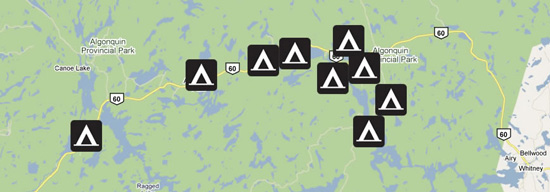
A train would only work for the second and third type of campers. On top of that, Hwy 60 passes right through the park and most of the campsites are off of the highway.


Developed Campgrounds - Highway 60


There was a rail line that parallels the highway. It is long since gone.
A train to Huntsville and then a bus into the park would work. If the Northlander does return, and it is set up properly, it could be used to commute to the ark. ONR could add a bus to the park. Maybe if there was ever enough demand, a rail line could be built. However, that is more fantasy than Via owning the old CN line to Thunder Bay.

I think you are talking about the old OAPS line, which traveled through the southern end of the park and was split east and west of the park in 1933 when CN decided that the trestle over Cache Lake wasn't worth repairing. I'm guessing it became Hwy-60 through the park, though I might be mistaken on that one.

There was also the old Canadian Northern line which traveled through the middle of the park and was abandoned in the late 90's. The latter ROW passes through the Achray, Brent and Kiosk Campgrounds, and would make a nice tourist train route that could double as access for campers. The only thing is the park was eager to get the trains out of the park as they made a lot of noise, so it could be a challenge to start up again.
 
HFR from Toronto would come in from the South (right side), so they won't need to use the REM tracks. If they figure out how to get HFR from Quebec to Montreal through the tunnel, they would share tracks with REM, but that seems very unlikely at this point.
Agreed, I can't wait for JPO results. I'm giddy. Don't disappoint me!!
I am very worried about HFR. We should have heard something more by now. It seems with all the talk of a new election and the uncertainty of a minority government, HFR is going to fall through the cracks which is terrible as it has great potential to improve VIA.
 
How many campers would actually use the train to camp? I once worked with a guy who said their are 3 types of campers:
  1. The majority want to be able to drive to the campsite with a vehicle full of all the stuff they "need"
  2. Some will canoe to their campsite, to to get away from the crowds, but it means you need to be able to fit everything you need in the canoe,
  3. He would portage his canoe (I seem to remember him saying he did it twice) to find a site so remote that they wouldn't see anyone else all week. That means you need to be able to carry everything you need, including your canoe.
A train would only work for the second and third type of campers. On top of that, Hwy 60 passes right through the park and most of the campsites are off of the highway.


Developed Campgrounds - Highway 60


I think you are talking about the old OAPS line, which traveled through the southern end of the park and was split east and west of the park in 1933 when CN decided that the trestle over Cache Lake wasn't worth repairing. I'm guessing it became Hwy-60 through the park, though I might be mistaken on that one.

There was also the old Canadian Northern line which traveled through the middle of the park and was abandoned in the late 90's. The latter ROW passes through the Achray, Brent and Kiosk Campgrounds, and would make a nice tourist train route that could double as access for campers. The only thing is the park was eager to get the trains out of the park as they made a lot of noise, so it could be a challenge to start up again.

At the risk of continuing this off-topic bounce, I'm not aware of any of Hwy 60 follows the old OAPS line. The ROW ran south of it then crosses the highway roughly around Cache Lake then runs north of it, exiting the park near Kearney.
 
I've been getting impatient about the slow progress on the US Customs pre-clearance facility at Montréal Gare Centrale, so I fell down a rabbit hole reading up on that station.

It turns out that REM will be using tracks 09 and 12, with a wide island platform between them. Unfortunately, this cuts nearly half the station off from mainline trains. The remaining tracks to the south will only be used for storing REM trains. While this setup was certainly the path of least resistance given that those were the platforms the Deux-Montagnes and Mascouche trains used to use, I think it would have been more foresightful to use tracks 07 and 10 instead. Platforms 09/10 and 11/12 are the only two platforms with multiple vertical access points along their length, and given that REM platforms are only 80 metres long, they aren't even making use of all of them. It is a silly situation to have full 8-car bilevel trains coming in from Mont-Saint-Hilaire and funneling all the passengers through the single staircase into the great hall.

Vertical Circulation highlighted in red
View attachment 294015
Platform 07/08 apparently had its staircase removed at some point, leaving it unusable for revenue service, but REM could have made use of its space since its platform would include the existing accesses to platform 09/10.

Where do those other "vertical access points" come out in the great hall? I don't ever remember seeing them.

As you said, platform 07/08 had its staircase removed to create more retail space (I beleive Bureau en Gros, aka Staples, occupied it last time I was in Montreal), so using it would require convincing the owner of the station, Cominar REIT, to evict a one of its tenants. Also, if you look at this track diagram (not to scale) tracks 4-12 are completely isolated from tracks 13-23 until they merge at switch 195. I beleive the plan is to break that merge and run new set of parallel tracks out of the station for the REM. Reconfiguring the tree to allow VIA access to tracks 11 & 12 would require more work. You can actually see the construction for the new bridge across the Peel Basin in Google Maps (also below).

Regardless, this change will help VIA a bit, since they will have fewer trains to compete with when approaching the station.

MontrealCentralStationTrackPlan.gif


New Montreal Bridge.png

Anyway, the obvious place for a future US customs-sealed platform would be platform 23, which used to be a private platform for CN executives. It has never been used in revenue service since it doesn't connect directly to the great hall, but its isolation actually makes it perfect for a customs-controlled area. Locating Amtrak there also avoids the need to take any space away from VIA and the RTM.
View attachment 294016
According to this floorplan (which seems to be from the 60's or 70's), there seems to be an open area adjacent to the platform with a staircase, but I don't see where the staircase comes out on the upstairs floorplan. To access that area from the main level, whichever shop is above that spot may need to be acquired.

To improve air quality in the trainshed, I wonder if it would be practical to electrify the Amtrak track with the same 750V DC third rail system that the trains already use in Penn Station at the other end of their route. That would allow the diesel engines to be off while sitting (quite deep in the trainshed) without the hassle of running the usual HEP cables.

On an unrelated note, the map suggests that there are some exits from the north end of the terminating platforms. I wonder what the state of those accesses is today.

One comment about your second map. I believe platform 21/22 is reserved for EXO's Mont-Saint-Hilaire and Mascouche lines, and VIA will use tracks 13-20.
 
Last edited:
How many campers would actually use the train to camp? I once worked with a guy who said their are 3 types of campers:
  1. The majority want to be able to drive to the campsite with a vehicle full of all the stuff they "need"
  2. Some will canoe to their campsite, to to get away from the crowds, but it means you need to be able to fit everything you need in the canoe,
  3. He would portage his canoe (I seem to remember him saying he did it twice) to find a site so remote that they wouldn't see anyone else all week. That means you need to be able to carry everything you need, including your canoe.
A train would only work for the second and third type of campers. On top of that, Hwy 60 passes right through the park and most of the campsites are off of the highway.


Developed Campgrounds - Highway 60


I think you are talking about the old OAPS line, which traveled through the southern end of the park and was split east and west of the park in 1933 when CN decided that the trestle over Cache Lake wasn't worth repairing. I'm guessing it became Hwy-60 through the park, though I might be mistaken on that one.

There was also the old Canadian Northern line which traveled through the middle of the park and was abandoned in the late 90's. The latter ROW passes through the Achray, Brent and Kiosk Campgrounds, and would make a nice tourist train route that could double as access for campers. The only thing is the park was eager to get the trains out of the park as they made a lot of noise, so it could be a challenge to start up again.

What about those that wish to camp at the regular campgrounds, but do not have a vehicle?

At the risk of continuing this off-topic bounce, I'm not aware of any of Hwy 60 follows the old OAPS line. The ROW ran south of it then crosses the highway roughly around Cache Lake then runs north of it, exiting the park near Kearney.

An old ROW does run near the Mew Lake and Rock Lake Campgrounds.
 
Does anybody know when we should know when HFR will either be officially approved or cancelled? Like a timeframe or date. I remember seeing something about this spring?

Again, with the strong potential of an election this year along with the uncertainty of a minority government, I sadly don't think HFR has a future.
 

Back
Top