News   GLOBAL  |  Apr 02, 2020
 11K     0 
News   GLOBAL  |  Apr 01, 2020
 43K     0 
News   GLOBAL  |  Apr 01, 2020
 6.7K     0 
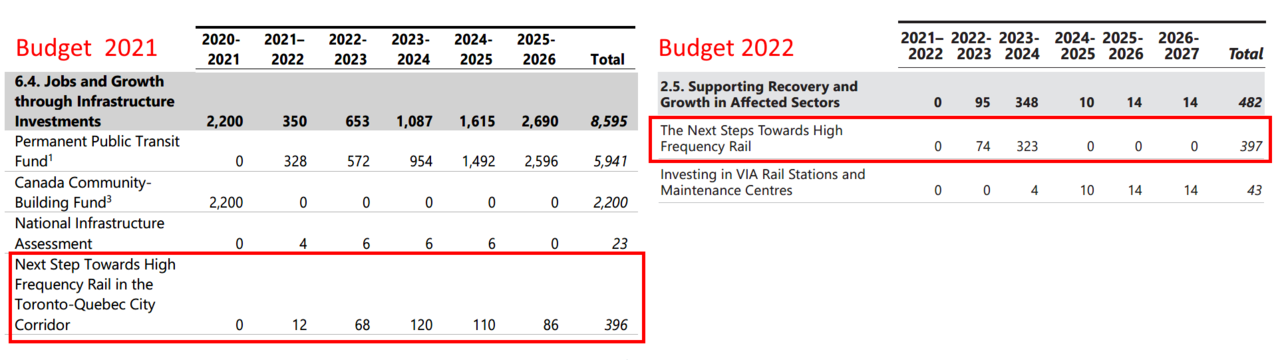
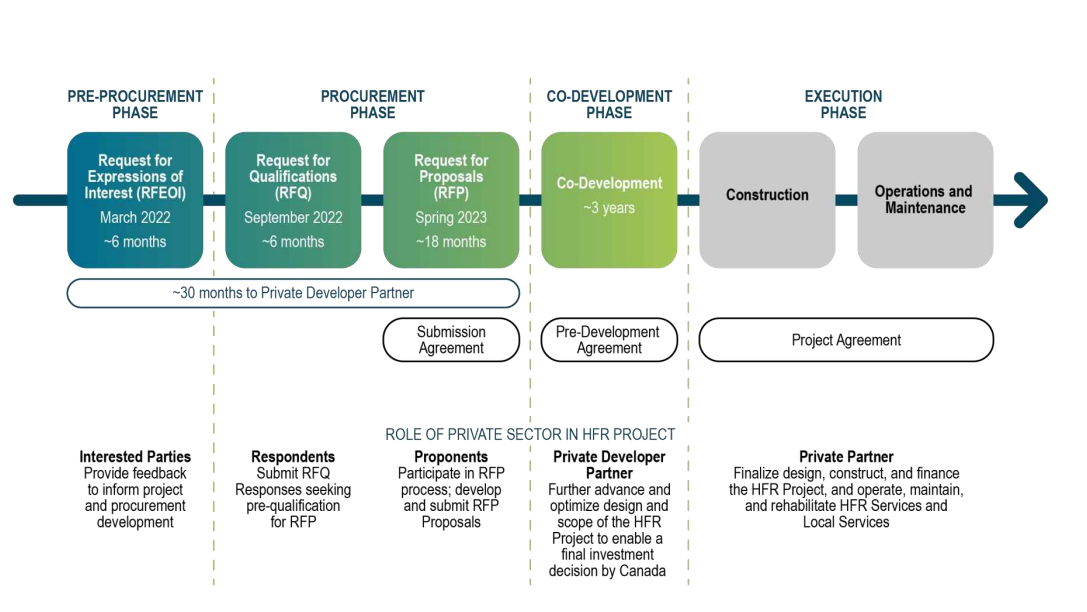
^ And for those who like visuals, below is a side-by-side comparison. @crs1026 any speculation on why the money in 2022 is mostly being spent in 2023-2024 instead of being more spread out? Does that fiscal year relate to the procurement schedule (picture below)?


1649374247454.png


1649374471581.png
 

Attachments

  • 1649374041181.png
    1649374041181.png
    119.5 KB · Views: 161
That $74M - $323M is followed by $0 in the following year.

Recall that the last budget set the amount at $396M over 6 years.

One wonders what changed.

Lines up with contract award that fiscal year. So at that point, not "Next steps" any more.

Again I ask. What the hell have they been doing all these years that they need another 2 years and another $400M in planning and design?
 
Last edited:
My theory is, it's land/track acquisition.

Can't be design work, or de-risking site preparation a la Metrolinx, because a) work can't be jumpstarted at that magnitude and b) the plan calls for a 3-year "co-development phase" from 2023 to 2026. Can't design and build something you haven't written the specs for yet.

Could be some sort of down payment to the successful bidder, perhaps, or royalties to somebody important to the deal (FN?) but the deal isn't final until much later.

Another possibility is that 2024 is when the CIB either starts funding things, or declines. So Treasury funds aren't required after that date, and this preserves what was set aside last year.

- Paul

Screen Shot 2022-04-07 at 7.42.01 PM.png
 
So clearly the driver had the ability to stop but chose not to. He slowed down because he saw that the gates are down.

Sure you could make it safer but in the end the driver decided their own fate.

Have you actually read the entire report? In the "On-site simulation" section, it concludes that the driver of the truck likely didn't perceive "the activated crossing warnings" until he "approached the crossing stop line" and swerved around them as an evasive maneuver to avoid hitting them. It continues to say, "The driver’s attempt to steer around the lowered crossing gates further suggests that he was likely unaware of how close the train was to the crossing and may have been taking evasive action to avoid a collision."

Even though the report doesn't recommend any changes, I still think the crossing should be closed with a detour as I suggested in my previous post. The detour would eliminate the need for vehicles to cross the tracks (twice) when traveling between Barnsdale Rd and Eagleson to/from the south, while maintaining the same number of crossings for vehicles traveling to/from the northern leg of Eagleson.

 
Have you actually read the entire report? In the "On-site simulation" section, it concludes that the driver of the truck likely didn't perceive "the activated crossing warnings" until he "approached the crossing stop line" and swerved around them as an evasive maneuver to avoid hitting them. It continues to say, "The driver’s attempt to steer around the lowered crossing gates further suggests that he was likely unaware of how close the train was to the crossing and may have been taking evasive action to avoid a collision."

Even though the report doesn't recommend any changes, I still think the crossing should be closed with a detour as I suggested in my previous post. The detour would eliminate the need for vehicles to cross the tracks (twice) when traveling between Barnsdale Rd and Eagleson to/from the south, while maintaining the same number of crossings for vehicles traveling to/from the northern leg of Eagleson.
How could he not see that the crossing arms were down? He was also familiar with the area.

Was he destracted?
 
How could he not see that the crossing arms were down? He was also familiar with the area.

Was he destracted?

Once again, if you had actually read the report, you would have read:
During the simulation, the TSB noted that, once the crossing gates were fully down, they blended into the background, and that the bright daylight conditions diminished the conspicuity of the gate lights. Consequently, the crossing gates and gate lights were not conspicuous from a distance, nor were they designed to be.
and later on:
Drivers periodically shift their focus to look further ahead or closer to their vehicle depending on several factors such as the presence of upcoming intersections, traffic density, time of day, weather, their own vehicle speed, and road geometry. Drivers continually perform visual scans to the left and to the right to monitor the outside environment, particularly the road signs. Up to 90% of drivers’ visual attention is spent looking at elements directly ahead in their view, given that these are objects with which they are most likely to interact.

While travelling west along Barnsdale Road toward the Eagleson Road intersection, drivers must shift their focus from the road ahead to the “Railway crossing ahead” sign and pavement markings (railway advance warning sign and “X” painted on the asphalt). The purpose of these warning signs is to attract drivers’ visual attention toward the upcoming crossing so that they are more ready to respond to an active signal. If drivers are unable to see an approaching train or hear its horn, safety at the crossing relies solely on the conspicuity of the crossing signals.

Expectancies relate to a driver’s readiness to respond to situations, and influence how quickly information is perceived and an appropriate course of action is selected. If a westbound driver on Barnsdale Road were not expecting a train, the driver’s visual and cognitive attention would likely be focused on the “Stop ahead” sign and the intersection with Eagleson Road beyond the crossing. This focus away from the crossing would tend to increase driver reaction time to crossing warnings of an approaching train. The driver’s delayed reaction in this occurrence was consistent with such an expectation.
and earlier in the report:
When a driver becomes familiar with a particular level crossing or with a particular type of level crossing, and where the driver has never, or seldom, encountered an approaching train at the level crossing, the driver will tend to not expect to encounter a train. Since the driver in this occurrence was familiar with the crossing and had likely seldom encountered any trains there, he would likely have formed the expectation that there would not be a train at the crossing.

When drivers receive information contrary to their expectations, their performance tends to be slow or inappropriate.
 
So they should look at having additional lights farther from the crossing to give drivers more notice, and give them a chance to slow down.

Or better yet, close the crossing as I previously suggested. The fewer cars crossing the tracks, the less likely for there to be a collision. Level crossings are a safety compromise.
 
Lots of focus?? Focus since 1991 with everything from TGV to JetTrain to the current plan which is little more than regular trains on tracks where the train isn't forced to pull into a siding to let freight pass. Let's quickly expand the scope of 30 years of relative inaction to look at other corridors so they too can share in the disillusionment of the paper based exercise.
 
Lots of focus?? Focus since 1991 with everything from TGV to JetTrain to the current plan which is little more than regular trains on tracks where the train isn't forced to pull into a siding to let freight pass. Let's quickly expand the scope of 30 years of relative inaction to look at other corridors so they too can share in the disillusionment of the paper based exercise.
Just to underline how ludicrous the use of the word "viable" is when this Mathew-guy assesses the ridership potential of these "corridors":
1649725137793.png


Basically, TRTO-OTTW-MTRL has approximately 10 times the ridership potential of Calgary-Edmonton and 100 (!) times the other four corridors our friend Mathew has identified...
 
Just to underline how ludicrous the use of the word "viable" is when this Mathew-guy assesses the ridership potential of these "corridors":
View attachment 392090

Basically, TRTO-OTTW-MTRL has approximately 10 times the ridership potential of Calgary-Edmonton and 100 (!) times the other four corridors our friend Mathew has identified...
As someone from the Okanagan, I can unfortunately confirm the absurdity of the idea of a viable passenger rail corridor between Kelowna and Kamloops.
 

Back
Top