




Bordercollie
Senior Member
Maybe if they replace the non corridor fleet, they can still run the legacy fleet over the Rockies for tourist's? Nostalgia is something people pay lots of money for.
|
|
|

Maybe 1 or 2 sets as a seasonal tourist train but certainly the majority need to be replaced soon as they are way past their shelf lifeMaybe if they replace the non corridor fleet, they can still run the legacy fleet over the Rockies for tourist's? Nostalgia is something people pay lots of money for.
when is the next trainset scheduled to arrive?
 www.trains.com
What exactly do you mean by “this”?VIA runs test train of new Siemens equipment - Trains
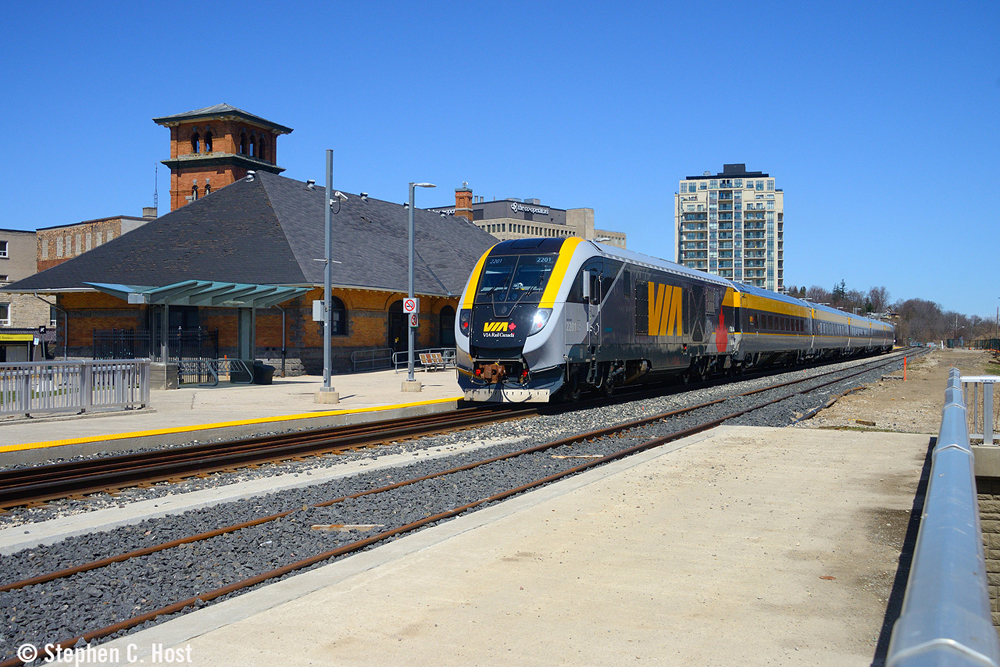
TORONTO — A trainset of VIA Rail Canada’s new Siemens-built equipment made a circuit of corridor stations in Ontario stations April 13-14, 2022, testing track geometry and passenger loading and unloading. Running as special train No. 649, the Charger locomotive and full set of Venture cars...
Is there any reason why this wouldn't work? Aren't all breaking systems standard across North America?;
VIA runs test train of new Siemens equipment - Trains
TORONTO — A trainset of VIA Rail Canada’s new Siemens-built equipment made a circuit of corridor stations in Ontario stations April 13-14, 2022, testing track geometry and passenger loading and unloading. Running as special train No. 649, the Charger locomotive and full set of Venture cars...
Is there any reason why this wouldn't work? Aren't all breaking systems standard across North America?;
The HEP voltage is not the same so the MP40 would not be able to provide HEP power to the "dead" train set, unless they have inverters installed for this particular situation.
So now it's confirmed that they can have GO dispatch an MP40 to potentially rescue a disabled VIA train set.It makes good sense to try something new proactively, and see what happens, rather than assume and find out the hard way in the heat of the moment.
With both trainsets having any number of electronic systems tied to braking and control function, it’s possibly not as simple as adding the rescue unit “the old fashioned way”. One breaker in the wrong position somewhere could prevent safe operation of brakes or throttle and kill the movement. If you need to control things on the trainset, or receive data from it, it’s better to experiment and verify.
I note too that the MP 40 was added at the cabcar end of the train. The Siemens cabcar-to-loco control functions may be different than GO’s. So again a test of continuity during acceptance testing might be a good idea.
- Paul
So now it's confirmed that they can have GO dispatch an MP40 to potentially rescue a disabled VIA train set.
I guess it would be because there are more MP40's around than F40's or P42's?

I don't believe there was as in-depth demand modelling done for the early 1980s VIA studies - and that was done for the late 1980s study - which was exclusively for Ontario/Quebec.The study didn’t dive deep into travel demand and rail demand sucked between the cities in the 80s with unreliable not fast service which required a cab to get to downtown Edmonton.
That has more to do with GO's own operations and the positioning of their locos - there's not really much else to read into it.I note too that the MP 40 was added at the cabcar end of the train. The Siemens cabcar-to-loco control functions may be different than GO’s. So again a test of continuity during acceptance testing might be a good idea.
- Paul
That has more to do with GO's own operations and the positioning of their locos - there's not really much else to read into it.
For the record, the only connections made in this case between the GO loco and the VIA set were coupler and both air lines. HEP and MU connections are incompatible, so the GO loco wasn't able to "read" anything inside the VIA set anyways.
Dan
No disagreement from this side of the peanut gallery.Interesting.
There would still be no-brainer things to verify, eg are the hoses mounted such that they actually reach each other. And how does the brake system on the trainset behave while being “towed”. Murphy’s Law applies.
- Paul
So now that the test was successful, will they lift the speed restriction?No disagreement from this side of the peanut gallery.
But Metrolinx is also instituting it's own set of random and non-nonsensical restrictions on the new equipment unilaterally (60mph limit on the Kingston and Oakville Subs? Really?), so for them to actually forcibly go out and require this test so early on in the process shouldn't really be much of a surprise. VIA has already done this test, as has CN. Why shouldn't Metrolinx get in on the action? And so, it's not.
I guess it says a lot that very little about Metrolinx surprises us anymore.
Dan
Stay tuned to have someone who even after decades of advocacy for High Speed Rail has yet to grasp the economic and commercial fundamentals of intercity passenger rail (let alone: HSR) explain to you why the Business Case for High Frequency Rail is deeply flawed…