





GenerationLee
Senior Member
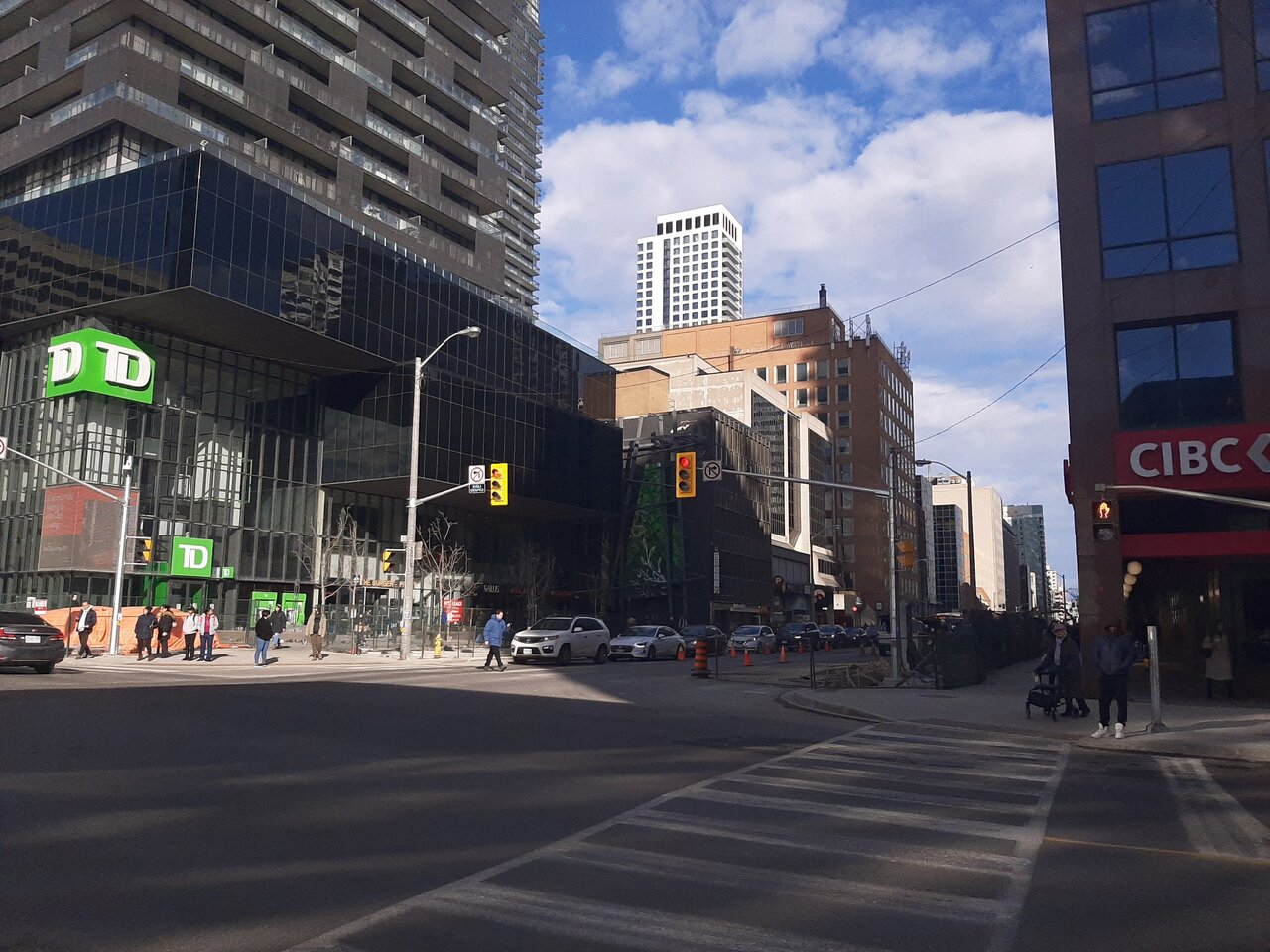
Yesterday, just a quick shot of some of the remaining works adjacent to the main inrersection.
|
|
|
We don't know about the LRT yet, as it hasn't opened, and the schedules not known, but on the subway....Based on what, just how much time is being lost with the stops you want to remove?
Yesterday, just a quick shot of some of the remaining works adjacent to the main inrersection.
View attachment 539031

Proper bike infrastructure will not help you if you are disabled, otherwise have mobility challenges, or even stopped for shopping on your way home and have a heavy load.I mean sure, but I congratulate you on completely avoiding the point I was making. Again, local busses is just 1 part of the solution, proper bike infrastructure is also a major factor that should help with last mile connections.
This is what it is currently, from the January 7 service summary.Second, last I checked a few years ago the 97 ran every 15m. If that's no longer the case then I agree that's pretty bad.
There is no dictionary definition of democratic I have been able to find that incorporates actively screwing over the minority. What you are describing sounds like tyranny of the majority.And I'm sorry, but a system that properly serves the majority of the stakeholders is by definition democratic. Making compromises for the majority of users in favour of a comparably smaller minority is by definition anti-democratic.
Well, that will be hard to do, considering Line 1 has very little of those stations. But yes, let's, adding in line 2 stations as well so we can get a fully accurate picture of the situation. The caveat here is that these stats are from 2019, so pre-covid, as that is the most recent information I have beeGo ahead, look at the ridership statistics for Line 1 Stations. I'll wait.
While true, this misses a key portion of the equation.Its the same principle as transit vs the car. Adding priority measures to improve the performance and travel time of transit vehicles will often negatively impact the travel time of the car. At the same time though, the 70 people on the bus or heck even 200 people on an LRV should probably have the priority over the 30 or so cars waiting for the light.
Nice strawman you've set up there. I can use this exact argument in favour of abolishing wheelchair accessibility. "The minority of people in wheelchairs or with mobility challenges are simply selfish for taking up time that could be used to get the people already on the bus there faster."You know what? I agree. It is a selfish view. That's why we should under no circumstances take away car lanes in favour of transit priority lanes. The people taking transit are simply selfish for thinking they have the right to save time in comparison to the fewer people who use the car.
... see how ridiculous that sounds?
I thought we were talking about crosstown trips, here? If you're talking about station to station or stop to stop journeys, then why wouldn't Crosstown also be competitive? After all, if you are taking the car you have to get the car from its parking space, and then find a new parking space at your end point.This really isn't true. Line 1 for instance is extremely competitive with the car if you go from station to station.
Maybe at 11pm sure, but in the middle of day even during off peak hours? 34m would be quite the miracle.
In what world? It typically takes 25m to get from Finch to Union on Line 1. And 25m by car? Again, maybe at 11pm when nobody is out, but even in the middle of the day during off peak you'd be lucky to reach Union in 40m. This is also ignoring the time needed to find a parking lot to park your car and actually park your car.
As a side note, I just checked that it seems like Line 1 currently takes 30m to reach Union from Finch, but that is due to TSR that are in place for some track maintenance they're doing. This isn't what a normal travel time looks like.
LSW happens to be placed right next to a freeway, which makes it difficult to compete. But even then, this doesn't include express services that can reach Burlington by ~40m iirc (They ran a superexpress from Union to Burlington last July and that took ~30m). While express services aren't common these days, they should be more common after GO Expansion (the business case from 2018 showed 1 super express and 2 express trains per hour, and I imagine there could be more considering current information).
In other words, even if we don't have it now, we are working on making it possible in the future.
All of these travel times were provided by Google Maps.First, the Milton Line only operates during rush hours where it takes 1h10, so using it as some sort of standard is weird on the face of it. Second, yes, maybe 42m at 11pm, but certainly not off peak during the day (I'm not even talking about rush hours).
All of these points would have some weight to them if the stop spacing was comparable to what we see on local buses and streetcars today. Many of these are separated only by 150-200 m. But that's not what is happening here, and, as I note for what feels like the millionth time, the changes you are railing for would deliver trivial time savings of only 2-3 minutes. Please address this exact point - in what universe is having a trip take 2-3 minutes more time than it otherwise would the end of the world?I agree, in many cases transit won't be able to literally beat the car, but we should at least try. This means:
A) building Rapid Transit with reasonable stop spacing and vehicles that allow for decent dwell times (ie, not low floor LRVs),
B) Concentrating development around stations so that the majority of people live around places with direct access to a rapid transit station
and C) having a strong network of arterial busses and bike lanes that can get everyone else to the stations and serve as last mile connections.
If you're going to go around with the mentality of "It will never beat the car so speed doesn't matter", then you're not building a transit network that makes transit comfortable - you're making a transit network that acts as a pseudo-welfare program for those who can't afford a car. I call this "The American Way".
No offense, but when you're arguing to nix stops so that those people who don't live by your decided-on major stops end up having a much longer journey, just so that the main transit line can shave 2-3 minutes off a trip, I find this to be a shockingly hollow argument."Time" is the most valuable thing we have.
I'm not sure why you are clouding the issue with a line from another city, you can just as easily point at any GO train line and achieve the same argument. "To put things in perspective, GO Transit's Milton line runs from Union to Kipling, taking only 17 minutes, while the same journey by subway takes 53 minutes, therefore the subway is a failure and we should change it."And just to put things in perspective, the Eglinton Crosstown (including Westward extension) is roughly 28kms with 32 stations, while the Montreal REM is 67kms with 26 stations. The REM also reaches a speed of 100km/h on some portions of the line.


One thing that you need to consider is that a stop not only affects the people that are accessing the stop, but that it needs to be balanced by the riders already on the vehicle and that time savings are generally assessed based on utilitarianism (greatest benefit to greatest number). If we keep using transit to solve last-mile and accessibility challenges by adding stops, instead of making smarter land use decisions, restricting autos, and providing a more pleasant environment for active transportation, we will never truly be able to increase the transit mode share. In more transit focused cities', transit is competitive with the car and can often be faster. Stop placement should be a function of density.All of these travel times were provided by Google Maps.
All of these points would have some weight to them if the stop spacing was comparable to what we see on local buses and streetcars today. Many of these are separated only by 150-200 m. But that's not what is happening here, and, as I note for what feels like the millionth time, the changes you are railing for would deliver trivial time savings of only 2-3 minutes. Please address this exact point - in what universe is having a trip take 2-3 minutes more time than it otherwise would the end of the world?
No offense, but when you're arguing to nix stops so that those people who don't live by your decided-on major stops end up having a much longer journey, just so that the main transit line can shave 2-3 minutes off a trip, I find this to be a shockingly hollow argument.
Why is it more important that you shave 2-3 minutes off your trip, rather than that someone else gets to shave 10-15+ (if again, as I've noted, you have mobility challenges and you have to use the parallel bus, it could be even more than this) minutes off theirs?
Is your time more important? Please explain at length your sociological theory.
I'm not sure why you are clouding the issue with a line from another city, you can just as easily point at any GO train line and achieve the same argument. "To put things in perspective, GO Transit's Milton line runs from Union to Kipling, taking only 17 minutes, while the same journey by subway takes 53 minutes, therefore the subway is a failure and we should change it."
With 26 stations over 67 km, that would come out to an average of 2.5 km, which doesn't sound like any local metro that I have ever heard of. And I assume that for local trips, any surface service will run at much better frequencies than 15-30 minutes... if not, then Montreal's transit planners are short sighted idiots.
While it's unfortunate, I genuinely don't hold a candle to much of Metrolinx's communications regarding this, or even the Ontario Line. At best, I remain skeptical. My general assumption is this area will continue to be a pain to walk around in until they some day complete this, but of course by then we'll see more intensive redevelopments occur in the area like the Canada Square project.Don't you just love the fact that Metrolinx has proclaimed that "CONSTRUCTION IS DONE!!1!", and yet there are still lane closures and construction fencing up all over the place?
Dan

If you are disabled and have mobility challenges, we have something for that its called wheel-trans, and I'm perfectly fine with giving it more funding.Proper bike infrastructure will not help you if you are disabled, otherwise have mobility challenges, or even stopped for shopping on your way home and have a heavy load.
If that's what you want to call it, be my guest.There is no dictionary definition of democratic I have been able to find that incorporates actively screwing over the minority. What you are describing sounds like tyranny of the majority.
But compare the difference: 31k for NYC, vs 28k for York Mills. This isn't that large of a gap in the grand scheme of things, and York Mills is by no means a large arterial. Its actually a fairly mundane arterial with competitive options 2km both north and south of it. In other words, in order to match or even surpass the ridership of a standard major arterial, you have to have the density of NORTH YORK CENTRE.Well, that will be hard to do, considering Line 1 has very little of those stations. But yes, let's, adding in line 2 stations as well so we can get a fully accurate picture of the situation. The caveat here is that these stats are from 2019, so pre-covid, as that is the most recent information I have bee...
What do we notice here?
-North York Centre, despite being an infill station which has only its density going for it, posts higher ridership numbers than not only York Mills, which as you rightly note is in the middle of nowhere, but also has higher numbers than Pape, Dufferin, Lawrence, Sherbourne, St. Patrick, Osgoode, Wellesley, Eglinton West, Keele, Jane, or Spadina on line 1 (all dense downtown/innercity neighbourhoods, some of which even have very busy bus lines feeding into them), or than Wilson, Sheppard West, Yorkdale, Finch West, Pioneer Village, which are all major suburban transfer points, and has comparable numbers to Spadina on line 2, Bay, Bathurst, Dundas West.
-Infill station Main has better ridership than Wilson, Finch West, Pioneer Village, Eglinton West, and Lawrence West and posts comparable figures to Sheppard West and York Mills.
Wellesley and Museum are perfect examples of what I'm talking about. First, they're not "dense", museum especially is located at the heart of U of T which is medium density at best. Second they don't connect to any major streetcar lines unlike the rest of the downtown U stations. As such they more or less exist exclusively local stations that generate their ridership from local patronage, and as you can see it doesn't generate that much ridership. In fact its a perfect comparison to station like Hakimi-Lebovic, except I imagine Hakimi is probably going to be far far worse long term.-Despite being in a dense downtown zone, Wellesley is very low on the station ranking.
-Museum, despite being in a dense downtown zone and near a major tourist attraction, posts very low on the station ranking. Meanwhile, the stations you propose to close, Christie and Greenwood, do better despite there being nothing there.
I am surprised that it is this low, and for what its worth it is the only outlier here that doesn't make any sense to me.-Despite being fed by a major bus line (the 35) and sitting on a major arterial, Jane has very low ridership, comparable to Woodbine and Lansdowne, which host far lesser bus lines.
I do agree with you, which is why I typically don't advocate for harsh actions against car infrastructure. I do believe strong transit infrastructure needs to be able to stand on its own merit, and not only be good by virtue of gutting car infrastructure.While true, this misses a key portion of the equation.
In order to promote transit usage against the car, you need to make using the transit acceptable. If you have a bus line that runs every 2 minutes in its own private lane, then you give the heavier ridership line priority, but you also give car drivers a highly acceptable alternative.
If you ban, or otherwise restrict, cars from using a road where transit runs at much wider frequencies, you haven't done anything to promote transit, you've just done it to spite car drivers, and they will rightfully hate you.
This isn't comparable though. There is a big difference between having to wait for an extra 30s for someone for a wheelchair to get on a bus (something that isn't an issue on rapid transit with level boarding anyway) once in a blue moon (I have spent the last 14 months living near downtown Ottawa, and I have maybe seen a wheelchair user on a bus twice), versus extra stations that each permanently increase the travel time of a train by a minute for every trip and every rider.Nice strawman you've set up there. I can use this exact argument in favour of abolishing wheelchair accessibility. "The minority of people in wheelchairs or with mobility challenges are simply selfish for taking up time that could be used to get the people already on the bus there faster."
Uber wide? We're talking about 800m stop spacing in undense suburbs. This is Rapid Transit, not the GO trainNot every single thing that benefits a minority is selfish. It has to be taken in its own context. And arguing for uber wide stop spacing to shave off a few minutes (not an appreciable amount, again, I will note! It's not like we would be seeing time savings of 10+ minutes here!) IS selfish.
Maybe in the underground section yes...I thought we were talking about crosstown trips, here? If you're talking about station to station or stop to stop journeys, then why wouldn't Crosstown also be competitive? After all, if you are taking the car you have to get the car from its parking space, and then find a new parking space at your end point.
So are mine.All of these travel times were provided by Google Maps.
All of these points would have some weight to them if the stop spacing was comparable to what we see on local buses and streetcars today. Many of these are separated only by 150-200 m. But that's not what is happening here, and, as I note for what feels like the millionth time, the changes you are railing for would deliver trivial time savings of only 2-3 minutes. Please address this exact point - in what universe is having a trip take 2-3 minutes more time than it otherwise would the end of the world?

I'd like to point out that Wheel Trans exists almost exclusively because the TTC has been cash strapped for decades and has been forced to be pound wise, penny foolish and make short-term decisions that cost vastly more in the long run. Wheel Trans is a highly expensive stopgap that makes/made up for the lack of accessibility concessions, and a lack of coverage.If you are disabled and have mobility challenges, we have something for that its called wheel-trans, and I'm perfectly fine with giving it more funding.
https://thelocal.to/wheel-trans-accessibility-cuts-ttc/Wheel-Trans door-to-door trips are expensive for the agency: the TTC subsidizes each ride by $30, versus $1 for each trip on conventional transit. Wheel-Trans’ gross operating budget was over $133 million in 2022, about 6 percent of the TTC’s operating budget. -
Pulled Off Wheel-Trans and Forced onto the Subway | The Local
Cost-cutting measures are pushing thousands of paratransit users onto the TTC, with disabled and elderly riders forced into gruelling bus and subway trips.thelocal.to

Not the end of the world. This sort of thing adds up though - a few minutes here for unreliability, a few minutes there for TSP, an extra stop or four, and you've just missed your local bus at Kennedy and need to wait an extra 10 minutes.All of these travel times were provided by Google Maps.
All of these points would have some weight to them if the stop spacing was comparable to what we see on local buses and streetcars today. Many of these are separated only by 150-200 m. But that's not what is happening here, and, as I note for what feels like the millionth time, the changes you are railing for would deliver trivial time savings of only 2-3 minutes. Please address this exact point - in what universe is having a trip take 2-3 minutes more time than it otherwise would the end of the world?
I'm not @ARG1, but this is a case of cost/benefit analysis.No offense, but when you're arguing to nix stops so that those people who don't live by your decided-on major stops end up having a much longer journey, just so that the main transit line can shave 2-3 minutes off a trip, I find this to be a shockingly hollow argument.
Why is it more important that you shave 2-3 minutes off your trip, rather than that someone else gets to shave 10-15+ (if again, as I've noted, you have mobility challenges and you have to use the parallel bus, it could be even more than this) minutes off theirs?
Is your time more important? Please explain at length your sociological theory.
This is about the types of trips we serve.I'm not sure why you are clouding the issue with a line from another city, you can just as easily point at any GO train line and achieve the same argument. "To put things in perspective, GO Transit's Milton line runs from Union to Kipling, taking only 17 minutes, while the same journey by subway takes 53 minutes, therefore the subway is a failure and we should change it."
Metrolinx procedures are about as transparent as a brick wall, but 57,000 annual trips is 200 trips/weekday (weekends not counted), or 100 people. Which does seem high, but speed is more important for longer journeys like on GO.I would like to see the methodology that was used to reach these conclusions.
View attachment 539127
All of these catastrophic results because of ONE station that would cause a ONE minute increase in travel times? Either some NIMBY cooked the numbers to make sure the station didn't get built, or otherwise southern Ontarians are, by a considerable margin, the most spoiled and maladjusted population in the entire world. These do not seem like decisions any rational adult would make over ONE additional station.
You mean penny wise, pound foolish?I'd like to point out that Wheel Trans exists almost exclusively because the TTC has been cash strapped for decades and has been forced to be pound wise, penny foolish and make short-term decisions that cost vastly more in the long run. Wheel Trans is a highly expensive stopgap that makes/made up for the lack of accessibility concessions, and a lack of coverage.
https://thelocal.to/wheel-trans-accessibility-cuts-ttc/
While spending 6% of your operating budget is a lot, it's far less than the billions in capital required over the years to get the system fully usable for those with disabilities. And the TTC has been painfully slow in the meantime:
The bus network wasn't even fully accessible until 2011 with the retirement of the last GM New Look buses.
The streetcar network wasn't until 2019 with the retirement of the last CLRV.
The one system that always had level boarding—the subway—still isn't even fully accessible.


Page 1650. Just a random guess.Impressive - 1,600 pages of posts on this singular topic is about to be reached, and yet, no functioning service. Anyone care to speculate on the number of pages we may reach before the line comes into service?
Impressive - 1,600 pages of posts on this singular topic is about to be reached, and yet, no functioning service. Anyone care to speculate on the number of pages we may reach before the line comes into service?