This is precisely the issue. I am never going to use a go train, that then requires me to transfer to a go bus (which may or may not be full) and whose schedule does not precisely line up with the go train, and which then needs to get on the highway, which may hit traffic. I would only ever use regional rail service and local transit (tram, subway or bus), and I am almost never likely to use a regional bus service. I don't think I'm alone in this sentiment.
You are certainly not the only person with an irrational aversion to buses, but I think you are overestimating how many others have that same prejudice. For example, the bus+train combo is so popular that during busy periods GO needs to run three double-decker buses back-to-back just to handle the number of people who want to use it to get to Kitchener.
Most people do not completely discount certain modes of public transit, rather they make choices based on the performance of public transit (speed, frequency, reliability, comfort, etc), regardless of what mode is used to accomplish that.
Rail is just fair superior (faster, no traffic, on time and predictable, etc.)
Rail
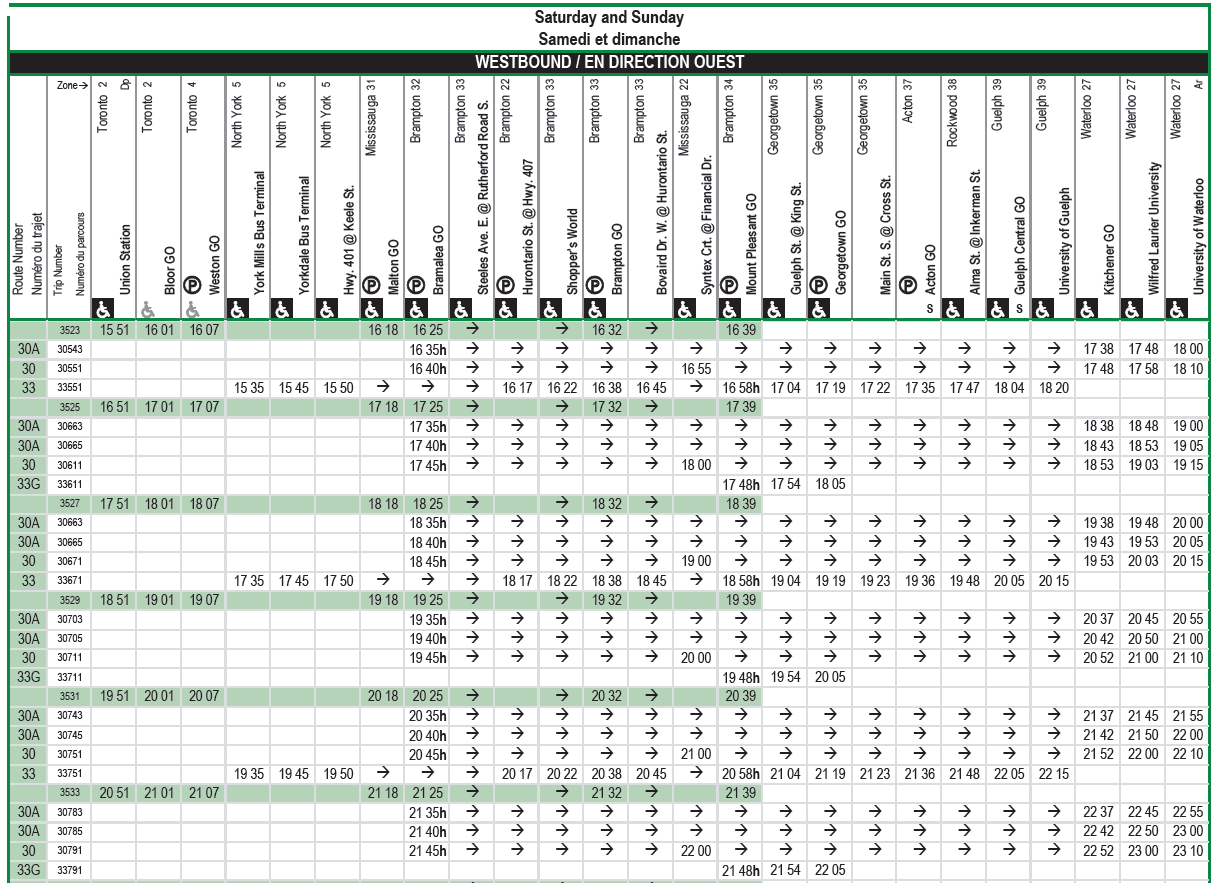
can be faster than buses, but that is not necessarily the case. Route 30A, which runs non-stop from Bramalea to Kitchener, is considerably faster than the train. For example, you can get off the Kitchener train at Bramalea at 10:09, wait five minutes for bus route 30A (which holds for the train connection), and get to Kitchener earlier than the train you were just on.
The key difference here is that all Kitchener Line trains make every single stop between Bramalea and Kitchener (even the express trains!) while the bus runs non-stop using a tollway to avoid congestion in the GTA.
I am travelling from Toronto to Kitchener. Currently there is only one train that goes directly to Kitchener in the morning at 9:34, which has you arriving at 11:22 (1 hour, 50 minutes). The next direct train is at 12:34, which has you arriving at 2:22. The rest of the trips are once every hour (ridiculously low frequency) and they only go as far as Bramlea, at which point I need to transfer to a bus, with a 15-minute wait time for that bus. For reference, the 7:34 train gets you to Bramalea at 8:10, you then have to wait for the bus that departs at 8:23, which then gets you to Kitchener at 9:36. So, 2 hours 2 minutes, assuming no traffic (unlikely). Adding in the time it takes me to get to union (lets say 40 minutes) and then the time it takes me to get to work from Kitchener GO (lets say 15 minutes), that means (assuming I don't take the direct train, which wouldn't have me arrive by 9:00 anyways), it would take me approximately 3 hours to get to my work from Toronto using transit. This trip would also cost me $17.00.
My other option is to can also drive (which takes me 1:10 minutes door to door), approximately 2 hours faster, and costs me only like $8 in gas.
The counter-peak situation is currently very bad indeed and needs to be improved. Due to the peak-period traffic congestion, that's one time of day when a direct train has a particularly large advantage over a bus.
As you've described here, the biggest issue is in fact not whether the service is operated by a bus or train, nor how frequent it is, but rather how long the travel time is. Even if we had a direct train every 15 minutes, it would still be very uncompetitive for your trip. If it takes 40 min for you to get to Union, 1h50 on the train and 15 min to get to work from Kitchener GO, then you're still looking at 2h45, which is double your quoted driving time, regardless of how frequent it is, and regardless of the fact that you don't need to take a bus.
This is my point. It is not enough to just ask for a frequent direct train service to Kitchener instead of the bus+train connection. We need to be pushing Metrolinx to operate a faster and more reliable direct train service, because the travel time on its own is already enough to dissuade many riders. That means ensuring that trains from Kitchener and Guelph make as few stops as possible, with separate local trains serving demand between Brampton and Toronto.
I wish we had high-frequency/high-speed rail, so that this trip could be cut down to ~1:00 or less, and 15-minute frequency. You would see massive uptick in usage, and it would connect all the regions so much more, making them highly desirable to live/work in.
A travel time of 1h or less would be an average speed of 100+ km/h, which is far outside of the territory of regional rail. Even the fastest regional trains in the world only average about 80 km/h. Above that is really the territory of intercity rail (stop spacing 25+ km). So Via Rail in our case. The downside of intercity rail is that it tends to be focused on much longer-distance trips (e.g. to London, Sarnia, Windsor) so they can get away with a lower degree of ticket flexibility.
See for example, the case of London UK to Oxford: although there are fast and frequent trains, they have variable ticket prices so if you just show up at the station you end up spending a fortune. Which severely undermines the flexibility of those services for regional travel.