News   GLOBAL  |  Apr 02, 2020
 11K     0 
News   GLOBAL  |  Apr 01, 2020
 43K     0 
News   GLOBAL  |  Apr 01, 2020
 6.6K     0 
Somewhere I saw a TTC diagram highlighting the locations of the tightest curves but I can't find it right now. If anyone else knows where it is, that would be much appreciated.
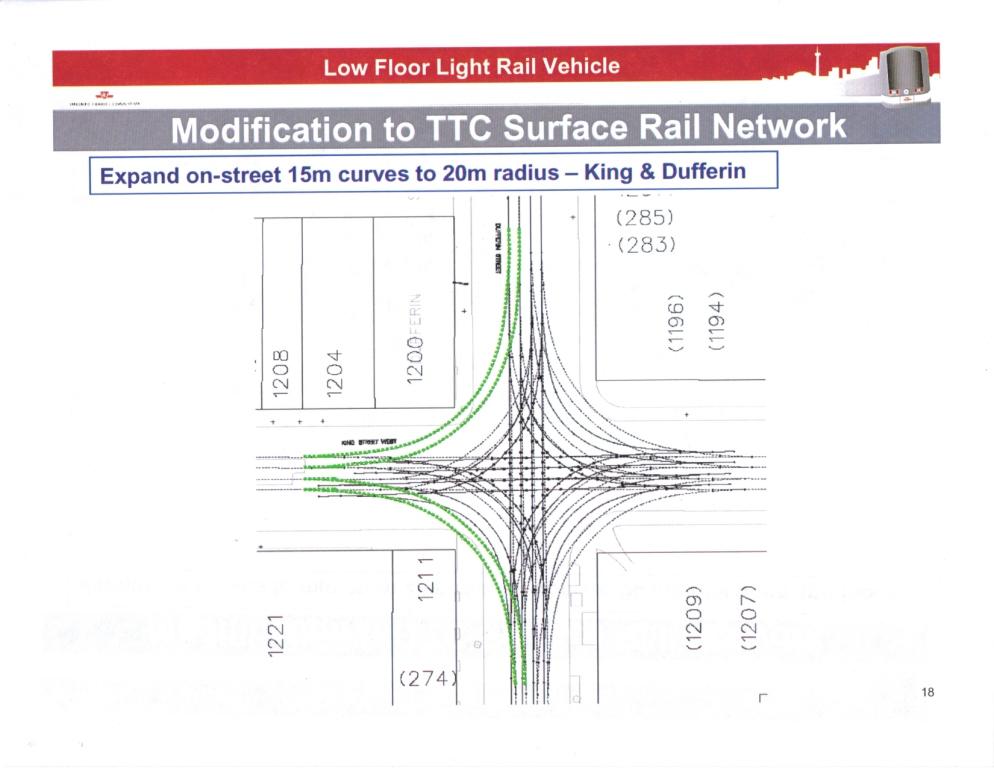
Steve Munro has an old blog post from 2008 with this diagram from a TTC presentation.

Screenshot 2026-02-18 at 7.37.09 PM.png
 
Thanks! Turns out it was a 20-metre radius they were looking at, not 25, but that's still obviously silly. They show that they can't increase the radius from 15 metres to 20 at King & Dufferin, but that misses the point that 15 metres is already far better than the 11-metre radius found in a handful of other places on the network. The question isn't whether we can increase the radius at King & Dufferin, it's whether we can bring other corners up to the radius we already have at King & Dufferin. Steve mentions in the comments that Basel has a minimum radius of 11.8 metres, Boston has a minimum of 13.5 m and Melbourne has a minimum of 15 m. Getting up to those slightly higher radii would presumably make it possible to use those cities' tram models with relatively little modification.
lflrv18c.jpg


In the same presentation they show this diagram, which suggests that there it might take as few as 5 curve realignments to get the minimum radius up to 12.2 metres, or 8 realigments to get it up to Boston's 13.5 metres.
Capture1.JPG


The purpose of that discussion in 2008 was related to an imminent vehicle procurement so yes of course the conclusion was that they couldn't rebuilt the network to make off-the-shelf streetcars fit. But after making that conclusion there was no plan set forth to address the infrastucture issues over the next half century for the next time we need to procure streetcars.

I also can't help but notice that the vast majority of the sub-15 curves crossed out on the map are short-turn or terminal loops that would be unnecessary with bidirectional streetcars...
 
Last edited:
I am not knowledgeable on other places, but I have never understood this weird situation where we like to buy only in huge, bulk orders, then no orders for the next x decades, and never piecemeal. It makes it much harder to have any form of industry here in Canada, because instead of a few, stable jobs, it's this huge burst of cold start manufacturing, hire & fire, then lose all the knowledge, and repeat.

I’ve always assumed it has to do with the TTC being long-starved for money; only able to buy new stock when the province or feds decide to open their wallets.
 
I am not knowledgeable on other places, but I have never understood this weird situation where we like to buy only in huge, bulk orders, then no orders for the next x decades, and never piecemeal. It makes it much harder to have any form of industry here in Canada, because instead of a few, stable jobs, it's this huge burst of cold start manufacturing, hire & fire, then lose all the knowledge, and repeat.

The shorter lifecycle, volume of bus transit, & private operators here makes it easier for buses, theyve figured it out there, but for rail...? TTC streetcar had no orders between '89 and '12, Line 2 got their rolling stock in '95 and probably be replaced by '30... What are manus supposed to do in the 35 year time between orders? Sit around?

When everything is bespoke, the fewer times you need them to engineer a solution the cheaper it will be.

If we could get more cities to build streetcars and subways to our standards, then the costs of buying new rolling stock would go down, and there would be a far greater likelihood of being able to buy in small batches of equipment, rather than these huge wholesale investments.

And that was the point of Transit City and all of the LRTs that are being built now in Ontario. Yes, they may differ in the details, but ultimately they are (almost) all being built to the same basic form factor and standard, which means that there should be a possibility to buy cars in smaller batches, and with less customization, from a greater number of manufacturers.

Dan
 
Last edited:
Some of the loops are for short turns. If they installed crossovers, then over time when it comes comes for new streetcars, they could order double-ended streetcars that could use the crossover tracks instead of short turn loops.
 
I'm seeing a pattern here.
Or convert into double-ended streetcars,
they could order double-ended streetcars
If the TTC went instead with double-ended streetcars
put in a order to use double-ended streetcars
If we had double-ended streetcars,
Maybe double-ended streetcars?
Not going to happen. We are never going to operate double-ended streetcars in your lifetime or mine. The single cab Flexity Outlooks and any follow-on orders from Alstom will be operating on the TTC for the next forty to fifty years, same as we did for the CLRV (1979-2019) and the PCC (1938-1995). You will never see double-ended streetcars on the TTC's streetcar network. Perhaps we'll see them on a LRT or airport shuttle in Ontario, but on Toronto’s general streetcar network? No chance.
 
Last edited:

Back
Top