News   GLOBAL  |  Apr 02, 2020
 11K     0 
News   GLOBAL  |  Apr 01, 2020
 43K     0 
News   GLOBAL  |  Apr 01, 2020
 6.7K     0 
 
That's an exaggeration of the difficulty of the terrain. The Canadian Shield is really only from east of Tweed to west of Perth, a distance of roughly 80 km. The rest of the route is largely farmland with lots of concession road crossings. For example, here's where the current trail crosses County Road 38 near Springbrook. Not exactly rugged or uninhabited.

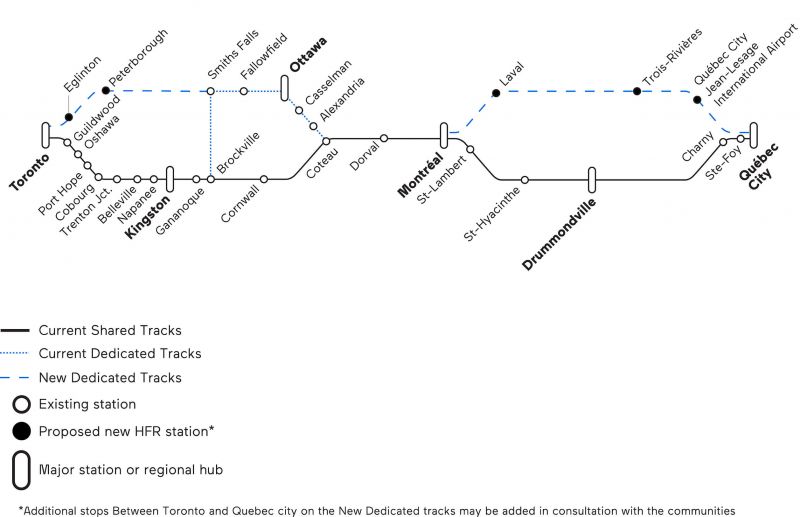
As far as we know, the JPO mandate is upgrading the existing line Agincourt-Havelock and restoring the once-built ROW Havelock-Perth substantially "as it was", albeit with a few curves improved, better superelevation, and modern signalling. And adding a dedicated VIA track Perth-Smiths Falls.

I'm dubious that the plan now involves some different route selection. That could necessitate new consultations, EA study, engineering, and land acquisition. And, new segments might take longer to build than the simpler restoration of the old ROW, especially if they are targeted to HSR standard.

Assuming a more HSR like line, with a whole different price point, also forces a whole new look at the economics of the line. That's also rework at this point.

So, while I have had lots to say about HFR's deficiencies, I'm more worried that some change in scope (even if promptly funded and launched) might lead to a later in-service date, by a year or two. I would be happier if anything that looks like a first bit of construction towards HSR were deferred in the interest of getting HFR Phase I launched and built.

I'm still not convinced that McKenna/Sabia have the floor sufficiently to redirect the decision away from HFR, in fact the "leak" may have been sour grapes if the decision leans to HFR as proposed.

- Paul

PS - If we are indeed heading for a new route selection, with the envelope no longer limited to that basic de minimus investment in the well known alignment, then I'm quite happy to offer straw man proposals within a similar scope (ie 80 km of new route selection, 15 miles of new track alongside existing CP/CN track in a shared ROW, restoration of 32 miles of abandoned ROW, upgrading of 120ish miles of existing worn-out trackage). I would likely swap the cost of 120+32 for the cost of some number of additional new miles of track alongside freight trackage, and look for an 80 km new track stretch through more favourable terrain than Tweed-Perth. For now, I won't go there unless Ottawa does.

 
Last edited:
For some rough ideas, just look at the 2010 Ecotrain study:


The F200 proposal came in at $9B for TOM. Probably closer to $11-12B today. It was $14B for TOMQ, which would be closer to $16B today. There's a lot of room between the $4B VIA proposed for the original TOMQ HFR proposal and $16B 200 kph HSR. And a lot of the Ecotrain study was using existing corridors too.

I think somewhere around $8B is probably the right price point. It should get Toronto-Montreal to around 4 hrs. Say 4:15 max. And it should get Toronto-Ottawa to under 3 hrs. That shouldn't require lots of grade separation or new corridors. Maybe just the Kaladar-Smiths Falls stretch and a few kms elsewhere to smooth out bad curves. That is something that they could get into service inside 5 years. With portions like Toronto-Peterborough and Ottawa-Montreal probably starting service inside 3 years.
 
While fares are based on demand, they also need to cover costs. Operationally HSR costs significantly more. Not only does it require significantly more energy to have a train run at a higher speed (fluid friction is proportional to the square of the velocity) but the track needs to be maintained to a higher standard. One of the biggest differences between different classes of track is the tolerances to which gauge, gaps, etc need to be kept. This tighter tolerance means more frequent inspections and repairs. There is a reason CP keeps the Havelock sub at Class 1 even though the slow speed increases costs of operating the trains by hundreds of thousands of dollars a year (3 trains a week each way times 12 hours each way equals 72 train operation hours per week or 3744 per year. Upgrading to Class 2 would cut that in half, but they obviously they don't think it is worth the cost).
While the first is true of course, you're missing that low fares would induce a boat load of demand, so you're spreading that higher capital and operational cost among way more users.

Anyways, I think this group has way too much Kremlinology on the brain. In the end, if a subsidy is needed, the Minister responsible will bring a recommendation to a committee of cabinet, and before that happens will confer with the PMO on whether to bring a single recommendation or a few options. Then the committee will set into motion the processes to get the JPO work into a proper environmental assessment for cabinet alongside a duty to consult report, while simultaneous work starts to prepare the Treasury Board further authorization. It is likely while that happens a fleet of consultants will once again be hired to keep things moving while the process works it way through.

The TMX pipeline ran into similar complaints with boosters - why can't the government be out there cheerleading? When the government is the regulator, and The Crown for the purposes of duty to consult, you can't cheer as loud as maybe people think you should.
 
Last edited:
Interesting. What this will mean for HFR is certainly unclear. I could imagine we will start seeing some scope creep on the HFR proposal. Certainly, the path ahead is far from clear.

To address the resolution without derailing HFR, the scope creep need be as simple as grade separation of as little as 20-30 miles of the HFR route, and declaring a modest higher zone speed (say 125 mph, which the Venture stock can likely handle). The government can point to HFR as the beginning step to HSR and say it is already building the first segment of an eventual HSR network.
No need to rush out and spend billions to accommodate the politics of the resolution.

- Paul
 
I hope that when we do HFR Phase II to Windsor, we can have bi-hourly service to Detroit.
Heck ... I'd settle for twice a day, let alone twice an hour!

Though I don't see Detroit being a big seller. I had the radio on the other day (a rare event these days), and the DJ was actually making fun of this ... going down the who in Toronto is going to actually want to go to Detroit - let alone by train..

Perhaps a connection through to Chicago though would be tempting.
 
Heck ... I'd settle for twice a day, let alone twice an hour!

Bi-hourly! Not semi-hourly!

And honestly, there's a case for it, if trains are going to Windsor anyway. More if connected to the airport over there.
 
Last edited:
Bi-hourly! Not semi-hourly!

And honestly, there's a case for it, if trains are doing to Windsor anyway.
Short-term I have a hard time seeing the case for any service that actually terminates in Windsor as opposed to Detroit, but that is predicated on the idea that Michigan Central can support pre-clearance and Amtrak can also terminate there with some sort of regional rail taking over Detroit - Pontiac - Flint
 
Bi-hourly! Not semi-hourly!
I honestly haven't seen the word bi-hourly before, but if bi-weekly can mean twice a week, I'm not sure why bi-hourly can't mean twice an hour. But does it really matter?

1618112562245.png
 

Back
Top