News   GLOBAL  |  Apr 02, 2020
 11K     0 
News   GLOBAL  |  Apr 01, 2020
 43K     0 
News   GLOBAL  |  Apr 01, 2020
 6.7K     0 
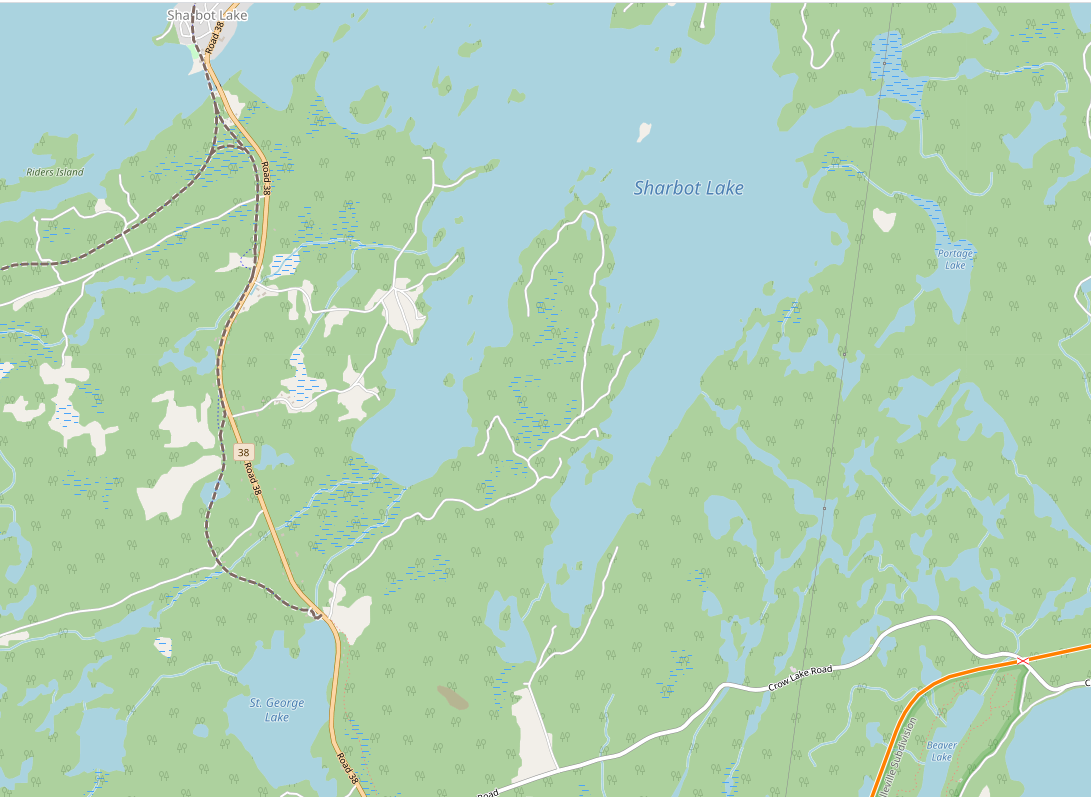
CP Belleville somewhat parallels the Havelock route between Perth and the town of Sharbot Lake. Would there be any utility in HSR trying to coexist on a widened CP Belleville beyond Perth to Meisel Woods Conservation Area (bottom right of picture below), then building a connecting track for about 7km to west of Sharbot Lake, rather than maintain 40km of winding separate route between Sharbot Lake and Perth, and the impacts on Sharbot Lake of having the trains traverse the town? About 3km could follow the former K&P, but given the terrain I wouldn't want to underestimate the difficulty of building a new alignment. Just seemed like something worth considering at least.

1618508935664.png
 
^Very interesting suggestion. I had never taken out a measurement and noticed how close the CP Belleville Sub comes as the crow flies to the K+P south of Sharbot Lake.

The problems I would see with the idea are
a) adding a track alongside the CP mainline is more expensive than rebuilding the old Havelock line on an existing roadbed. It's 20 miles from Glen Tay to the closest cutoff point on the Belleville versus 21 miles Glen Tay to Sharbot Lake on the Havelock. So costs on that section alone would favour the Havelock route.
b) The new section to reach the K+P could be as little as 3 miles as the crow flies, but I count three lowland areas and a hefty amount of swamp to cross. So either a very winding route would be needed, or an awful lot of blasting and fill. More cost.
c) The stretch between Sharbot and Glen Tay, while far from straight, is not the worst section of the Havelock line. So the time saved by taking the CP route, and heading north, would not be that significant for the money spent. 21 miles at 60 mph versus 20 miles at 100 mph plus 5 miles at 60 mph - a difference of maybe 3 minutes.
d) The Belleville Sub does run alongside some lakes with cottage properties....trading opposition in one location for opposition in other areas

The old junction was further south at Tichborne. I don't think that following the Belleville Sub all the way to Tichborne and then heading north would be faster and it's certainly much longer, therefore more expensive still.

I guess it's how much money one is willing to spend to remove the political opposition of the town. I wonder what the market value of the entire town's real estate is worth. Might be cheaper to just buy out some people.

- Paul

Screen Shot 2021-04-15 at 2.05.27 PM.png
 
That means the huge expense of HSR in the Corridor will have to be backed up by a clean nationwide fleet and when the costs are tabulated most Canadians will bulk at the idea.

to be fair, decarbonization is a medium-term project. And while I get the whole bAtTeRy TrAiNs aRe ThE fUtUrE discussion has been done to death on this site, battery technology has genuinely been progressing at a blistering pace -- they're rapidly getting both better and cheaper. It's possible that at some point, a switchover to battery trains will be the most economic option -- regardless of environmental concerns.
 
Battery trains are useless for long distance travel and will be for probably over half a century. Ya in 20 years they will be able to go from Union to London at high speeds and maybe even Windsor. Then however they will have to sit and re-charge for hours on end and time is money. It's not just getting to the destination but also the down time. Batteries for true long-distance travel on VIA's massive network is out of the question and almost laughably so. Hydrogen, for such applications, is the only option.

The good news is that freight railways realise this which is why they are not at all looking into battery but exclusively hydrogen just like the airlines, cargo, agricultural, and manufacturing sectors are. The good news is that if Ottawa FORCES CN/CP to switch to a totally carbon neutral power, which is de-facto hydrogen, then they will have to build the nationwide infrastructure to support it and VIA could 'piggy-back' onto their infrastructure............it would require new/renovated trains but the massive infrastructure costs would be born by the freight companies.
 
CP Belleville somewhat parallels the Havelock route between Perth and the town of Sharbot Lake. Would there be any utility in HSR trying to coexist on a widened CP Belleville beyond Perth to Meisel Woods Conservation Area (bottom right of picture below), then building a connecting track for about 7km to west of Sharbot Lake, rather than maintain 40km of winding separate route between Sharbot Lake and Perth, and the impacts on Sharbot Lake of having the trains traverse the town? About 3km could follow the former K&P, but given the terrain I wouldn't want to underestimate the difficulty of building a new alignment. Just seemed like something worth considering at least.

View attachment 312832

Interesting thought. Another option would be to continue to follow the Belleville Sub past Tichborne and then use the old Bay of Quinte Railway to cut over to the Havelock Sub just south of Tweed, thus bypassing both towns. Parts of it has become Marlbank Rd. though, so that would need to be addressed. In the end, I am not sure if it would be that much better.

HFR Bay of Quinte Railway.png
 
Battery trains are useless for long distance travel and will be for probably over half a century. Ya in 20 years they will be able to go from Union to London at high speeds and maybe even Windsor. Then however they will have to sit and re-charge for hours on end and time is money. It's not just getting to the destination but also the down time. Batteries for true long-distance travel on VIA's massive network is out of the question and almost laughably so. Hydrogen, for such applications, is the only option.

The good news is that freight railways realise this which is why they are not at all looking into battery but exclusively hydrogen just like the airlines, cargo, agricultural, and manufacturing sectors are. The good news is that if Ottawa FORCES CN/CP to switch to a totally carbon neutral power, which is de-facto hydrogen, then they will have to build the nationwide infrastructure to support it and VIA could 'piggy-back' onto their infrastructure............it would require new/renovated trains but the massive infrastructure costs would be born by the freight companies.
Agree on the battery front, but is it not inconceivable that electrification of sections of at least the Prairies is not that far off given the levels of traffic they're running at? I'm imagining it would be pretty natural for hydrogen locomotives to be dual mode units. Electrification for any of the mountain grade sections is probably impossible from what little I've read, though. The kind of power that 10,000 ton freight trains require to get moving from a standstill on any kind of a slope would be more load than contemporary electrical grids could flexibly provide, least of all in remote mountain passes.
 
Interesting thought. Another option would be to continue to follow the Belleville Sub past Tichborne and then use the old Bay of Quinte Railway to cut over to the Havelock Sub just south of Tweed, thus bypassing both towns. Parts of it has become Marlbank Rd. though, so that would need to be addressed. In the end, I am not sure if it would be that much better.

View attachment 312860

It certainly wouldn't cheap. It was built to late 1800s standards of alignment and has been out of service since the 1930s. The ROW would most certainly have to be entirely expropriated.
 
Agree on the battery front, but is it not inconceivable that electrification of sections of at least the Prairies is not that far off given the levels of traffic they're running at? I'm imagining it would be pretty natural for hydrogen locomotives to be dual mode units. Electrification for any of the mountain grade sections is probably impossible from what little I've read, though. The kind of power that 10,000 ton freight trains require to get moving from a standstill on any kind of a slope would be more load than contemporary electrical grids could flexibly provide, least of all in remote mountain passes.

Of course they could electrify the entire network but the cost would be ridiculously high while just changing the power systems on the trains themselves much cheaper. This is why CP recently announced that they are teaming up with Ballard to create a prototype hydrogen locomotive.........they know batteries are a non-starter and electrifying the entire system would bankrupt them. This mean CN/CP will have to create a nationwide hydrogen infrastructure system which VIA could take advantage of. Also, transforming over to hydrogen trains does not actually require new trains but rather just a retrofit as they have done in the UK and the actual passenger cars themselves don't require any work at all.

CN/CP will NEVER go catenary due to the astronomical cost and decades to build out and batteries are a laughable idea for freight. Hell the sheer weight of the batteries would probably crush the tracks beneath them. They know that hydrogen is their only alternative and VIA could take advantage of that................if you can't afford something, let someone else pay for it.
 
Last edited:
Of course they could electrify the entire network but the cost would be ridiculously high while just changing the power systems on the trains themselves much cheaper. This is why CP recently announced that they are teaming up with Ballard to create a prototype hydrogen locomotive.........they know batteries are a non-started and electrifying the entire system would bankrupt them. This mean CN/CP will have to create a nationwide hydrogen infrastructure system which VIA could take advantage of. Also, transforming over to hydrogen trains does not actually require new trains but rather just a retrofit as they have done in the UK and the actual passenger cars themselves don't require any work at all.

CN/CP will NEVER go catenary due to the astronomical cost and decades to build out and batteries are a laughable idea for freight. Hell the sheer weight of the batteries would probably crush the tracks beneath them. They know that hydrogen is their only alternative and VIA could take advantage of that................if you can't afford something, let someone else pay for it.
I'm sure that people said the same thing about having a device more powerful then the computer that send mankind to the moon fit in the palm of your hand. And that was only 50 or so years ago.
 
Via Rail already serves several towns in the 5000 population ballpark in the Corridor. Casselman, Glencoe and Gananoque to name a few. Having barebones stations in towns of that size is hardly unusual. I don't know how many people use them but it's obviously more than 1-2 per train, and it's enough to make it worth having some basic service. That doesn't turn the overall service into crap at all; most trains just go through without even slowing down.
Yes, the Express trains do not stop in these small places (only the 'milk run) BUT this means they have very few trains every day.
 
Certainly in 50 years you maybe able to drive your car 200 km on a Duracell but we don't have 50 years. Despite the dizzying rate of battery development, the idea of a freight train with 100 cars behind it plying it's way thru the Rockies is probably a century away. This is the same with air planes, cargo ships, agricultural equipment, ferries, and heavy manufacturing. NONE of these sectors are even contemplating battery systems as they know that hydrogen is the only zero emissions alternative they have. Think about it...........the Tesla SUVs are ILLEGAL on the Brooklyn Bridge because they weigh more than the bridge allows.
 
I don't imagine the battery weight presents any problems as far as the rails themselves are concerned, inasmuch as you could just attach modular battery (or hydrogen) cars, like in the age of steam. I'm just thinking that they're probably looking at the build out of catenary between Edmonton, Calgary, and Winnipeg on the main lines. Maybe in northern Ontario too. My apologies to the other folks for extending this tangent.
 
I too do not want to get off topic and don't want the thread to turn into a technology battle.

The only reason I brought it up is that this is a real canary-in-the-coalmine issue for VIA and will be a heavy expense on top of any improvements {ie HSR/HFR/Cal-Edm} that the corporation is going to have to deal with in the next 20 years. Regardless if they employ catenary, battery, hydrogen or a combination of all 3 will not change the fact they have a real financial hit coming with little to pay for it due to lack of support from Ottawa and being at the mercy of CN & CP.

I have yet to see any real long-term policy framework from VIA on how they are going to address this issue. Switching to lower emissions Tier 4 diesel trains is a stop-gap measure. VIA must have a concrete plan, both in infrastructure, technology, and cost, on how they are going to transfer over to a zero emissions rail system and so far, and correct me if I'm wrong, I have seen no such policy developments from VIA.

Ottawa wants to meet net zero by 2050 and that will require a complete decarbonising of our transportation system. and Ottawa will not be able to dictate to every other transportation supplier and provider that they go carbon-free while giving it's only transportation corporation a pass. This is a REAL challenge for VIA and they had better start planning for it because 20 years isn't very long.
 
VIA is a small fish in the North American pond - it isn't a real concern, the rest of the industry will move on, and VIA will purchase near off the shelf solutions. Easy to think of VIA like the TTC, having to think of much of a technology framework for a bespoke product. But instead VIA is in a world that has produced 5000 GE evolution series locomotives in 20 years. VIA rail has 78 locomotives.
 

Back
Top