|
|
|





You are using an out of date browser. It may not display this or other websites correctly.
You should upgrade or use an alternative browser.
You should upgrade or use an alternative browser.
- Thread starter ehlow
- Start date
Nouvellecosse
New Member
I don't have an issue with your criticism of the proposal (or criticism of the proposal in general) as we're all entitled to our own opinions. I just get frustrated when I encounter people who, despite the gravity of the challenge we face, seem to be unwilling to make any concessions or put forth any personal effort whatsoever toward solving it. But I realize I should avoid sounding judgemental as that doesn't tend to be productive and it isn't fair on an individual level without knowing a person's individual circumstances.I don’t accept your assumptions or the government’s about climate change. I’m simply stating that the government will have a harder time reaching its climate goals without a viable rail system. Yes HFR is helpful, but our trains are woefully slow and dated. Bypasses and straightening should help. Getting off the freight corridors should help, but even though going through Peterborough and accessing disused stretches of line will help, you’re still using slow trains that will continue to slow down too often to reach top speeds for very long. If the most we can hope to reduce travel time between Toronto and Montreal in 10 years is 30 minutes, then no, this is not a great plan. Put in the billions and do it right. Make people actually consider trains instead of planes or autos. This plan doesn’t go far enough fast enough.
In terms of the overall proposal, the vast majority of rail passenger kms in Europe are provided by non HSR, so I think it's pretty clear that high rail usage can be achieved under the right circumstances by providing good service at conventional speeds. Good service can be measured in a variety of ways and should include travel time, yes, but also frequency, reliability, price, comfort, etc. I think the crux of it is that it isn't a practical strategy for a government wishing to reduce carbon emissions to stick solely to the "carrots" approach by spending obscene amounts of cash on individual big ticket projects in an attempt to lure every carbon indifferent motorist and air passenger onto trains as funds need to be spread across the full domain of society. There needs to be a balance of carrots and sticks which both offers rail as a reasonable (though not necessarily bedazzled) alternative, while imposing disincentives such as carbon taxes, road tolls, and ticket surcharges on competing modes. I don't support sticks without carrots (pushing people off polluting modes without offering an alternative) but I also reject carrots without sticks because it's just not that effective.
And let's not forgot that the HFR project isn't just about emissions reduction. I'd argue that a major priority should simply be providing a better passenger experience to VIA's existing customer base. As several people have mentioned, offering increased reliability and additional scheduling flexibility are both big improvements regardless of any reduction in journey time or lack thereof.

asher__jo
Active Member
I'll just say regardless of the indirectness of the route, connecting Toronto, Peterborough, and Ottawa on a continuous route to Montreal will ensure that this line has ridership increase potential.
EnviroTO
Senior Member
The first Shinkansen series, series 0, could only go 210 km/h (only 10 km/h faster that the Siemens Charger + Venture trainset VIA is getting). They built the tracks it ran on to be passenger only because freight was slowing things down. Today that same line runs at 285 km/h. It isn't the fastest of the JR lines but it is more than adequate.
It's my hope and belief that the operating speed and times at opening are only the beginning because when they own the infrastructure they have the ability to improve it. If they can make the trips faster than the alternatives and convenient for timings and frequency then the ridership would be enough to politically sell future improvements. Today there is nothing to incrementally improve because VIA doesn't own most of the track it runs on.
It's my hope and belief that the operating speed and times at opening are only the beginning because when they own the infrastructure they have the ability to improve it. If they can make the trips faster than the alternatives and convenient for timings and frequency then the ridership would be enough to politically sell future improvements. Today there is nothing to incrementally improve because VIA doesn't own most of the track it runs on.
Bordercollie
Senior Member
As it is right now it almost takes the same amount of time to fly from Toronto to Ottawa or Montreal if you consider the time it takes to travel to the airport and wait, and then from the airport to downtown.
Especially in bad weather. And this is only assuming that the train is on time.
If you can improve the speed and ensure ontime departure and arrival then you can compete with flying.
Driving on the other hand is only going get worse.
Especially in bad weather. And this is only assuming that the train is on time.
If you can improve the speed and ensure ontime departure and arrival then you can compete with flying.
Driving on the other hand is only going get worse.

Allandale25
Senior Member
gibsonm
Active Member
I appreciate your detailed and well-researched response. I don’t dispute the value of HFR, and it will be an improvement for those who depend on the train as commuters or for mid-distance travel. I just don’t see much in the plan to entice new customers. VIA is selling reliability the way the TTC sold “state of good repair”. It’s important but uninspiring. I know the rail enthusiasts on here get apoplectic about such criticisms, but illustrating that our national passenger rail is no less mediocre than many European services isn’t especially encouraging, except perhaps in an inside baseball way.Just to put things into perspective:
Toronto is the largest metropolitan center in Canada (5.9 million in 2016) and Montreal the second-largest (4.1 million), whereas Berlin is the largest city in (and capital of) Germany (3.5 million in 2015) and Munich is its third-largest city (1.5 million).
When measuring a straight line (euclidean distance - or "as the crow flies"), Toronto's Union Station and Montreal's Gare Centrale are 504.5 km apart, whereas the respective main stations (Hauptbahnhof in German) of Berlin and Munich are 504.2 km apart.
In 1977, when VIA took over the passenger rail services of CN and CP, the fastest scheduled train between Toronto and Montreal was 4:30h, whereas between Berlin and Munich it was ... *drumroll* ... 8:45h (yes, almost twice as much!).
In 1989, when the Berlin wall fell, it was still 4:30h between Toronto and Montreal, but even 9:43h (i.e. more than twice as much!) between Berlin and Munich.
In 1992, when the collapsed GDR had been absorbed by the Federal Republic of Germany, the fastest travel time between Toronto and Montreal had fallen to 3:59h and (thanks to some urgent repairs on the dramatically under-maintained rail network in the former GDR) to 8:47h between Berlin and Munich.
In 2006, the fastest travel time between Toronto and Montreal increased to 4:15h, whereas it decreased to 5:49h between Berlin and Munich (thanks to the opening of the North-South mainline with its tunnel underneath Berlin - thus avoiding the detour via Berlin-Schönefeld Airport - and of various High Speed Lines just in time for the FIFA World Cup 2006, which upgraded speeds on 77.4 km to 300 km/h and on another 194.4 km to 200 km/h).
Finally, in December 2017, the fastest travel time between Toronto and Montreal increased further to 4:49h and was overtaken (for the first time!) by Berlin-Munich, which decreased to 3:58h, thanks to the opening of the final (but most crucial) piece of the Berlin-Nuremberg HSR axis: the 107 km long HSL Erfurt-Ebensfeld.
This means that Germany had to first invest a total of $22.7 billion in 2021 dollars (€3.6 billion by 2006 for Nuremberg-Munich and €10 billion by 2017 for Berlin-Nuremberg) to upgrade 73% of the route to at least 200 km/h and 40% even to 300 km/h, until they finally beat (by only a heartbeat!) what Toronto-Montreal had achieved for a few days during the ill-fated first passenger service trials of the Turbo Train in 1968/69 and then in regular revenue service with the LRC trains between October 1992 and May 1999 and again between May 2000 and May 2005.
So, why did Germany have to invest so much money to match the travel time which Canada achieved (over virtually the same - euclidean - distance!) almost exactly 50 years before? It's because the Kingston Subdivision is so incredibly direct: 539 km length between two points 504.5 km apart equals a detour of just 7% compared to the straight line, whereas the fastest route between Berlin and Munich (via Halle-Erfurt-Nuremberg-Ingolstadt) is still 622.0 km long, which equals a detour of 23% (compared to the straight line of 504.2 km) and is in fact only 11 km shorter than the 633 km which #51 covers between Montreal and Toronto as the only remaining M-O-T train:
View attachment 333919
Compiled from: timetable data obtained from official VIA schedules and the Fernbahn.de timetable database, as well as infrastructure data obtained from DB Netze.
Notes: above break down of speed limits refers to the design speed of the respective segments (a bit like Canada's track classes impose certain speed limits), while ignoring any more local speed limits (e.g. for tight curves). Also, the 80.8 km of 200 km/h infrastructure shown for the years 1977-2005 opened between Donauwörth, Augsburg and Munich between 1965 and 1977; however, equipment capable of reaching at least 200 km/h rather than just 140-160 km/h only seems to have been used from 1994 onwards. Finally, the fastest travel time has been found between München Hauptbahnhof and either Berlin Zoologischer Garten (for years 1977-1991 and 1993), Berlin Ostbahnhof (for years 1992 and 1994-2005, confusingly called "Hauptbahnhof" between 1987 and 1998) and the new Berlin Hauptbahnhof (for all years since its opening in 2006).
***
Why do I write all of this? Because the tragic of Canada's passenger rail sector is that whereas Germany continuously improved the travel time between Berlin and Munich (less than 9 hours by 1992, less than 8 by 1994, 7 by 2000, 6 by 2006 and less than 4 by 2018), we are paralyzed in this country, because at some point, the track was cleared from all other passenger and freight trains, so that one measly train per day (and direction) could achieve the travel time of 3:59h (or at least on paper, as more than the absolute minimum in track switches would make this travel time infeasible).
Therefore, no, the biggest liability of HFR (or any attempt to fix the Corridor at a price tag which doesn't instantly kill the project) is not the targeted travel time between Toronto and Montreal (even today's 4:49h is almost an hour faster than what was ever achieved between Berlin and Munich before the 108 km long and 300 km/h fast HSL Erfurt-Ebensfeld opened in December 2017), it's the historical coincidence that that distance has at some point been covered at just under 4 hours.
In other words: we can't have faster train service now because we once had even faster train service (even if it was just one train per day). If HFR fails and we'll still have just a pathetic 6 trains per day between this country's two largest cities in 10 and 15 years' time, then it will be mostly because of that 3:59h. I'm afraid that we will never achieve a service standard which is remotely comparable with what similar corridors in Europe receive, unless we stop compulsively talking about that stupid figure. It doesn't have the slightest effect on the benefits which any improvement to the current passenger rail services would bring...
The end user wants a fast trip. Toronto to Montreal in 3 hours isn’t the highest speed possible with existing technology, but I think it would be sufficiently fast to divert some air and auto travel. It would also represent a significant and necessary modernization. As our Air Force is mocked on South Park with fleets of WW2 prop planes, VIA is often associated with used British train sets and milk train stoppages, real or perceived. I understand that the financial constraints mean that improvements are incremental and a compromise, but really? Can we see some government investment here? There’s a lot of unspent federal infrastructure money and a climate action plan that needs fleshing out.
Bordercollie
Senior Member
What happens at the part where the old line is abandoned and the line goes south to meet the Belleville SUB?

reaperexpress
Senior Member
Do you mean like a comparison between the Ottawa route and this "bypass"?
We know the Ottawa route will take just over 4 hours.
Wheres that guy who does all of the really in depth calculations on the HFR, with charts and graphs and stuff?
Does he have like a bat signal I can call? haha. He would know.
I initially did some back of the envelope calculations for travel times, but @crs1026 and @Urban Sky proceeded to find a bunch of errors/oversights in it. I think Urban Sky would be the go-to for travel time estimates given that he has developed a very detailed spreadsheet specifically for calculating it.I think you mean @reaperexpress
Though others sometimes contribute this type of work, he is UT's most prolific at it!
crs1026
Superstar
^@Urban Sky was good enough to share some of his calculations with me off line. I am in awe of the precision of his analysis.
His data convinced me that if the line can be banked sufficiently, some of the transit times VIA is suggesting are much more credible than some of us were giving VIA credit for.
I am still a bit pessimistic about what VIA can achieve end to end given slow speed through some parts - particularly, the approaches to Toronto and Montreal where track will be shared with freight and commuter. And the segments through Peterboro, Tweed, Sharbot Lake, and Perth, and the approach to Ottawa from Fallowfield - where the regulatory and political impacts (plus curvature, urban proximity, etc) may force permanent slow orders. If one adds up the minutes required for all those stretches, and deducts from 185 minutes, the remaining segments will have to be pretty fast to get to 3:05.
I can certainly see pretty impressive timings, although 2:55 - 3:05 still feels a bit unrealistic. And I'm dubious overall that a single track line could handle more than hourly service (some press reports this past week were musing about 15 minute headways, which seems like just journalistic confusion of HFR and other things eg RER). So I'm still cautious.
Anyways, all of that was predicated on HFR 1.0.... ie only restoring the as-built former line with fairly minimal curve improvements. If Ottawa has now upgraded the plan to allow significant stretches of newer, straighter track, it's a whole new ballgame.
However^2 .....if Ottawa does intend to fund a significant new alignment construction, then I am back to wondering if that's the best place for a new line. If we can afford say 50 miles of new track through the Canadian Shield, then I'd be looking for their comparison of that plan versus other routings, such as anew direct Kingston-Smiths Falls line plus new dedicated tracks paralleling the Lakeshore line from Kingston to Toronto. But I won't go down that rabbit hole til we see more of the plan.
- Paul
His data convinced me that if the line can be banked sufficiently, some of the transit times VIA is suggesting are much more credible than some of us were giving VIA credit for.
I am still a bit pessimistic about what VIA can achieve end to end given slow speed through some parts - particularly, the approaches to Toronto and Montreal where track will be shared with freight and commuter. And the segments through Peterboro, Tweed, Sharbot Lake, and Perth, and the approach to Ottawa from Fallowfield - where the regulatory and political impacts (plus curvature, urban proximity, etc) may force permanent slow orders. If one adds up the minutes required for all those stretches, and deducts from 185 minutes, the remaining segments will have to be pretty fast to get to 3:05.
I can certainly see pretty impressive timings, although 2:55 - 3:05 still feels a bit unrealistic. And I'm dubious overall that a single track line could handle more than hourly service (some press reports this past week were musing about 15 minute headways, which seems like just journalistic confusion of HFR and other things eg RER). So I'm still cautious.
Anyways, all of that was predicated on HFR 1.0.... ie only restoring the as-built former line with fairly minimal curve improvements. If Ottawa has now upgraded the plan to allow significant stretches of newer, straighter track, it's a whole new ballgame.
However^2 .....if Ottawa does intend to fund a significant new alignment construction, then I am back to wondering if that's the best place for a new line. If we can afford say 50 miles of new track through the Canadian Shield, then I'd be looking for their comparison of that plan versus other routings, such as anew direct Kingston-Smiths Falls line plus new dedicated tracks paralleling the Lakeshore line from Kingston to Toronto. But I won't go down that rabbit hole til we see more of the plan.
- Paul
reaperexpress
Senior Member
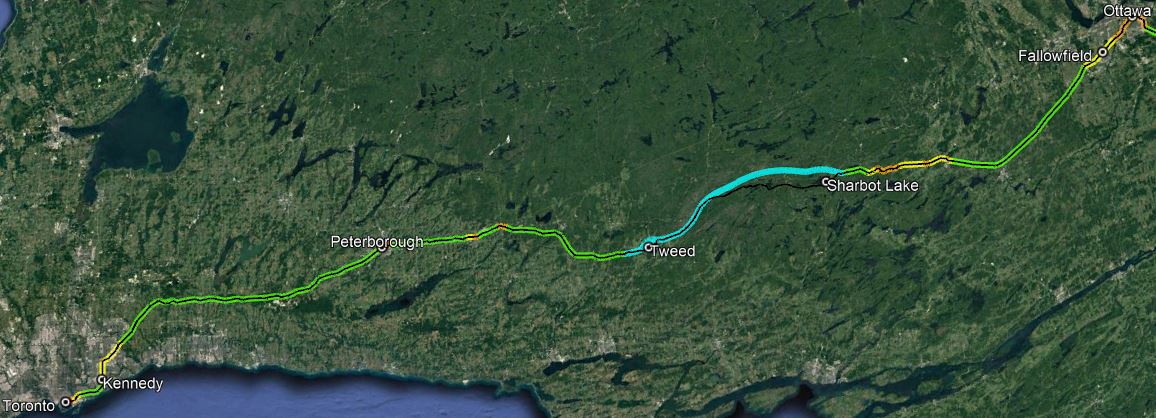
Given this discussion of 200 km/h running, here's where I can see that happening based on my non-scientific look at the existing Havelock ROW in Google Earth:
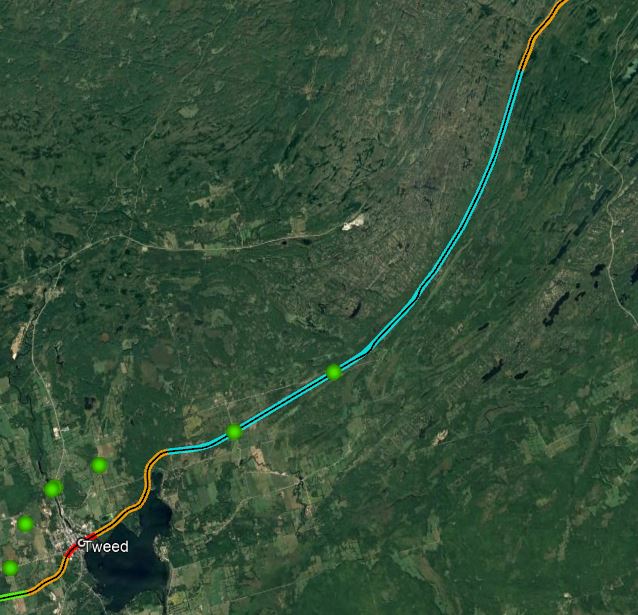
Due to the remote location, this segment only includes two road crossings (both of Sulfide Road).
This little 200 km/h zone would bring no significant travel time benefit on its own, but there also seems to be a case for new 200+ km/h lines on both sides of it.
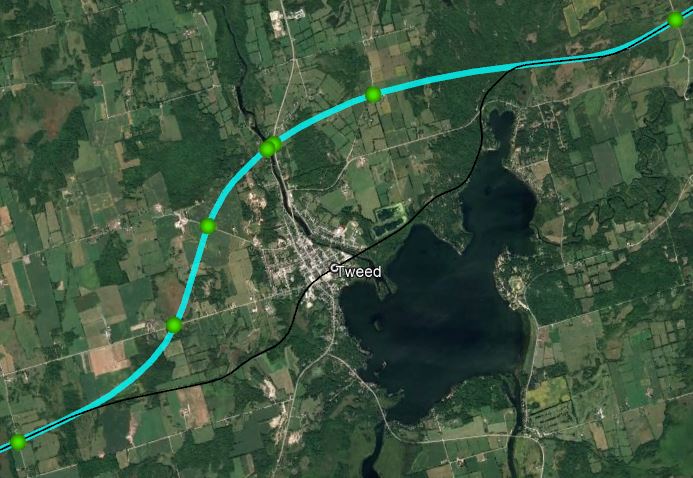
This segment would need a bridge over the Moira River, and I figure we might as well build it high enough to grade separate the two adjacent roads while we're at it.
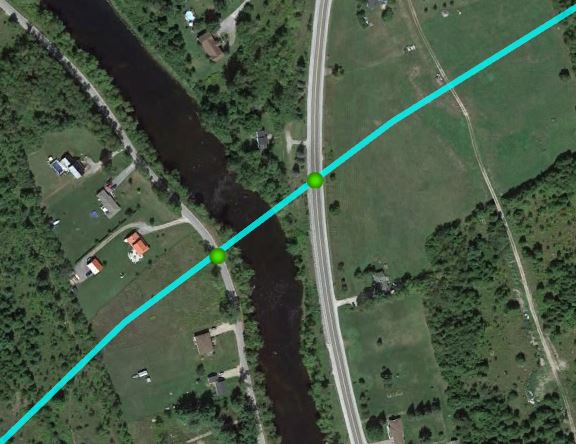
Combined with the possible 200 km/h zone along the existing ROW, this bypass would produce a 26 km (16 mi) 200 km/h zone if all 7 crossings are grade-separated, or a 22 km ( 14 mi) zone if the line is only the 4 easternmost crossings are grade separated (including the two Sulfide Road crossings along the existing ROW). In both scenarios, one of the crossings is a minor road which could alternatively be closed rather than grade-separated.
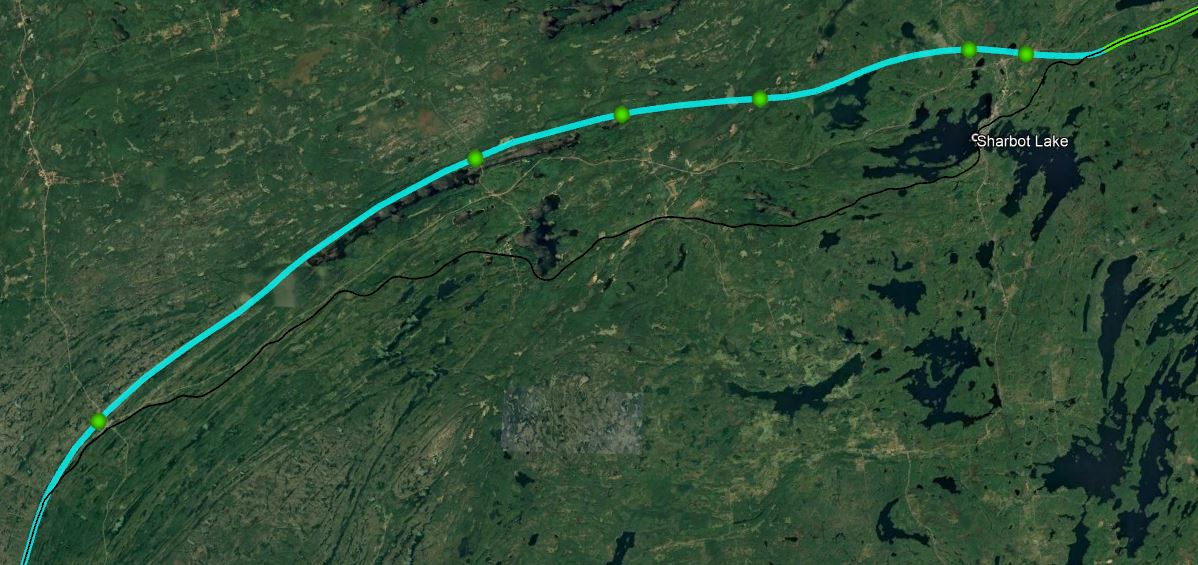
If the bypass rejoins the existing ROW east of Sharbot Lake, the length of new ROW required would be 49 km (30 mi). Combined with the possible 200 km/h zone along the existing ROW and the Tweed Bypass, there would be 75 km (47 mi) of continuous 200 km/h running.
Blue: >=200 km/h
Green: 145-180 km/h
Yellow: 105-130 km/h
Orange: 65-100 km/h
It's also worth noting that the net cost of jumping from 110 mph to 125 mph is pretty low in the Shield since there are few road crossings anyway, but building a new line along the lakeshore would mean either building tons of level crossings (not future-proof) or tons of grade separations (extremely expensive). The new lines through the Shield would also be somewhat future-proof for HSR, since it wouldn't be a big deal for an otherwise 300 km/h high speed line to slow down to 225 km/h for those 75 km through rocky terrain.
My most optimistic interpretation of the newly-discussed 200 km/h top speeds and 3h00 Toronto-Ottawa travel times is that the analysis showed that the HFR 1.0 plan wouldn't actually achieve 3h15 travel times in practice once those other factors are considered (urban slow zones, schedule padding etc). But if we do actually shell out for a 200+ km/h bypass of those really bad segments around Tweed and Sharbot Lake, it would become possible to actually beat that 3h15 target by a decent margin, even accounting for those factors.
Existing 200km/h-plausible segment
There is a 16 km (10 mile) stretch of the existing ROW just east of Tweed which could be plausibly upgraded to 125 mph (200 km/h), marked in blue on the image below. The existing Havelock ROW generally has lots of sharp curves in this area because they made only the bare minimum investment to overcome geographic obstacles, but this particular segment has quite gentle curvature because it is following a ridgeline which itself is curving very gently. There are two sharp S-bends which would need to be bypassed, but that's less than a kilometre of realignment in total.Due to the remote location, this segment only includes two road crossings (both of Sulfide Road).
This little 200 km/h zone would bring no significant travel time benefit on its own, but there also seems to be a case for new 200+ km/h lines on both sides of it.
Tweed Bypass
Immediately to the west of this segment is the town of Tweed, which is a significant political and logistical obstacle to the alignment. The existing ROW makes a sharp curve through the middle of town and crosses numerous streets at odd angles. Trains would need to slow to a crawl, and even then they would still be extremely annoying to the town residents, who would certainly demand a station as compensation. Instead, an 8 km (5 mi) bypass could be built through relatively easy terrain north and west of the town.This segment would need a bridge over the Moira River, and I figure we might as well build it high enough to grade separate the two adjacent roads while we're at it.
Combined with the possible 200 km/h zone along the existing ROW, this bypass would produce a 26 km (16 mi) 200 km/h zone if all 7 crossings are grade-separated, or a 22 km ( 14 mi) zone if the line is only the 4 easternmost crossings are grade separated (including the two Sulfide Road crossings along the existing ROW). In both scenarios, one of the crossings is a minor road which could alternatively be closed rather than grade-separated.
Sharbot Lake Bypass
East of that existing 200km/h-plausible segment is the notoriously squiggly segment which includes ploughing through the centre of the town of Sharbot Lake. As a few others here have suggested, there may be an opportunity to build a new bypass railway north of Highway 7. Since the ridgelines in this area have very gentle curvature and are running parallel to the route, the new railway line would rarely need to cross them. So there is a chance that a new high speed line here could be relatively affordable despite the rocky terrain.If the bypass rejoins the existing ROW east of Sharbot Lake, the length of new ROW required would be 49 km (30 mi). Combined with the possible 200 km/h zone along the existing ROW and the Tweed Bypass, there would be 75 km (47 mi) of continuous 200 km/h running.
Blue: >=200 km/h
Green: 145-180 km/h
Yellow: 105-130 km/h
Orange: 65-100 km/h
This is of course the 6-billion dollar question. But it is plausible that the Havelock alignment still provides better bang-for-the-buck than a lakeshore alignment even with the need to build new ROW through the Shield. The two bypass lines described above only total 55 km (37 mi) of new ROW. The rest of the existing ROW is actually fairly decent and could sustain quite good speeds with some curve realignments.However^2 .....if Ottawa does intend to fund a significant new alignment construction, then I am back to wondering if that's the best place for a new line. If we can afford say 50 miles of new track through the Canadian Shield, then I'd be looking for their comparison of that plan versus other routings, such as anew direct Kingston-Smiths Falls line plus new dedicated tracks paralleling the Lakeshore line from Kingston to Toronto. But I won't go down that rabbit hole til we see more of the plan.
It's also worth noting that the net cost of jumping from 110 mph to 125 mph is pretty low in the Shield since there are few road crossings anyway, but building a new line along the lakeshore would mean either building tons of level crossings (not future-proof) or tons of grade separations (extremely expensive). The new lines through the Shield would also be somewhat future-proof for HSR, since it wouldn't be a big deal for an otherwise 300 km/h high speed line to slow down to 225 km/h for those 75 km through rocky terrain.
His data convinced me that if the line can be banked sufficiently, some of the transit times VIA is suggesting are much more credible than some of us were giving VIA credit for.
I am still a bit pessimistic about what VIA can achieve end to end given slow speed through some parts - particularly, the approaches to Toronto and Montreal where track will be shared with freight and commuter. And the segments through Peterboro, Tweed, Sharbot Lake, and Perth, and the approach to Ottawa from Fallowfield - where the regulatory and political impacts (plus curvature, urban proximity, etc) may force permanent slow orders. If one adds up the minutes required for all those stretches, and deducts from 185 minutes, the remaining segments will have to be pretty fast to get to 3:05.
I can certainly see pretty impressive timings, although 2:55 - 3:05 still feels a bit unrealistic. And I'm dubious overall that a single track line could handle more than hourly service (some press reports this past week were musing about 15 minute headways, which seems like just journalistic confusion of HFR and other things eg RER). So I'm still cautious.
Anyways, all of that was predicated on HFR 1.0.... ie only restoring the as-built former line with fairly minimal curve improvements. If Ottawa has now upgraded the plan to allow significant stretches of newer, straighter track, it's a whole new ballgame.
My most optimistic interpretation of the newly-discussed 200 km/h top speeds and 3h00 Toronto-Ottawa travel times is that the analysis showed that the HFR 1.0 plan wouldn't actually achieve 3h15 travel times in practice once those other factors are considered (urban slow zones, schedule padding etc). But if we do actually shell out for a 200+ km/h bypass of those really bad segments around Tweed and Sharbot Lake, it would become possible to actually beat that 3h15 target by a decent margin, even accounting for those factors.
Last edited:
EnviroTO
Senior Member
They want a mix of speed, convenience, and price. When you can sit down in a larger seat, not have to shuffle through various queues, and can avoid the traffic related frustrations for less, then it seems obvious that people will see that is a viable option..The end user wants a fast trip.
Air travel = 1h20min flight, 1h15min pre-flight/check-in, 20min post-flight/get-to-curb, 45min to get to downtown Toronto, 20min to get to downtown Montreal = approx 4h.
Driving = 5h20min
HFR to Montreal = approx 4h.
That seems competitive to me and a great starting point. The Ottawa timing of 3h is even more competitive beating easily the other two options. If it is truly frequent, then it will take market share away from the airlines, and if the ridership is significant then the appetite to put more investments into the line will be greater.

innsertnamehere
Superstar
Those flight times are a bit long - total travel time is probably closer to 3:30-3:45, especially if you use Porter.
for the extra bit of time people would probably rather take the train anyway as it’s more comfortable and easier to work on board than on a plane. The reality is that you can take the train to Montreal and back in a day for a meeting and have basically no downtime.
for the extra bit of time people would probably rather take the train anyway as it’s more comfortable and easier to work on board than on a plane. The reality is that you can take the train to Montreal and back in a day for a meeting and have basically no downtime.
Bordercollie
Senior Member
The issue is that the last train to Montreal leaves Toronto at around 5:30 (Pre covid). If there was a trip that left around 8pm and could get you to Montreal by 12:30 that would be useful.Those flight times are a bit long - total travel time is probably closer to 3:30-3:45, especially if you use Porter.
for the extra bit of time people would probably rather take the train anyway as it’s more comfortable and easier to work on board than on a plane. The reality is that you can take the train to Montreal and back in a day for a meeting and have basically no downtime.
robmausser
Senior Member
I have to completely disagree with this. Of the people ive tried to convince to take the Toronto/Montreal train, or people who tried of their own volition and stopped, every single person stopped for one reason: they were on a train that was hours late. Prior to that experience, they enjoyed the train and found the 4.5h trip from Toronto to Montreal faster than driving and more convenient than flying.VIA is selling reliability the way the TTC sold “state of good repair”.
Every single one, and these people continually now badmouth VIA for their terrible ontop performance. Its in my opinion the single most important issue facing VIA at this moment. One really bad trip with terrible ontime performance is all it takes and then this person not only nixes VIA, but lambastes them to others.
Were not talking about a train being 5 minutes late, we are talking about trains being quite commonly an hour late+