News   GLOBAL  |  Apr 02, 2020
 11K     0 
News   GLOBAL  |  Apr 01, 2020
 43K     0 
News   GLOBAL  |  Apr 01, 2020
 6.7K     0 
This is a tough problem. Hitachi is working on train to do a 300mile route in the UK from battery but that's the longest I've seen. Most target a 100 mile.

A battery powered The Canadian train appears technically possible but it'll be a royal pain in the ass due to the very large distances between major stops.

A company in Utah sells 1MWh of stored energy within a standard 40 foot container (designed for solar storage; they have a 1 hour quick-charge time and about a 4 hour discharge-time) but you probably need 25 to 30 containers to make the trip from Toronto to Winnipeg. Obviously some electronics needs to change to power a locomotive but it seems useful to use an off-the-shelf product as a reference point.

Charging at small towns isn't practical; the grid wouldn't support it. So charging would be major stations only likely via a cruise-ship style 8MW plug over a 90 minute period OR swapping the battery cars.

In either case, they're hauling around 50-60 tonnes of battery (that's lighter than expected) and making the train 50% longer if double-stacked.
This type of application is suitable for GO transits lakeshore line. They can recharge at end point and at Union.

The only problem is that if for whatever reason the train is late and you need to turn the train and around faster it will be physically impossible to do that because the train nerds to charge at each end point.

For example if train A arrives at Oshawa and has a dwell time of 30 minutes but has a technical problem. With a 15 minute frequency when train B arrives it will need to de-train and then immediately leave to take train A's trip. It won't have the 30 minute dwell time to charge.

So that means to account for this you need to either be able to cover a round trip on one charge OR have an extra trainset idle to maintain schedule.

I think if it's for a less demanding application, it could be suitable like rush hour only from Richmond Hill to Union and then then it would have time to charge before departing for its next trip.
 
VIA also has another problem which they generally ignore................they have to decarbonize their fleet.

There is no way, in hell, that Ottawa will demand the people and businesses spend money and effort to reach net-zero by 2050 and yet gives one of it's key Crown Corporations a pass. We are also not just talking about the Corridor either but the entire network from Vancouver to Halifax.

I don't think we are going to see any electrification of the routes within 10 years. Not until battery and hydrogen technology develop and the infrastructure is in place will Ottawa really consider zero emission vehicles for VIA. The first such trials would obviously take place in SWO and possibly Ottawa to Montreal.

The climate crisis is a real issue but as somebody that has had experience working on large battery systems, I do not believe that they make sense for the vast majority or railway applications even with improvements with battery technologies. Railways not only face the standard battery challenges of weight, range, and changing time, but are also presented with the opportunity of using a direct connection to the electric grid to avoid these issues! Ofc batteries can make sense for limited applications such as minor branch lines and perhaps short sections where catenary installation would be exceedingly difficult. Lithium batteries are an amazing technology that are exceptional in many applications but, like any technology, they should not be viewed as a cure-all.
 
The climate crisis is a real issue but as somebody that has had experience working on large battery systems, I do not believe that they make sense for the vast majority or railway applications even with improvements with battery technologies. Railways not only face the standard battery challenges of weight, range, and changing time, but are also presented with the opportunity of using a direct connection to the electric grid to avoid these issues! Ofc batteries can make sense for limited applications such as minor branch lines and perhaps short sections where catenary installation would be exceedingly difficult. Lithium batteries are an amazing technology that are exceptional in many applications but, like any technology, they should not be viewed as a cure-all.
Lets think about this:
One 12 car GO train can carry 1400 people in seats. That's the equivalent to 1400 cars not on the road creating congestion assuming people dont car pool.
Trains have much lower rolling resistance than cars, which already makes this very efficient.
The carbon emissions from one train is significantly less than 1400 cars.

Making this more efficient using whatever new technology that costs millions of dollars takes away money from projects to expand the use of transit. You need to do it as cost efficient and attractive as possible.

Lets also walk before we run, so maybe Hybrid Diesel Locomotives might be something we should adopt first seeing that it's a readily available and proven technology.

That is likely going to be cheaper and more realistic than spending billions running cables eveywhere when you dont even own all the track.

And dont even get me started on Hydrogen and how you will fuel those locomotives, and train everyone on how to maintain them.
 
VIA also has another problem which they generally ignore................they have to decarbonize their fleet.

There is no way, in hell, that Ottawa will demand the people and businesses spend money and effort to reach net-zero by 2050 and yet gives one of it's key Crown Corporations a pass. We are also not just talking about the Corridor either but the entire network from Vancouver to Halifax.

I don't think we are going to see any electrification of the routes within 10 years. Not until battery and hydrogen technology develop and the infrastructure is in place will Ottawa really consider zero emission vehicles for VIA. The first such trials would obviously take place in SWO and possibly Ottawa to Montreal.

You seem to struggle with understanding what "net zero" means. It doesn't mean "zero emissions".

Aside from the fact that government targets three decades away are kind of dubious and that you shouldn't extrapolate national level targets down to individual agencies, let alone individual operations, a net zero target could be easily achieved for VIA, as long as the Corridor is electrified. Most of the rest of its network is a substantially smaller portion of emissions, such that a combination of lower emissions intensity fuels (such as synthetic biodiesel) and a few offset projects, can more than make up for those emissions. And that's if the federal government cares. VIA's non-Corridor emissions are miniscule compared to what the rest of the Government of Canada puts out, particularly the agencies involved in security and stability operations (CAF, CCG, RCMP, CBSA, DFO). Heck, Canada Post has higher emissions than VIA Long Haul.

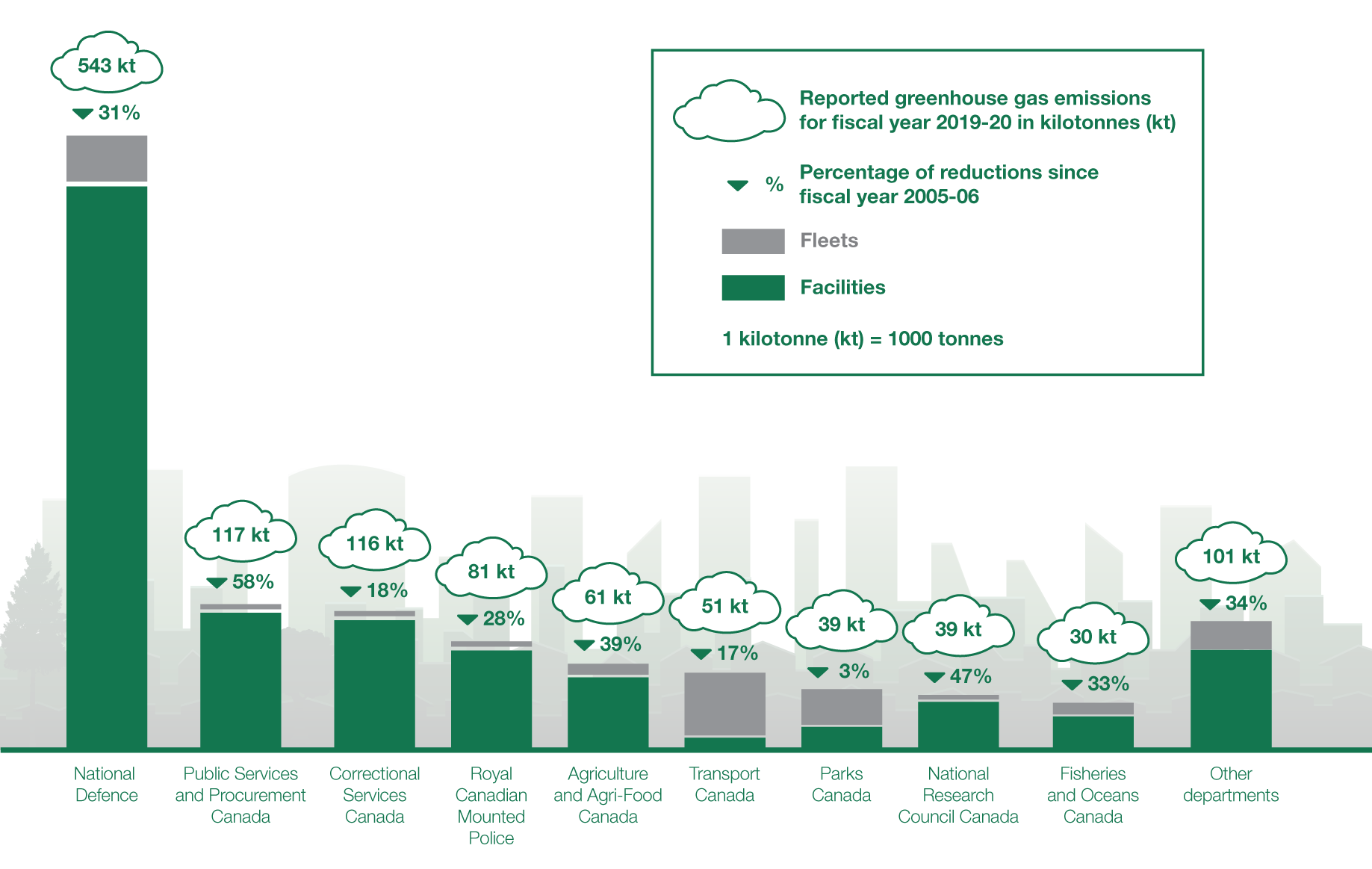
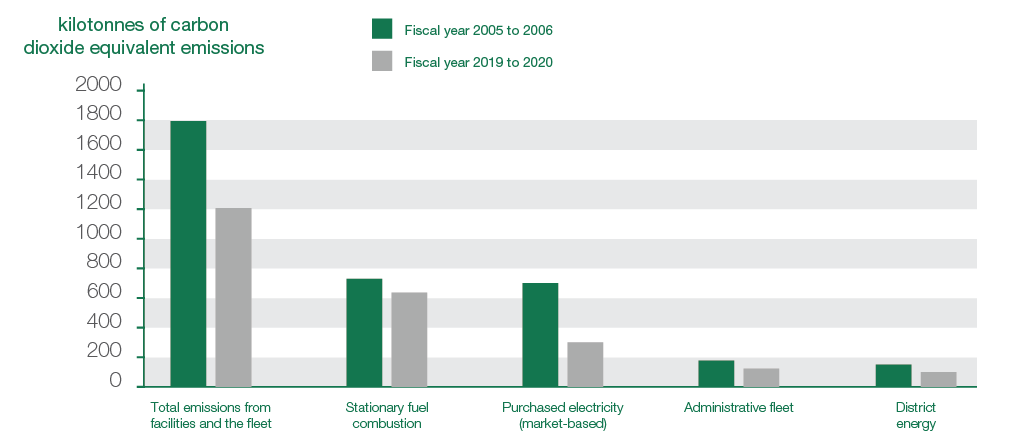
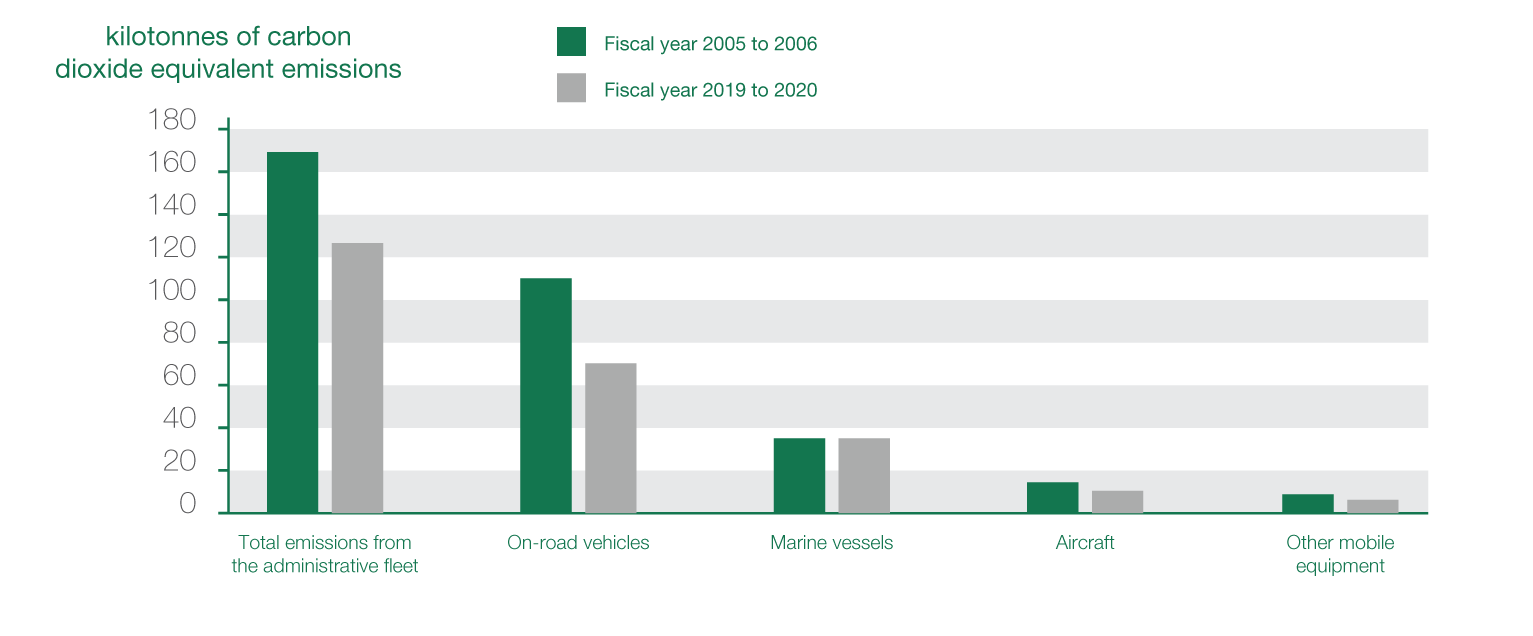
Edit: Just to add some further data to make it clear, just how unimportant VIA's emissions are, just look at which departments and operations really generate emissions:

  • In fiscal year 2019 to 2020, the top 6 emitting organizations (National Defence, Public Services and Procurement Canada, Correctional Service Canada, Royal Canadian Mounted Police, Agriculture and Agri-Food Canada and Transport Canada) generated 82% of the Government of Canada’s real property and administrative fleet GHG emissions

20200127ghg-fig04-eng.png

20200127ghg-fig01-eng.png


20200127ghg-fig03-eng.png

Source: https://www.canada.ca/en/treasury-b...anada-greenhouse-gas-emissions-inventory.html

As a point of comparison, VIA Rail's total Scope 1 and Scope 2 emissions in 2019 were 146 212 tCO2e, as per VIA's 2019 Sustainable Mobility Report. Emissions avoided, is estimated at 289 177 tCO2e. Scope 1 and 2 emissions will fall substantially in the coming years with the new fleet. And emissions avoided would go up substantially with HFR.
 
Last edited:
Not meaning to shoot the messenger here, but...

That smells pretty strongly of marketing bunk. If they were simply overhauling for continued service - replacing like for like - then there should be no concerns with the locos going forward. If that was the case, than CN would be screwed with their hundreds of 1950s-era locos still running every day.

I know that parts for them are starting to become harder to come by - I've certainly said as much here before - but for VIA to throw up excuses such as those is more than a bit unseemly, verging on outright lying.

Dan
 
Not meaning to shoot the messenger here, but...

That smells pretty strongly of marketing bunk. If they were simply overhauling for continued service - replacing like for like - then there should be no concerns with the locos going forward. If that was the case, than CN would be screwed with their hundreds of 1950s-era locos still running every day.

I know that parts for them are starting to become harder to come by - I've certainly said as much here before - but for VIA to throw up excuses such as those is more than a bit unseemly, verging on outright lying.

Dan
I would rather argue that CN would be much more screwed than that if they were still running "hundreds of 1950s-era locos [...] every day", as you bizzarly seem to claim...
 
What is happening at National Defense facilities? Is the heat on max and someone left the hangar door open?
 
You seem to struggle with understanding what "net zero" means. It doesn't mean "zero emissions".

Aside from the fact that government targets three decades away are kind of dubious and that you shouldn't extrapolate national level targets down to individual agencies, let alone individual operations, a net zero target could be easily achieved for VIA, as long as the Corridor is electrified. Most of the rest of its network is a substantially smaller portion of emissions, such that a combination of lower emissions intensity fuels (such as synthetic biodiesel) and a few offset projects, can more than make up for those emissions. And that's if the federal government cares. VIA's non-Corridor emissions are miniscule compared to what the rest of the Government of Canada puts out, particularly the agencies involved in security and stability operations (CAF, CCG, RCMP, CBSA, DFO). Heck, Canada Post has higher emissions than VIA Long Haul.
Net Zero simply means that you need to be able to offset the emissions you put into the environment.
I would rather argue that CN would be much more screwed than that if they were still running "hundreds of 1950s-era locos [...] every day", as you bizzarly seem to claim...

So that means that after they are retired from VIA someone like ONR could purchase them and put them into service on the Nothlander should that service return. Or surplus F59's from GO transit.
 
What is happening at National Defense facilities? Is the heat on max and someone left the hangar door open?

Partly the nature of the work, partly the fact that DND has a ton of facilities, often in remote areas where fuel must be shipped in, and partly the fact that most buildings on our bases are half a century or more old.
 
Partly the nature of the work, partly the fact that DND has a ton of facilities, often in remote areas where fuel must be shipped in, and partly the fact that most buildings on our bases are half a century or more old.

Not to mention the supersonic jets and ancient navel vessels neither of which are particularly low carbon.
 
So that means that after they are retired from VIA someone like ONR could purchase them and put them into service on the Nothlander should that service return. Or surplus F59's from GO transit.

I won't go down a rabbit hole and debate what ONR might do if the Northlander returned, but your suggestions sound like a railfan fantasy. I would expect ONR to stick to what they know worked for them and fits their own maintenance direction.... ie the non-turbocharged EMD dual service power they know and love.. But who knows, they may be ready to switch to something else fleet-wide.

GE (and several rebuilders) are very proficient in the art of developing and pitching refurbs of older products, sometimes bringing them up to a new standard and sometimes not changing what isn't broken. One has to assume that they have talked with VIA and Amtrak. It's pretty obvious that both customers see better value in buying new.

One also has to assume that Siemens has a proposal ready to address the long distance fleet. As a matter of standardisation, updated technology, and emissions, they may have the edge over a rebuild proposal.

The attrition of the existing VIA loco fleet as the Chargers arrive will likely look like the attrition of the TTC ALRV/CLRV fleet.... a few junkers deactivated early and stripped for parts, then more taken out of service when anything costly fails, and then the still-operable survivors gradually set aside as new units roll in. Offers to purchase may come in for dead units as VIA's surplus function tenders for their removal. Some supplier might even try to flip a few to other customers overseas. The units will go wherever the best offer takes them.... that may be to a scrapyard, or not.

I suspect that the F40's can be kept running long enough for the long distance railcar fleet to reach end of life. If that event doesn't trigger renewal, the locos can be retired then... and if anyone proposes building a new LD fleet, new locos will not be a prohibitive cost.

- Paul
 
Partly the nature of the work, partly the fact that DND has a ton of facilities, often in remote areas where fuel must be shipped in, and partly the fact that most buildings on our bases are half a century or more old.

Approximately 20,000 buildings, including residential housing and massive hangars. It does seem weighted heavily to 'facilities' though. I wonder if the if the maritime fleet is being somehow captured by that category.
 
That smells pretty strongly of marketing bunk. If they were simply overhauling for continued service - replacing like for like - then there should be no concerns with the locos going forward. If that was the case, than CN would be screwed with their hundreds of 1950s-era locos still running every day.

How many of those "1950s-era locos" have a monocoque design? Most locomotives use a body on frame design, which makes upgrading the cab or fuel tanks without compromising the structural integrity of the locomotive much easier.

I do find it interesting that Amtrak and NJT refurbished their older P40DCs , but both Amtrak and VIA are retiring their newer P42DCs. Makes me wonder if GE broke something when they did the redesign. Either that or the refurbishments began before the new crashworthiness standards came into effect.

So that means that after they are retired from VIA someone like ONR could purchase them and put them into service on the Nothlander should that service return. Or surplus F59's from GO transit.

I guess if ONR wanted unreliable locomotives that might breakdown, potentially loosing HEP in a remote northern community in the middle of winter, then sure. More than likely they will either be sold for parts or scrap, though a foreign country that doesn't have strict crash worthiness standards might buy them.
 
Last edited:
The long haul fleet is about 235 coaches and 28 locomotives.

Big replacement for VIA. But not that huge a replacement in the grand scheme of things. And given that the Siemens Venture sets are based on the Siemens Viaggio Comfort design, I don't see why Siemens couldn't simply make the Railjet/Nightjet design compliant to North American standards to win any long haul fleet order. It's an order that would be worth at least CA$1.5B. And at least for VIA, commonality would be a giant benefit. But even if Siemens doesn't win, going down to just two fleets would be a large gain for serviceability.

I hope we see an RFP in 2024, after they've had 2 years of experience with the new fleet and can tweak the RFP based on lessons learned.
 

Back
Top