


News   GLOBAL  |  Apr 02, 2020
 11K     0 
News   GLOBAL  |  Apr 01, 2020
 43K     0 
News   GLOBAL  |  Apr 01, 2020
 6.7K     0 
(Post continued from above)

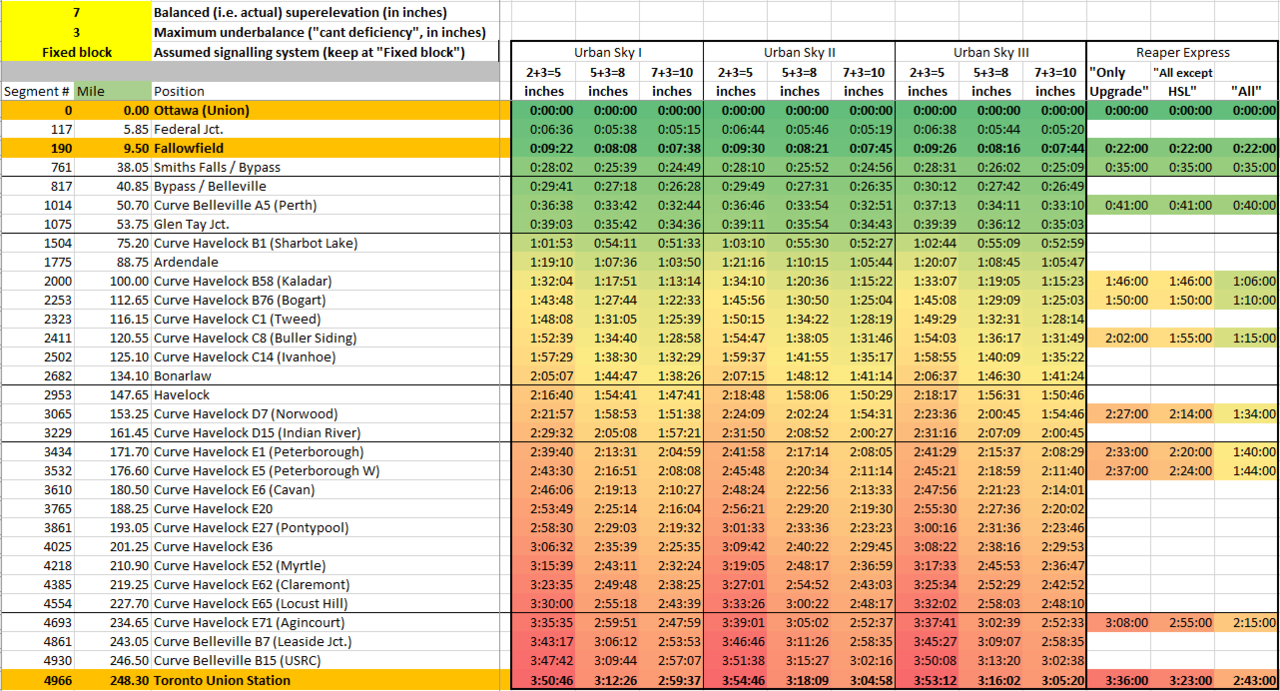
First off, I have modelled the travel times for 5, 8 and 10 inches of total superelevation (i.e. actual and unbalanced superelevation combined) in three iterations for each:
  • In my first set of calculations (called "Urban Sky I" in above table), I had ignored the problem of reversed curves ("s-curves").
  • In my second set of calculations (called "Urban Sky II" in above table), I had tried to somewhat approximate the combined transition length of a reverse curve and then work out the maximum level of superelevation to maximum the speed allowed after respecting the requirements for transition lengths and tangent lengths.
  • In my third set of calculations (called "Urban Sky III" in above table), I only measured the tangent track between the curved sections of reverse curves and then set the maximum speed so that the spiral lengths would not exceed the length of the tangent track (i.e. the "straight segment") in between the reversed curves.
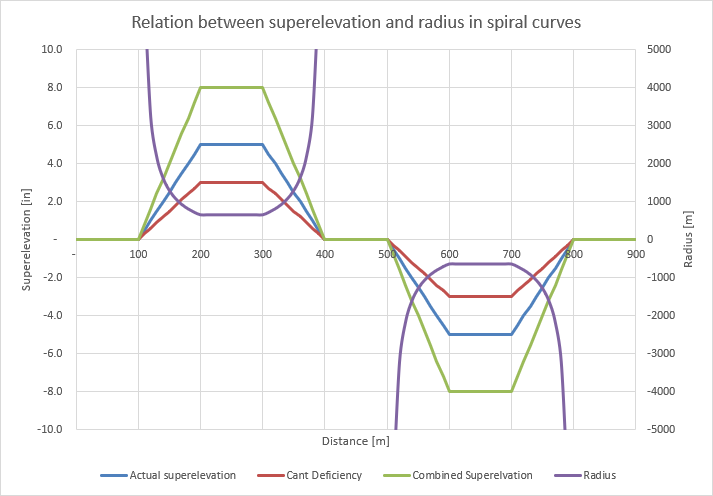
Even though the second approach closer resembles in real-life, it is impossible to measure a spiral length with the tools available in Google Earth plus, as the radius of a transition curve changes from infinity (where the track starts curving) to the radius of the main part of the curve), as shown for a hypothetical spiral curve (with a radius 650 meters and a maximum allowable speed of 65 mph) below:
1603073147117.png

Source: own work
Note: tangent track sections are where the superelevation is zero and transition sections are where the radius and superelevation change.


Consequently, it was more practical to only measure the transition lengths and to arbitrarily set the superelevations (balanced and unbalanced) in a way that the resulting spirallengths would not exceed the transition lengths, which is why I set the superelevation values to a balanced (actual) superelevation of 5 inches and a cant deficiency (unbalanced superelevation) of 3 inches, because 5 inches of actual superelevation requires a minimum spiral length of 96 meters, while 3 inches of cant deficiency in combination of a maximum speed of 65 mph requires a mimimum spiral length of 97 meters.

I refer to Part 3 of my "modelling travel times for the Havelock alignment" exercise if anyone struggles to make sense of the above, accompanied by the following excellent video by Gareth Dennis (a UK-based railway engineer which also teaches at university and an enthusiastic audience through his Youtube channel):


Long story short, I simulated travel times between 3:50 and 3:55 for 5 inches of total superelevation, between 3:12 and 3:19 for 8 inches of superelevation and between 2:59 and 3:06, which suggests that the (previously or currently) existing alignment of the Havelock route might at least theoretically allow a travel time of 3:15:
1603073186703.png

Compiled from: own calculations with geographical and track alignment data approximated with the help of Google Earth

But on the flipside, if that line does get built, it may be possible to even beat the 3:15 estimate. Including the real-world factors, maybe the 2:47 theoretical minimum could plausibly correspond to a real-world scheduled time in the ballpark of 3:00-3:10.
We will of course need to add some more of the "real-world factors" you mention, but I will of course share my spreadsheet with my calculations with you and @crs1026 in the next few days so that you can add a few more constraints and fix some of the shortcomings, such as:
  • The acceleration and deceleration capabilities of the electrical trainset I had selected for my Master Thesis (and thus also for this exercise) may exaggerate the capabilities of VIAs future (fuel-operated) fleet
  • Local speed limits (in addition to those imposed by track geometry) might apply when traversing built-up areas such as around Ottawa, Peterborough and Toronto
  • Tracks shared with freight traffic might permit only lower levels of superelevation than those which will be dedicated to passenger trains
Afterwards, you will also be able to estimate how much realignments are needed to get the travel time back to 3:15...


Personaly I'd like to see the third option persued right off the bat, rather than reinstalling tracks along the crappy segment of the CP ROW and then abandoning them later.
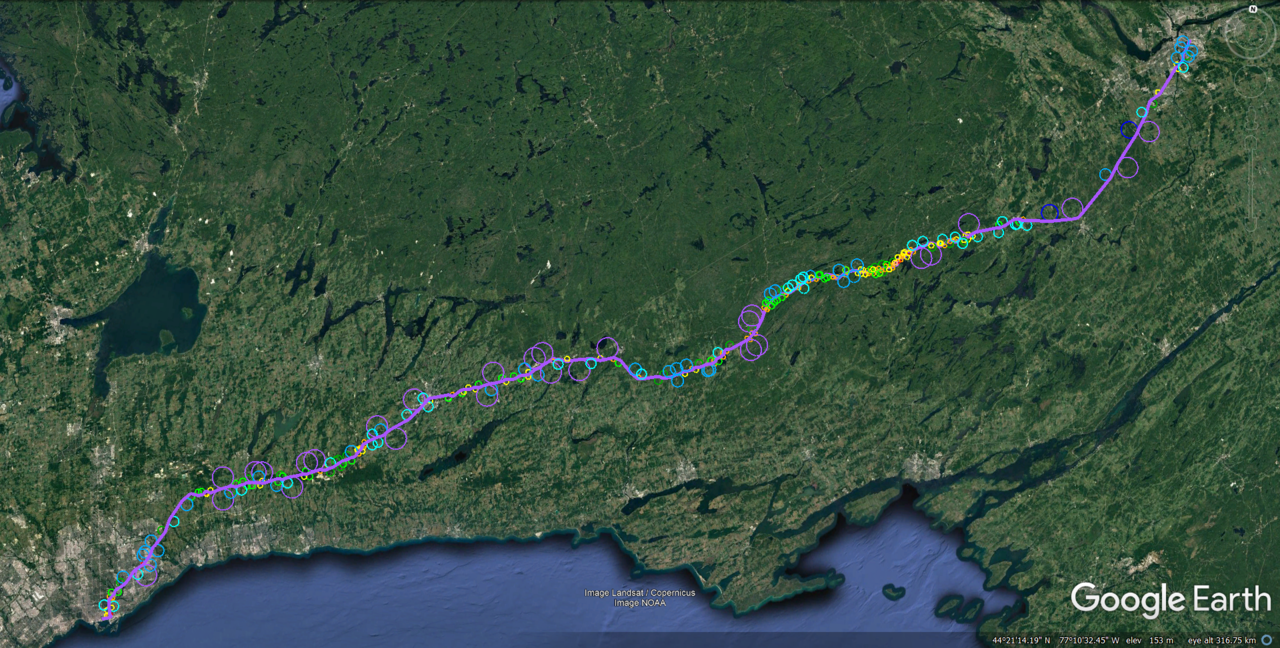
You really have to get your head around the fundamentals of cost-benefit analysis, which is calculating the Net Present Value and dividing the incremental benefits of a project by its incremental costs, as the more you re-align the existing/former ROW, the less will be the incremental benefit of upgrading later to HSR (as it's most important component is "travel time saved"), while the incremental cost will be basically the same (as you will hardly be able to justify the extra expense to design HFR with a minimum radius in excess of 4 km, like what would be required for speeds of 300 km/h and more). At the same time, I would expect politicians in Kingston to change their attitude from supportive to hostile if they start to sense that HFR is making the creation of a HSR route serving their city less rather than more likely. The challenge is therefore to design HFR in a way that keeps the capital requirements (and thus the travel time savings) minimal, but opens up the avenue for a cost-effective upgrade towards HSR. Given that quite a few curves seem to already have a radius of 3000 meters (which would allow 155 mph or 249 km/h at a superelevation of 10 inches), designing any realignments required for HFR with the same radius could ensure that they can be eventually reused by HSR:
1603076578983.png


In the end, that's how HSR was built in Germany: upgrade existing alignments where they are straight enough to allow 200-250 km/h (an approach called "Ausbaustrecke" and used for Hannover-Berlin, Hamburg-Berlin-Leipzig and Köln-Aachen) and build greenfield HSR alignments for 250-300 km/h (called "Neubaustrecke") wherever existing alignments are too winding to achieve speeds which would be acceptable for HSR (e.g. Hannover-Würzburg, Köln-Frankfurt and Halle/Leipzig-Erfurt-Bamberg)...


The project could be phased to first upgrade Toronto to Peterborough, and start a basic service on that segment to develop ridership and interest (a.k.a ribbon cuttings for politicians) while works continue on the HSL further east. That would be similar to how Brightline started its operation with service on the upgraded line from Miami to West Palm Beach, while work continues on the new 125 mph railway to Orlando.
I've actually done a research trip* to Miami as I was planning to include Brightline as a case study for my Master Thesis (which at that time had a scope which was orders of magnitude larger than the small subtopic I eventually retained as my research question), but if you look at the at the actual passenger counts and revenue streams they've actually generated while operating between Miami, Fort Lauderdale and West Palm Beach (operations have been suspended since March, for obvious reasons), then running such a commuter-distance service is hardly worth it. Also, Brightline limits itself to 110 mph on all segments which are within existing rail corridors (which is the same as what Brightline is doing) and only designs its greenfield alignment between Orlando and Cocoa for 125 mph...

* admittedly, I spent far more time at the beach and sampling fast food chains (my favorite: Pollo Tropical) you can't find here in Quebec
 
Last edited:
It’s been exactly two months since @reaperexpress published his post about "mythbusting VIA's HFR travel time claims" and I'm finally able to provide some comments onto his post (strictly as a transport enthusiast, of course!).

I've said it before, but I'll say it again, many thanks for your contributions. Given how long it took me to do a very very rough back-of-the envelope look, I can only imagine how many hours you have invested in this exercise.

I'd also like to point out that in those two months since I've published that post we've also had many informative disussions here which have changed my estimations and opinions. I no longer stand by some of the things in that post (I've been thinking i need to go back an make a new version but figured I might as well wait until you were finished your analysis). In particular you and others have looked much more in-depth at the relationships between speed, radius and superelevation.

The assessment of any transportation project always starts with establishing a "Status Quo" (or more accurately: "do nothing") scenario and that's why I start with today's travel times, even though he omitted that part in the summary he posted here:

Train 56/646 even ran the 446 km between TRTO and OTTW in only 3:46 hours (TRTO 16:35 / OTTW 20:21) in the January 2014 schedule (which is the fastest timing I found in my database) and Train 43 ran the distance in 4:05 hours (OTTW 07:20 / TRTO 11:25) until Corona struck (while the reduction of frequencies and the addition of extra stops on the remaining trips has now inflated the fastest travel time to exactly 4:30 - Train 55: OTTW 15:23 / TRTO 19:53). However, we should rather look at the average scheduled travel times, as they are much more representative for the travel times passengers are currently promised (even though they still understate the travel time passengers actually achieve) and by doing so, we quickly see that that metric has hovered between 4:20 and 4:37 hours in the last 12 years, which I believe to be very accurately described as "travel times of approximately 4 hours and 30 minutes":

VIA's statement "travel times from Ottawa to Toronto as low as 3 hours and 15 minutes" appears to be referring to a best-case travel time (i.e. the fastest trip), not the average travel time over the course of the day. The comparable metric in present and past schedules is therefore the fastest trip, not the average trip. Our plausibility-check methods also represent a best-case travel time given that they do not account for multi-train scheduling challenges (slowing/stopping for meets, switching tracks, etc).

You are assuming that you need to upgrade the entire route to be suitable for 110 mph, but an average speed of only 76.4 mph (i.e. 69% of the top speed of 110 mph) is needed to achieve a travel time of 3:15 hours over a distance of 400 km (which is of course challenging enough). Therefore, the key question for how to achieve 3:15 hours is not "how do we upgrade the 102 kilometers from Kaladar to Smiths Falls to 110 mph", but "how can we achieve an average speed of 76.4 mph over the total distance with the least capital costs possible".

At the time my "research" question was "how much of the route could be upgraded to 110 mph with only minor realigments to the ROW". I never suggested that the whole route needs to be 110 mph - obviously that would result in an average speed better than 76.4 mph over a 400 km route.

The bottom line is: we know what building an alignment for speeds beyond 110 mph costs ($13-17 million per km, thus approximately $1.4-1.7 billion for your "new 102-kilometre high-speed railway from Kaladar to Smiths Falls" you propose further below) and we know that nobody is willing to pay the tab at the moment (or for at least as long as passenger intercity rail remains a niche mode). Therefore, I'm afraid that it's rather pointless to contemplate making extended greenfield alignments part of HFR...

Actually I was talking about a ~140 mph line, so the cost would be well over $2 Billion. But anyway it's a moot point.

My overall strategy at the time was consistent with what you said earlier: "how can we achieve an average speed of 76.4 mph over the total distance with the least capital costs possible".

However, based on further thought and our discussions since then, I no longer think that that is the most resilient strategy. In order to keep the door open for incremental improvements in the future, I now think that it is best to dispropotionately focus investments on the "better" segments of the existing ROW, since those are the most likely to stick around in the future. It is much easier to "upgrade" an alignment while there is negligible train service, whereas building a totally new alignment is equally easy whether we do it now or later.

Unless I missed something when measuring the curves in Google Earth, there is only a single track without any sidings between Smiths Falls and Glen Tay and thus on a ROW which historically had two tracks (and the missing track is conveniently the more Northern one). To illustrate, this is how the level crossing with one of Perth's main streets looks like:

Therefore, building an entirely new ROW between Smiths Falls and Glen Tay (or beyond) is only one of the available options.

When I suggested building additional tracks in the CP Midtown corridor for GO service, I got some responses suggesting that it would be impractical to share a ROW with CP even with dedicated tracks (unfortunately I can't seem to find those posts now). That's why my post referred to a separate ROW, either in the same corridor or a different one.
 
Last edited:
You really have to get your head around the fundamentals of cost-benefit analysis, which is calculating the Net Present Value and dividing the incremental benefits of a project by its incremental costs, as the more you re-align the existing/former ROW, the less will be the incremental benefit of upgrading later to HSR (as it's most important component is "travel time saved"), while the incremental cost will be basically the same (as you will hardly be able to justify the extra expense to design HFR with a minimum radius in excess of 4 km, like what would be required for speeds of 300 km/h and more). At the same time, I would expect politicians in Kingston to change their attitude from supportive to hostile if they start to sense that HFR is making the creation of a HSR route serving their city less rather than more likely. The challenge is therefore to design HFR in a way that keeps the capital requirements (and thus the travel time savings) minimal, but opens up the avenue for a cost-effective upgrade towards HSR. Given that quite a few curves seem to already have a radius of 3000 meters (which would allow 155 mph or 249 km/h at a superelevation of 10 inches), designing any realignments required for HFR with the same radius could ensure that they can be eventually reused by HSR:

In the end, that's how HSR was built in Germany: upgrade existing alignments where they are straight enough to allow 200-250 km/h (an approach called "Ausbaustrecke" and used for Hannover-Berlin, Hamburg-Berlin-Leipzig and Köln-Aachen) and build greenfield HSR alignments for 250-300 km/h (called "Neubaustrecke") wherever existing alignments are too winding to achieve speeds which would be acceptable for HSR (e.g. Hannover-Würzburg, Köln-Frankfurt and Halle/Leipzig-Erfurt-Bamberg)...

My suggestion that the HFR alignment needs to provide better travel times than the current alignment is based on the cost-benefit fundamental that if the benefit is negative, the cost-benefit ratio will also be negative. There will be a certain level of investment required to build a line with equal benefits to the current line (i.e. net benefit = 0). Only further investments above this level will actually start to provide a positive return on investment.

The level of investment that is required to create a new line that is significantly better than the current one (i.e. provides net benefits to offset whatever costs) is what we're fleshing out here and I look forward to seeing your spreadsheet.

I've actually done a research trip* to Miami as I was planning to include Brightline as a case study for my Master Thesis [...], but if you look at the at the actual passenger counts and revenue streams they've actually generated while operating between Miami, Fort Lauderdale and West Palm Beach (operations have been suspended since March, for obvious reasons), then running such a commuter-distance service is hardly worth it. Also, Brightline limits itself to 110 mph on all segments which are within existing rail corridors (which is the same as what Brightline is doing) and only designs its greenfield alignment between Orlando and Cocoa for 125 mph...

Yes, that's why I said that the standalone Peterborough-Toronto phase would purely be a political exercise. It obviously makes no financial sense as a standalone investment, it's merely a construction phasing that allows an early opening to ease public impatience while construction continues on the line further east.
 
Last edited:
The assessment of any transportation project always starts with establishing a "Status Quo" (or more accurately: "do nothing") scenario and that's why I start with today's travel times, even though he omitted that part in the summary he posted here:

However, we should rather look at the average scheduled travel times, as they are much more representative for the travel times passengers are currently promised (even though they still understate the travel time passengers actually achieve) and by doing so, we quickly see that that metric has hovered between 4:20 and 4:37 hours in the last 12 years, which I believe to be very accurately described as "travel times of approximately 4 hours and 30 minutes":

I don't disagree with the approach - but I would argue that the outriders in that data should be discarded. The range of data includes both express trains and trains that made many stops (by virtue of being on the Lakeshore route, and serving as locals). Considering the new route will put much less emphasis on intermediate stops, the apples-to-apples comparison should be express to express or some-stop to the new some-stop, whatever that becomes.

So long as VIA is aspiring to a travel time of under 4 hours, it is moot....VIA is asserting HFR will improve on that previous "best". Still, I would not compare a local train (which may generate more of its revenue from the intermediate locations, while perhaps failing to attract as many end to end passengers) with the express (whose ridership is fully predicated on end to end marketability).

As I've shown in a previous post, in order to achieve 110 mph, the minimum radius would even be 1500, 1900 and 3000 meters for 10, 8 and 5 inches of superelevation, respectively.

I'm still absorbing all of this - if I understand your graph, the premise is that there is opportunity to bank in many places provided there is enough room at either end for the required spiral and gradual banking?

The limiting factor seems to be the numerous short sections of only .2-.4 miles' length between curves. To this point I have thought of these as discrete tangents and curves rather than a compounded curve. I'm very interested to see how this might play out. If one models what I come to call a "futile sprint" - ie exit a 65 mph curve, accelerate to 110, immediately brake for the next 65 mph restriction, it's apparent that one needs a stretch of 2 miles or more to get a time benefit, over just continuing at the curve-dictated speed. Hence my concern that those short tangents won't translate to speed.

What I am already finding reassuring is simply the added confidence that one can bank the heavier curves to get 65-70mph. I had a fairly conservative view of what's possible. If speed restrictions over the roughest sections can be kept at that level, there is no need to try to squeeze 110 out of as much of the route.... one only needs to run at 85-90 in the gentler curves to get to an average speed of 75 mph. Looking forward to more on this.

We will of course need to add some more of the "real-world factors" you mention, but I will of course share my spreadsheet with my calculations with you and @crs1026 in the next few days so that you can add a few more constraints and fix some of the shortcomings, such as:
  • The acceleration and deceleration capabilities of the electrical trainset I had selected for my Master Thesis (and thus also for this exercise) may exaggerate the capabilities of VIAs future (fuel-operated) fleet
  • Local speed limits (in addition to those imposed by track geometry) might apply when traversing built-up areas such as around Ottawa, Peterborough and Toronto
  • Tracks shared with freight traffic might permit only lower levels of superelevation than those which will be dedicated to passenger trains
Afterwards, you will also be able to estimate how much realignments are needed to get the travel time back to 3:15...

This is really impressive work..... can't wait to see the detail.

- Paul
 
You really have to get your head around the fundamentals of cost-benefit analysis, which is calculating the Net Present Value and dividing the incremental benefits of a project by its incremental costs, as the more you re-align the existing/former ROW, the less will be the incremental benefit of upgrading later to HSR (as it's most important component is "travel time saved"), while the incremental cost will be basically the same (as you will hardly be able to justify the extra expense to design HFR with a minimum radius in excess of 4 km, like what would be required for speeds of 300 km/h and more). At the same time, I would expect politicians in Kingston to change their attitude from supportive to hostile if they start to sense that HFR is making the creation of a HSR route serving their city less rather than more likely. The challenge is therefore to design HFR in a way that keeps the capital requirements (and thus the travel time savings) minimal, but opens up the avenue for a cost-effective upgrade towards HSR. Given that quite a few curves seem to already have a radius of 3000 meters (which would allow 155 mph or 249 km/h at a superelevation of 10 inches), designing any realignments required for HFR with the same radius could ensure that they can be eventually reused by HSR:

So far we’ve mostly been kicking the tires around whether VIA can actually build a railroad of a defined quality for the notional price that has been tossed around publicly, and will it attract riders as anticipated.

Getting my head around the BCA brings me back to the concern that the wrong approach to cost-benefit analysis could drive the BCa back to “minimal cost” rather than “optimal cost”, leading to a system whose performance does not attract anyone’s interest nor properly serving the region’s interests over its lifetime..

Suppose the potential market has an “everyman” segment - average folks for whom time is not a determinant, but price is material.This segment might accept a five hour trip time but would only buy tickets if the are cheap. For illustration, suppose that segment would generate 1,000 riders per day with a maximum price of $50 each. (Obviously, those numbers are ficticious, for illustration purposes)

Now let’s suppose that there is an “elite” segment - folks who will pay more but only if the trip is under 3 hours. Let’s suppose that there are 400 riders per day willing to pay $250 each.

Which segment reaches break-even with the least capital expenditure?. Likely, the 5-hour service.

Which segment is cheaper to operate? Likely the three-hour service, as VIA only has to put 40% of the seats in service, and labour costs per train are only 60% on a per hour basis.

Which segment generates more revenue? Clearly, the “elite” service. It might run in the black even after servicing the added investment to improve trip speed.

If those 1,000 “everyman” travellers can’t afford the three-hour train, and end up on the highway, have we maximised the return to the nation for money that is (let’s face it) public borrowing (heavily camouflaged via a trip to the CIB)? Conversely, if we push those 400 elite travellers towards the airport, how does that benefit things?

So, I agree there has to be a proper BCA, but we are a long way from even knowing how that analysis is structured. If it puts the emphasis on the wrong things, especially if it demands a zero-based answer for incremental investment, it could lead to a wrong answer. And, does it make sense to build an asset that will be disposable once HSR is here?

If we align the BCA for HFR solely as a cheap throwaway demonstration project to sell HSR, we may be limiting the value received over its lifetime. I would be happy to see a little more spent sooner to get a better value over HFR’s life span.

Admittedly I’m definitely speaking from self interest, in that I will benefit from the quality of rail transportation over the next 20 years. My grandkids can worry about HSR ;-)

- Paul
 
A couple of things I would like to mention about the above:

Remember that in order to be successful, HFR doesn't have to be that much better than the posted travel times that already exist. It only has to be better than the ACTUAL travel times.

The single worst thing about VIA currently is not the travel times, its their unreliability to adhere to those travel times due to freight traffic, etc.

If HFR had the same travel time as the existing system, but a 99% reliability to sticking to those schedules, I'd still consider it a win.

Ontop of that, you have th F in HFR, which is increased frequency, which also is a win for HFR over the existing system.

So, just stating that while I certainly hope that decreased travel times is possible with HFR, its not mandatory for its success or to make it worth the investment, imo.
 
(Post continued from above)

First off, I have modelled the travel times for 5, 8 and 10 inches of total superelevation (i.e. actual and unbalanced superelevation combined) in three iterations for each:
  • In my first set of calculations (called "Urban Sky I" in above table), I had ignored the problem of reversed curves ("s-curves").
  • In my second set of calculations (called "Urban Sky II" in above table), I had tried to somewhat approximate the combined transition length of a reverse curve and then work out the maximum level of superelevation to maximum the speed allowed after respecting the requirements for transition lengths and tangent lengths.
  • In my third set of calculations (called "Urban Sky III" in above table), I only measured the tangent track between the curved sections of reverse curves and then set the maximum speed so that the spiral lengths would not exceed the length of the tangent track (i.e. the "straight segment") in between the reversed curves.
Even though the second approach closer resembles in real-life, it is impossible to measure a spiral length with the tools available in Google Earth plus, as the radius of a transition curve changes from infinity (where the track starts curving) to the radius of the main part of the curve), as shown for a hypothetical spiral curve (with a radius 650 meters and a maximum allowable speed of 65 mph) below:
View attachment 277656
Source: own work
Note: tangent track sections are where the superelevation is zero and transition sections are where the radius and superelevation change.


Consequently, it was more practical to only measure the transition lengths and to arbitrarily set the superelevations (balanced and unbalanced) in a way that the resulting spirallengths would not exceed the transition lengths, which is why I set the superelevation values to a balanced (actual) superelevation of 5 inches and a cant deficiency (unbalanced superelevation) of 3 inches, because 5 inches of actual superelevation requires a minimum spiral length of 96 meters, while 3 inches of cant deficiency in combination of a maximum speed of 65 mph requires a mimimum spiral length of 97 meters.

I refer to Part 3 of my "modelling travel times for the Havelock alignment" exercise if anyone struggles to make sense of the above, accompanied by the following excellent video by Gareth Dennis (a UK-based railway engineer which also teaches at university and an enthusiastic audience through his Youtube channel):


Long story short, I simulated travel times between 3:50 and 3:55 for 5 inches of total superelevation, between 3:12 and 3:19 for 8 inches of superelevation and between 2:59 and 3:06, which suggests that the (previously or currently) existing alignment of the Havelock route might at least theoretically allow a travel time of 3:15:
View attachment 277657
Compiled from: own calculations with geographical and track alignment data approximated with the help of Google Earth


We will of course need to add some more of the "real-world factors" you mention, but I will of course share my spreadsheet with my calculations with you and @crs1026 in the next few days so that you can add a few more constraints and fix some of the shortcomings, such as:
  • The acceleration and deceleration capabilities of the electrical trainset I had selected for my Master Thesis (and thus also for this exercise) may exaggerate the capabilities of VIAs future (fuel-operated) fleet
  • Local speed limits (in addition to those imposed by track geometry) might apply when traversing built-up areas such as around Ottawa, Peterborough and Toronto
  • Tracks shared with freight traffic might permit only lower levels of superelevation than those which will be dedicated to passenger trains
Afterwards, you will also be able to estimate how much realignments are needed to get the travel time back to 3:15...


You really have to get your head around the fundamentals of cost-benefit analysis, which is calculating the Net Present Value and dividing the incremental benefits of a project by its incremental costs, as the more you re-align the existing/former ROW, the less will be the incremental benefit of upgrading later to HSR (as it's most important component is "travel time saved"), while the incremental cost will be basically the same (as you will hardly be able to justify the extra expense to design HFR with a minimum radius in excess of 4 km, like what would be required for speeds of 300 km/h and more). At the same time, I would expect politicians in Kingston to change their attitude from supportive to hostile if they start to sense that HFR is making the creation of a HSR route serving their city less rather than more likely. The challenge is therefore to design HFR in a way that keeps the capital requirements (and thus the travel time savings) minimal, but opens up the avenue for a cost-effective upgrade towards HSR. Given that quite a few curves seem to already have a radius of 3000 meters (which would allow 155 mph or 249 km/h at a superelevation of 10 inches), designing any realignments required for HFR with the same radius could ensure that they can be eventually reused by HSR:
View attachment 277677

In the end, that's how HSR was built in Germany: upgrade existing alignments where they are straight enough to allow 200-250 km/h (an approach called "Ausbaustrecke" and used for Hannover-Berlin, Hamburg-Berlin-Leipzig and Köln-Aachen) and build greenfield HSR alignments for 250-300 km/h (called "Neubaustrecke") wherever existing alignments are too winding to achieve speeds which would be acceptable for HSR (e.g. Hannover-Würzburg, Köln-Frankfurt and Halle/Leipzig-Erfurt-Bamberg)...


I've actually done a research trip* to Miami as I was planning to include Brightline as a case study for my Master Thesis (which at that time had a scope which was orders of magnitude larger than the small subtopic I eventually retained as my research question), but if you look at the at the actual passenger counts and revenue streams they've actually generated while operating between Miami, Fort Lauderdale and West Palm Beach (operations have been suspended since March, for obvious reasons), then running such a commuter-distance service is hardly worth it. Also, Brightline limits itself to 110 mph on all segments which are within existing rail corridors (which is the same as what Brightline is doing) and only designs its greenfield alignment between Orlando and Cocoa for 125 mph...

* admittedly, I spent far more time at the beach and sampling fast food chains (my favorite: Pollo Tropical) you can't find here in Quebec

Wow. So much impressive research - so little brain to absorb it all.

I would think any effort to maximize speed in areas of reverse curves (or any curves) would have a significant impact on running and maintenance costs as well as possibly passenger comfort, particularly since, as mentioned previously, speed cannot be increased until the entire trainset is clear of the restricted zone. Superelevation may minimize lateral forces but repeated fore-and-aft forces of acceleration/deceleration might well become tiresome.

I would assume there would definitely be speed restrictions in areas of villages and settlement, independent of alignment; such as Norwood, Sharbot Lake and Perth. Communities that are intended for station stops will obviously have lower speeds.

Regardless, outstanding work!
 
Wasn't the public consultation RFP for consultants suppose to close around now? I can't remember when. It was posted here several pages back.
 
^ just out of curiosity why would it only go to Winnipeg? I assume there's some sort of operational reason? More double tracking in that stretch?
 
We are offering our customers in Western Canada an additional choice in regions where intercity transportation is more limited as a result of this pandemic.

Likely there isn't a lot of demand for Toronto to northern Ontario or Winnipeg (especially via train) while it is reasonable to use the train between cities west of Winnipeg. It's also clear they don't want this to be a "tourist" train for the time being. No Park Car service, likely no access to a Skyline and you are confined to your room or seat except for limited dining car service via reservations.
 
^ just out of curiosity why would it only go to Winnipeg? I assume there's some sort of operational reason? More double tracking in that stretch?

Winnipeg is where the On board crews are based, so it’s quite practical to run one direction and not the other.

One has to think that the COVID rates in Ontario and Quebec are a dissuading factor, but also it’s winter, and the potential business thru the Rockies is probably better than the business across Northern Ontario.

Much as I’m glad to see it running again, and bringing a few people back to work, one wonders about the travel logistics of arriving in either Winnipeg or Vancouver, given local health regulations etc.

- Paul
 
I'm afraid I won't be able to reply in more detail (and share my spreadsheet) before the weekend, but just two comments:
However, based on further thought and our discussions since then, I no longer think that that is the most resilient strategy. In order to keep the door open for incremental improvements in the future, I now think that it is best to dispropotionately focus investments on the "better" segments of the existing ROW, since those are the most likely to stick around in the future. It is much easier to "upgrade" an alignment while there is negligible train service, whereas building a totally new alignment is equally easy whether we do it now or later.
It's not that difficult to make a pre-selection as to which segments might fall in which category ("potentially upgradable to HSR" and "not upgradable") when looking at the map I had posted:
1603076578983-png.277677


What I am already finding reassuring is simply the added confidence that one can bank the heavier curves to get 65-70mph. I had a fairly conservative view of what's possible. If speed restrictions over the roughest sections can be kept at that level, there is no need to try to squeeze 110 out of as much of the route.... one only needs to run at 85-90 in the gentler curves to get to an average speed of 75 mph. Looking forward to more on this.
You can see the limitations imposed by the curves (and the influence of superelevation in mitigating them) in the distance-speed diagrams for 5, 8 and 10 inches, respectively:

1603244932953.png

1603244942199.png

1603244955623.png

Source: own modelling with geographical data measured with Google Earth

As you can see, with 10 inches of superelevation, there remain very few extended segments where the average speed over 10 miles (i.e. the green line) is lower than the 76.4 mph (i.e. the red line) required to beat 3:15 hours.

You can cross-reference with the map above or the following table to better approximate where the slow and where the fast segments are:

1603073186703-png.277657
 
Last edited:
I wonder if this could spur the future of Western Canada improvements. They already have scheduled trains that only go between Edmonton-Vancouver. Maybe this is the beginning of Winnipeg-Vancouver and then also eventually have the full Toronto-Vancouver.
 

Back
Top