I'm going three pages back here:
Given that we didn't see much out of the federal government in its fiscal update beyond some additional support to VIA to help cover the losses due to Covid-19. Should we look to the states in terms of the Amtrak State Supported rail lines model to try and get more service to areas that are presently underserved. The high-speed rail thing comes up every once and a while as a bit of a gimmick to try and win political points. If Ontario, for example, was willing to support Via Rail with an Ontario-based service could that be a viable option to provide the necessary funding for adequate service to communities like Sarnia, London, and Ottawa? I don't personally ever see Metrolinx expanding to the distance where London would be a viable option for them and I think that it would stretch them to thin. VIA presently has the services there but it needs assistance in funding for new trainsets and operational funds. Do you guys think that there could be enough political will in these areas to try and find a way to support VIA rail through direct funding from the province to help pay for the missing intercity connections and additional train runs? If you had to guess for VIA to become a viable option for people to take and stop driving or drive less to get around. What type of frequency or regularity would be needed to do so?
As far as your post concerns Ontario, your entire train of thought (please excuse the pun!) is based on the misconception that Corridor services require operational funding for themselves, whereas in reality, their variable revenues exceed their variable costs by enough ($77 million in 2018) to not only offset the deficit between variable revenues and variable of all non-Corridor services ($37.8 million), but to also contribute $39.2 million towards VIA's overheads (like, for instance, my salary):
Source: re-post from
post #6,707
Therefore, it is not the lack of funding which prevents the acceleration* of the rise of the intercity market share of the train, but the lack of track access and track capacity to obtain more slots to operate more trains...
*Note that Corridor ridership has gown from
3.588 million in 2012 to
4.782 million in 2019, an increase of 33% (or 4.2% per year) - which certainly outpaced the growth of population or of overall demand for intercity passenger transport.
The above also matters for the immediate discussion the above comment sparked:
First you'd have to break the consensus even a lot of public transit fans seem to have, that regional cities don't deserve better transit.
I don’t recall much controversy - especially among “public transit fans” - about offering better transit to cities outside of this country’s largest metropolitan areas (and I wholeheartedly support such demands!), but I’m afraid that there is a misconception here if you seemingly regard intercity passenger rail as an integral part of transit rather than being only highly complementary to those intra-urban and intra-regional transport networks that actual “transit” is all about...
Urban (or regional) and intercity (or inter-regional) travel serve two completely different markets and thus user groups: urban/regional travel is needed on a daily basis to access work, retailers and services, whereas intercity travel is needed much less frequently (e.g. for business travel, tourism or to visit family or friends). Given that car ownership tends to make the car the default mode for transportation of virtually all distances (since it is perceived as "free", i.e. "already paid for"), transit is mostly used by user groups without access to a car, such as low-income workers, poor (and often old) people and students. Conversely, many of the purposes for which intercity travel is used for requires a certain affluency (to pay for travel and lodging expenses while away from home), which is why intercity rail passengers is mostly used by relatively well-off demographics, such as office workers and pensioners.
This is one of the reasons why the Corona crisis has affected the poor so disproportionally hard: because more economically fortunate people now use their car to go to work (or work from home in their home office), thus depriving the transit networks of the revenues needed to maintain the service on which less economically fortunate people depend to get to work (which is disproportionally in manufacturing, in-person services like health/education/care/restaurants and thus much less convertible to telework). This is why whereas the currently offered reduced number of frequencies across the Corridor (
2-4 trains per day and direction) is adequate to cover the drastically decreased market for intercity travel during pandemic times, the cuts to transit systems disproportionally hurt the poor and other vulnerable groups*. But even without Corona, I'm vehemently against increasing or reintroducing intercity passenger rail services on routes which don't or won't recover their direct costs, as the same funds could do much more good if they were put into a mode (i.e. transit, be it buses, light rail or subways) which is much more essential to society than intercity trains are...
*If you wonder how you can help: I'm still paying for my monthly bus pas, despite rarely using it...
The lack of personal space was the main reason why I was questioning the use of GO trainsets for longer regional routes such as Toronto to Niagara. Assuming that they are configured similarly to the trains operated by EXO, they must have a very limited amount of storage space for personal items. The intercity double deck trains that I traveled on in France and Switzerland made up for the lack of personal storage by including large luggage racks at each end of each carriage, but that was only because they were intentionally configured for such travel. However, I understand that the GO trains are simply reusing equipment that would be otherwise be unused during lower weekend frequencies on the core network.
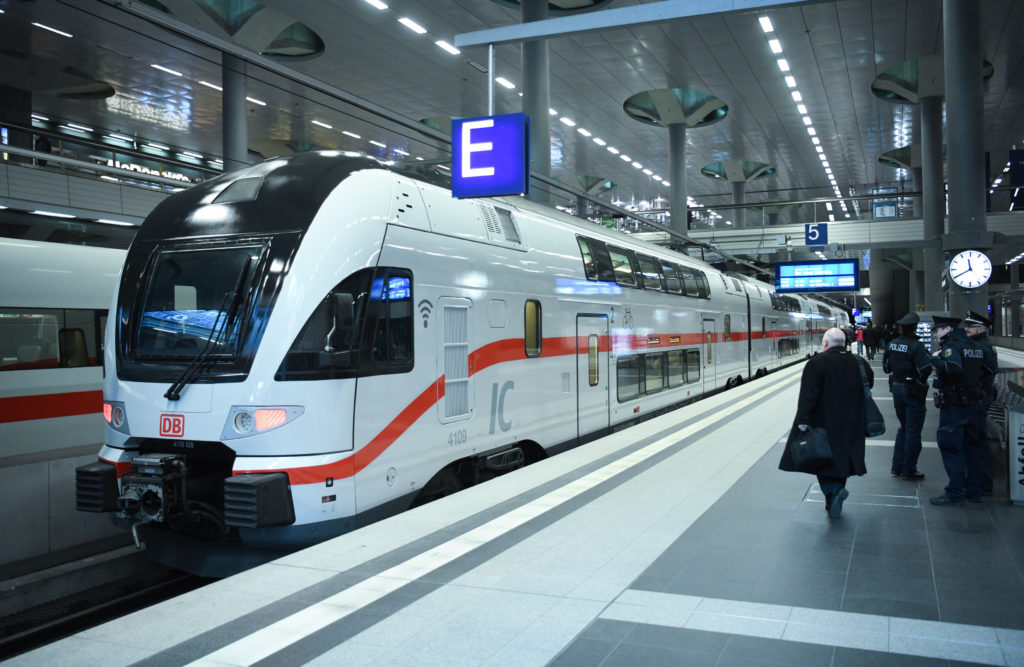
As for other countries with double-decker intercity trains, I recently saw that DB was getting some Stadler units for their intercity services.
DB will put the first Stadler KISS double-decker trains into service (IC2) on 8 March. It purchased them from Westbahn (Austria) last year.

railway-news.com
Bombardier Twindexx
Stadler KISS
Bombardier VIRMm
Talbot DDZ
Skoda Edo
Bombardier M6
[...]
Double-deckers might make sense in Corridor service if VIA wants to continue with its current business model with low-frequency service on freight-owned railways. But VIA has been very vocal about the fact that this model is not sustainable, and that they instead want to run higher frequencies on VIA-owned tracks. In the latter situation, you don't need to maximize seats-per-axle for the sake of track fees. Instead you'd want smaller lighter trainsets which will cause less wear-and-tear on the infrastructure. The 5-car Siemens consists will fit the bill nicely.
For long-distance services, bilevels would be ideal, but if they don't fit, they don't fit.
First of all: VIA's Corridor fleet will remain single-level for the foreseeable future, which renders any discussion about multi-level equipment on these routes useless.
Second, none of the remote routes faces any capacity constraints which would make multi-level equipment in any way desirable, which also renders any discussions about multi-level equipment on those routes useless.
Third, this only leaves the transcontinental routes, where customers tend to stay on board for journeys which last a multiple of what any of the rolling stock types
@reaperexpress mentioned operates. For the same reason, using any of these rolling stock types* would be completely unsuitable. One of the defining features of long-distance rail travel is that the train becomes a hotel on wheels and passengers move around. As this travel segment is heavily skewed towards older passengers, operating any fleet type which requires passengers to climb steps to move between cars would be a non-starter. Consequently, the only way to achieve a train which is step-free-accessible from one end to the other is to have cars connect at the upper deck. The Superliner fleet evidently achieves that (and I believe also the bilevel cars used on some of SBB's InterCity trains), but the inevitable consequence of such designs is that these cars become incompatible with unilevel fleets, as the access/egress points of these cars no longer match. This rules out a seamless phasing in of the new equipment and would introduce fleet compatibility constraints which are much more extreme than those imposed by the Renaissance fleet (which require an empty
Baggage Transition car to connect with regular equipment). All of that begs one simple question to everyone arguing in favor of VIA acquiring non-single-level fleets: what is the problem you are trying to fix and have you considered single-level solutions first?
*Note that these are mostly derived from regional/commuter rail operations: the primary use of Bomarbier Twindexx in Deutsche Bahn's fleet are Regional Express (i.e. limited-stop regional) trains, whereas that of Stadler's Kiss in SBB's fleet is the S-Bahn (Regional Express Rail) network of Zürich.