News   GLOBAL  |  Apr 02, 2020
 11K     0 
News   GLOBAL  |  Apr 01, 2020
 43K     0 
News   GLOBAL  |  Apr 01, 2020
 6.7K     0 
1600825551609.png
I'm surprised the RER is 3 times that of Inter-City. I'd have guessed that VIA's new trainsets had more acceleration than the current 12-car GO trainsets.

How do the current, future, and current 10- and 12-car trains compare?
 
I'm surprised the RER is 3 times that of Inter-City. I'd have guessed that VIA's new trainsets had more acceleration than the current 12-car GO trainsets.

A lower top speed allows a higher gear ratio with more torque, and RER trains likely have a higher proportion of driven axles than an intercity, which likely has just one power car at each end.
 
To those of you that have worked on large projects like this. I've always wondered if planning and engineering can't be sped up with money? This still seems to be running so slow to me.
 
China manages to build bridges that don't fall down, etc. at much greater speed than we do. I take that as evidence that our processes are slower than they could be. Might be that China doesn't worry about EAs, etc. as much.
 
I wonder if this has anything to do with the sale to Alstom and any potential concerns/issues etc that Via Rail has as a result. I know it made mention of the age of the cars (1950's ouch) but I feel like thats something that would have been well known when bidding on the contract itself unless the cars were in worse condition then Via let on?

It's doubtful that the sale had much to do with this contract cancellation - there have been mutterings for over a year about how much more complicated this project was than it had originally let on to be.

I suspect that both parties finally realized that the value for money simply wasn't there anymore, and thus both parties walked away from it.

Dan
 
China manages to build bridges that don't fall down, etc. at much greater speed than we do. I take that as evidence that our processes are slower than they could be. Might be that China doesn't worry about EAs, etc. as much.

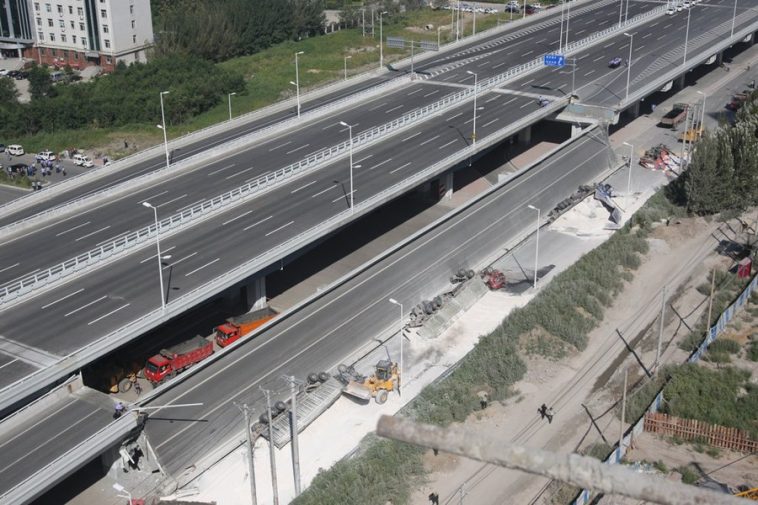
You mean this right? A brand new 9-lane bridge in northeastern China that collapses after 9 months of opening :) There is a running joke within China - the life expectancy of any new infrastructure in China can be measured by its construction duration (roughly) e.x. if a bridge is built in 8 months, it'll likely not last beyond a year of use; if it's built in 6 months, it'll last maybe half a year; if it's built in 2 months, well you may want to stay as far from it as you can... :cool: :cool:

china-harbin-yangmingtan-bridge-collapse-01-758x505.jpg
 
Last edited:
Might be that China doesn't worry about EAs, etc. as much.

Environmental Impact Assessments in China are indeed something of a non-issue. Prior to 2016 they were optional; the developer decided whether one was required or not and simply went ahead with work if they decided it wasn't required. The penalty for being caught after the fact (destroying something of significance) was being required to do an EIA after-the-fact and a fine of $30k USD. Even then, corruption at the provincial level meant it was cheaper just to bribe officials rather than pay even that paltry fine.

2016 changed the laws a bit in that area, some Chinese environmental groups claim they've been weakened been weakened. Fines for not doing an EIA are now 1% of project cost BUT approval is not required to begin construction; they're done in parallel with construction. You're basically expected to document what you destroy.

While they don't worry about EAs at all prior to starting construction, land ownership regulations are quite strict.

Protected areas are government owned (directly or via a government corporation) and have much stronger processes internally. Private contractors who destroy government land may find themselves jailed or even with a death sentence.
 
Last edited:
Environmental Impact Assessments in China are indeed something of a non-issue. Prior to 2016 they were optional; the developer decided whether one was required or not and simply went ahead with work if they decided it wasn't required. The penalty for being caught after the fact (destroying something of significance) was being required to do an EIA after-the-fact, and a fine of $30k USD. Even then, corruption at the provincial level meant it was cheaper just to bribe officials rather than pay even that paltry fine.

2016 changed the laws a bit in that area, some Chinese environmental groups claim they've been weakened been weakened. Fines for not doing an EIA are now 1% of project cost BUT approval is not required to begin construction; they're done in parallel with construction. You're basically expected to document what you destroy.

While they don't worry about EAs at all prior to starting construction, land ownership regulations are quite strict.

Protected areas are government owned (directly or via a government corporation) and have much stronger processes internally. Private contractors who destroy government land may find themselves jailed or even with a death sentence.

Also important to note that in China, all private land "ownership" are capped at 70 years maximum. Whatever you buy as a private corporation or individual - a house, an office, etc. - you essentially lease the land from the government for usage for a maximum duration of 70 years. Hence, the concept of property "ownership" is quite a bit weaker than in most other countries, because the government operates under the premise that all properties are public (government owned) because that is what socialism is according to their definition. Hence, forcibly removing residents from their homes because you need to build a highway or highspeed rail line becomes almost a non-issue, because they don't technically own the land they live on.

And of course, on top of that, bribery is rampant at a local level when it comes to real estate development and large scale infrastructure e.x. developers bribing officials to "sell" government-owned land at a steep discount; contractors bribing officials to raise the final billable cost of work while cutting corners on quality of materials used. It's all glamour and facade when you look at it from afar, but the system has very little accountability.
 
To those of you that have worked on large projects like this. I've always wondered if planning and engineering can't be sped up with money? This still seems to be running so slow to me.

I'm pretty confident that the designwork is getting done expeditiously behind the scenes, at least to the extent that money is being made available. It's the lack of desire to make a decision that is messing this one up.

In my experience, force-feeding money to the planning and engineering functions seemed to result in more conceptual studies and what-if discussions, which in turn drove changes to specs, which in turn drove rework and loss of focus on the goal.

The key seemed to be doing the spec well, but then locking it down and refusing to allow revisiting of design or changes to the spec.

The engineers seldom have trouble grinding out the needed plans once they understand the spec clearly and there is a commitment to get on with it.

This project seems to have a toe-in-the-water mentality. Let's ask some more questions before we say it's decision time....

- Paul
 
Details below:


A lot of classic consulting language where you spend millions to hire a team of consultants to produce a series of Powerpoint deliverables that support your initial hypothesis. Oh and it's a year long and likely doesn't include travel and other contingency expenses (billed separately to the government).

Nonetheless, this is a good sign, and shows that we are slowly, gradually putting more and more $$ into HFR, and walking the talk.

So the bids are due by October 5th. The says that the contract lasts one year. I wonder when we'll publicly see stuff related to the consultation (website/social media/meetings). I assume because of covid-19, all public meetings will be virtual?
 
Constantly comparing ourselves to China is pointless since any comparison can simply be dismissed because of vastly different government systems. Comparing ourselves to other wealthy democracies is a lot more useful. And there's no shortage of democracies that are better at building infrastructure than us.
 
So the bids are due by October 5th. The says that the contract lasts one year. I wonder when we'll publicly see stuff related to the consultation (website/social media/meetings). I assume because of covid-19, all public meetings will be virtual?

I would hope so. It would sure save VIA a lot of unnecessary travel expenses and per diems and help speed up the process. In the contract I would hope that vast majority of these consultation activities be done virtually via Skype, MS Teams, or Google Meet. We have so many virtual engagement tools these days there shouldn't be any excuse not to use them.
 
I am still digesting the curve data that @Urban Sky provided, and trying to assemble and end to end speed model for Toronto-Ottawa. While I don't have a final end to end calculations, I thought I would test my assumptions before I sink any further into Excell. There are some interesting high level realities that have struck me without a precise assessment of the actual track plan.

The starting point is the assumption that VIA's Siemens equipment will be the benchmark equipment for this run.

My first key assumption is that its performance envelope will prove to be similar to the "InterCity" equipment cited in @Urban Sky's thesis. The important point is the acceleration/deceleration parameter - 0.37m/sec^2. I am using that statistic for all my calculations of acceleration and deceleration on the line. That number may not be reality, but it's a sensible figure to use, and it aligns to @Urban Sky's work.

Second, I am assuming that deceleration and acceleration rates should be treated as the same.... again, that may not be the case, but it's a conservative assumption for modelling.

Finally, I am assuming that the superelevation that VIA can achieve on curves is, as noted in above posts, 8 inches total - three unbalanced and five balanced. While there is freight traffic west of Havelock, let's assume its volume is not so great to force lower superelevation. Using this FRA chart, the good news is, I can assume that a 3 degree curve can be negotiated at 60 mph. (I am doing all my work in miles rather than kilometers, so as to align to railway mileposts....it just keeps the source data readable). Since 3 degree curves are the most problemmatic limiting curve, 60 mph becomes the "worst case" for speed, other than in a few sections where either curvature is extraordinary or speed may be restricted for other reasons eg in urban areas.

The interesting thing for this track scenario is - we have numerous 3 degree curves where speed will have to be 60 mph, separated by shortish sections of tangent. In theory, one ought to model trains as running at the 3 degree maximum (60 mph) through the curves, then accelerating when possible, and slowing down for the next curve. Conclusion #1: The sheer number of these curves forces one to look at the line as a "60 mph line with the opportunity to go faster in places" rather than a "110 mph line with some slow sections". That's not all bad news, considering that highway speeds are comparable, and the 60 mph prevailing speed is a lot better than I had feared (I had figured most curves would be in the 50 mph range). So end to end times may prove to be fairly competitive to bus or car. (EDIT: This is most true east of Tweed; west of there there are certainly some credible 110 mph capable segments)

Here's the rub: Using the 0.37m/sec^2 spec, converted to mph of course, it takes a longer stretch of tangent to apply this principle than the actual track allows. I produced a table showing the distance needed for a train to accelerate from one speed to another speed.
Screen Shot 2020-09-24 at 6.16.21 PM.png


For the most favourable scenario - ie a train having slowed to 60 mph, then sprinting back up to 110 mph, it will take 1.42 miles to get back to 110 mph. If another slow section is approaching, it will take a further 1.42 miles to slow from 110 mph back down to 60 mph. Conclusion #2: Because the tangent sections between curves are rarely a minimum of 2.84 miles long, in many places the usable speed of tangent track will frequently not be 110 mph.

The practical problem this creates is that, in the absence of a sophisticated autopilot, a train run by human hand will have difficulty handling all the changes in speed to extract the optimum speed-up/slow-down cycles required. Further, the number of full throttle-followed-by-heavy-braking cycles are not condusive to equipment SOGR or fuel efficiency. The likely solution will be to impose "zone" speeds which limit speed over the short tangent stretches to something close to or equal to the slow points of the curves.

How much does this affect the speed envelope? Here's a hypothetical example. Consider a three mile tangent section between two 60 mph curve sections. One would like the train to accelerate in between, but here's how that looks:

Screen Shot 2020-09-24 at 6.17.10 PM.png


Now consider the alternative - just declare the whole length of track, ie the two curves, and the tangent connecting them, as one "zone" limited to 60 mph. The "No Accel" scenario shows the time required, compared to the speed-up-then-brake scenario. The "zone" scenario adds an extra minute to the timing over the "go like stink" scenario. Again, the sheer number of these short tangent sections suggests that a great deal of tangent track will not be usable at the vision of 110 mph. That will add minutes to the timing.

One reads many anecdotal accounts of how fast trains ran in the steam era, where locomotives didn't necessarily have a speedomenter, and speed enforcement was minimal. Old-school engineers did often work from the "go like stink" premise. However, I doubt that it would pass either today's regulatory regime, or a value engineering analysis.

I thought I would put this out there before I try to guesstimate where "zone" performance will be reality. It's a good news, bad news picture. While I haven't concluded that the line is a dud, I would discourage those who imagine it as a 110 mph racetrack.

Please, critique the above to shreds..... I'm still working on the granular picture, better now before I have to rework stuff.

- Paul

 
Last edited:
^^ The effort and knowledge you and Urban Sky apply to this is truly impressive.

Perhaps in the age of steam, there was more pride in on-time performance by the running crews operating on train orders. The biggest impact of a 'slow-then-go' engineer was on his fireman.
 
I am still digesting the curve data that @Urban Sky provided, and trying to assemble and end to end speed model for Toronto-Ottawa. While I don't have a final end to end calculations, I thought I would test my assumptions before I sink any further into Excell. There are some interesting high level realities that have struck me without a precise assessment of the actual track plan.

The starting point is the assumption that VIA's Siemens equipment will be the benchmark equipment for this run.

My first key assumption is that its performance envelope will prove to be similar to the "InterCity" equipment cited in @Urban Sky's thesis. The important point is the acceleration/deceleration parameter - 0.37m/sec^2. I am using that statistic for all my calculations of acceleration and deceleration on the line. That number may not be reality, but it's a sensible figure to use, and it aligns to @Urban Sky's work.

Second, I am assuming that deceleration and acceleration rates should be treated as the same.... again, that may not be the case, but it's a conservative assumption for modelling.

Finally, I am assuming that the superelevation that VIA can achieve on curves is, as noted in above posts, 8 inches total - three unbalanced and five balanced. While there is freight traffic west of Havelock, let's assume its volume is not so great to force lower superelevation. Using this FRA chart, the good news is, I can assume that a 3 degree curve can be negotiated at 60 mph. (I am doing all my work in miles rather than kilometers, so as to align to railway mileposts....it just keeps the source data readable). Since 3 degree curves are the most problemmatic limiting curve, 60 mph becomes the "worst case" for speed, other than in a few sections where either curvature is extraordinary or speed may be restricted for other reasons eg in urban areas.

The interesting thing for this track scenario is - we have numerous 3 degree curves where speed will have to be 60 mph, separated by shortish sections of tangent. In theory, one ought to model trains as running at the 3 degree maximum (60 mph) through the curves, then accelerating when possible, and slowing down for the next curve. Conclusion #1: The sheer number of these curves forces one to look at the line as a "60 mph line with the opportunity to go faster in places" rather than a "110 mph line with some slow sections". That's not all bad news, considering that highway speeds are comparable, and the 60 mph prevailing speed is a lot better than I had feared (I had figured most curves would be in the 50 mph range). So end to end times may prove to be fairly competitive to bus or car. (EDIT: This is most true east of Tweed; west of there there are certainly some credible 110 mph capable segments)

Here's the rub: Using the 0.37m/sec^2 spec, converted to mph of course, it takes a longer stretch of tangent to apply this principle than the actual track allows. I produced a table showing the distance needed for a train to accelerate from one speed to another speed.
View attachment 271638

For the most favourable scenario - ie a train having slowed to 60 mph, then sprinting back up to 110 mph, it will take 1.42 miles to get back to 110 mph. If another slow section is approaching, it will take a further 1.42 miles to slow from 110 mph back down to 60 mph. Conclusion #2: Because the tangent sections between curves are rarely a minimum of 2.84 miles long, in many places the usable speed of tangent track will frequently not be 110 mph.

The practical problem this creates is that, in the absence of a sophisticated autopilot, a train run by human hand will have difficulty handling all the changes in speed to extract the optimum speed-up/slow-down cycles required. Further, the number of full throttle-followed-by-heavy-braking cycles are not condusive to equipment SOGR or fuel efficiency. The likely solution will be to impose "zone" speeds which limit speed over the short tangent stretches to something close to or equal to the slow points of the curves.

How much does this affect the speed envelope? Here's a hypothetical example. Consider a three mile tangent section between two 60 mph curve sections. One would like the train to accelerate in between, but here's how that looks:

View attachment 271639

Now consider the alternative - just declare the whole length of track, ie the two curves, and the tangent connecting them, as one "zone" limited to 60 mph. The "No Accel" scenario shows the time required, compared to the speed-up-then-brake scenario. The "zone" scenario adds an extra minute to the timing over the "go like stink" scenario. Again, the sheer number of these short tangent sections suggests that a great deal of tangent track will not be usable at the vision of 110 mph. That will add minutes to the timing.

One reads many anecdotal accounts of how fast trains ran in the steam era, where locomotives didn't necessarily have a speedomenter, and speed enforcement was minimal. Old-school engineers did often work from the "go like stink" premise. However, I doubt that it would pass either today's regulatory regime, or a value engineering analysis.

I thought I would put this out there before I try to guesstimate where "zone" performance will be reality. It's a good news, bad news picture. While I haven't concluded that the line is a dud, I would discourage those who imagine it as a 110 mph racetrack.

Please, critique the above to shreds..... I'm still working on the granular picture, better now before I have to rework stuff.

- Paul

is 3 degrees really the maximum bank we can put on this track?
 

Back
Top