News   GLOBAL  |  Apr 02, 2020
 11K     0 
News   GLOBAL  |  Apr 01, 2020
 43K     0 
News   GLOBAL  |  Apr 01, 2020
 6.7K     0 
All those curves ...

Late to the game on this one, so forgive me if I am missing details as I only went back a few pages in the thread.

It makes me wonder, given the P3 element of the project, and the prospect of more demand and potentially higher fares with higher speed, if there will be at least a rough CBA of eliminating some additional curves/groups of curves. Should be able to write a nice little script which tiers offending curves into negative speed impacts. Calculate how much needed new ROW Take out the worst ones, then rerun the analysis. And again, and again. Soon enough you'd have 100s of options where you could apply very basic metrics for costs, and then rank all the potential ROW changes on cost versus speed tradeoffs.

And see if more than a handful are really worth it. Perhaps the reliability and frequency provides more than enough demand and fares alone, and incremental speeds aren't worth the investment. Perhaps doing almost all of them might unlock enough speed that the fare and ridership benefits outweigh the costs.
 
Just a bit of a throw back to the last time Peterborough had VIA Rail service until it was cut by Mulroney in 1990. I hadn't seen pictures of the VIA shelter beside the historic station before. The photos are by John Cowan and he has a great Facebook page for his photos here. Link to pictures here.

1601063804957.png


1601063824424.png


1601063912241.png


1601063926904.png


1601063945274.png


1601063957404.png
 
Just a bit of a throw back to the last time Peterborough had VIA Rail service until it was cut by Mulroney in 1990. I hadn't seen pictures of the VIA shelter beside the historic station before. The photos are by John Cowan and he has a great Facebook page for his photos here. Link to pictures here.

If those photos don't sum up the state of North American intercity rail in the 80's and 90's, then I don't know what does.
 
is 3 degrees really the maximum bank we can put on this track?

It depends.

If freight trains run on it? Yes. Any more and the amount of superelevation starts to mess up the center-of-gravity of the slower freight trains, loading the lower rail and causing accelerated rail wear.

No freights, though? I don't think that Transport Canada has any issues with up to 8 inches of superelevation (beyond their regular bullshit against passenger rail).

Dan
 
Before I proceed to the second part of the "estimating possible travel times on the existing Havelock alignment" exercise, I'd like to reply to some of the comments which have been posted in the meanwhile:

Interesting to see Train 71 leave Union almost 2 hours later. It's a more comfortable hour, that's for sure.
As long as #73 (dep. WDON 13:45) doesn't operate, having #71 arrive at 12:57 (instead of 11:02) will hardly be an issue, but it will have to operate at least 30 minutes earlier once #73 returns...


@Urban Sky thanks for all the information. I'm reading your master's thesis right now actually. It's very informative much like your posts.
Kudos for reading it and glad to hear you find it interesting enough to soldier through it...! 👍


I'm surprised the RER is 3 times that of Inter-City. I'd have guessed that VIA's new trainsets had more acceleration than the current 12-car GO trainsets.

How do the current, future, and current 10- and 12-car trains compare?
All the specs you see in that table are the result of arbitrarily selecting a train type in the literature (see table below) which I found most relevant for the Toronto-Kitchener route, but they won't necessarily have any resemblance to the capabilities of the trainsets which will actually be selected for GO RER and any other services on that corridor. That said, any service which has frequent stops (e.g. GO RER) will have a focus on acceleration, while those covering longer distances with fewer stops (e.g. VIA's HFR trains) will have a focus on maximum speed instead...
1601135078775.png

Quoted in: my Master Thesis (p.58)

To those of you that have worked on large projects like this. I've always wondered if planning and engineering can't be sped up with money? This still seems to be running so slow to me.
As Paul explained to you: even the best planning and engineering can’t offset delays incurred while obtaining the necessary approvals and funding...


is 3 degrees really the maximum bank we can put on this track?
If freight trains run on it? Yes. Any more and the amount of superelevation starts to mess up the center-of-gravity of the slower freight trains, loading the lower rail and causing accelerated rail wear.

No freights, though? I don't think that Transport Canada has any issues with up to 8 inches of superelevation (beyond their regular bullshit against passenger rail).

Dan
As I wrote in my previous post, Brightline in Florida operates with 8 inches of superelevation (5 inches of banking plus 3 inches of cant deficiency) on infrastructure which is still owned and operated by a freight railroad. Also, you should keep in mind that the freight railroad's resistance to increase the cant is less a result of safety concerns as that operating trains over tracks which is banked more than the equilibrium superelevation simply increases the tear and wear on the rails (as the wheels keep grinding at the inside of the lower rail), which suggests that even though freight railroads hate more aggressive superelevations as a RIC (rail infrastructure company), they should be rather indifferent about it on lines where they are merely a ROC (rail operating company) as a tenant...


1990 was a bad year for Transit in ontario.
Not just for transit in Ontario, but for intercity rail all across the country...
 
Last edited:
Just a bit of a throw back to the last time Peterborough had VIA Rail service until it was cut by Mulroney in 1990. I hadn't seen pictures of the VIA shelter beside the historic station before. The photos are by John Cowan and he has a great Facebook page for his photos here. Link to pictures here.

View attachment 271773

View attachment 271774

View attachment 271775

View attachment 271776

View attachment 271777

View attachment 271778

The state of a still in-service station (at the time), in a comparatively major town was indicative of the value place on rail service, certainly the politicians and arguably the broader public.

That's the sort of thing that drives ridership lower over time, making cut politically easier.

Death by (wilful) negligence.

****

This is a problem not unique to inter-city rail; always be weary of under-invested in infrastructure and public services, as the can lead to cuts and/or privatization, as the service deteriorates and becomes less popular.

It can apply to roads, rail, buses, long-term care, public healthcare, education/schools or parks.

Remember to call out that the ridership/usage is not down 50% because people don't like parks, schools or transit; its down because the service/location is neglected and offers poor service.
 
So, The Canadian and The Ocean have been delayed indefinitely it seems. I really hope they don't take advantage of this to axe it for good.
 
So, The Canadian and The Ocean have been delayed indefinitely it seems. I really hope they don't take advantage of this to axe it for good.
We are in the middle of refurbishing some HEP 1 Coaches & Diners for the Ocean and Canadian and sent a train with fresh equipment out west only a week or so ago, so no, there is no intention to cut transcontinental services on this side of the border. If you want to worry for a reason, I suggest you look South of the (currently closed) border, because that really is scary...
 
We are in the middle of refurbishing some HEP 1 Coaches & Diners for the Ocean and Canadian and sent a train with fresh equipment out west only a week or so ago, so no, there is no intention to cut transcontinental services on this side of the border. If you want to worry for a reason, I suggest you look South of the (currently closed) border, because that really is scary...

Interestingly, in that piece you link to, a strong argument is made that reducing Long Distance trains below the threshold of daily service did more harm than good to their financial performance.

That Amtrak in the past reversed many of those cuts as they exasperated poor financial performance.

Has that been VIA's experience? (is the loss per rider higher on a 2-3x per week Ocean than a daily? )

Is there a financial case for more regularly scheduled service? (outside the corridor)
 
Interestingly, in that piece you link to, a strong argument is made that reducing Long Distance trains below the threshold of daily service did more harm than good to their financial performance.

That Amtrak in the past reversed many of those cuts as they exasperated poor financial performance.

Has that been VIA's experience? (is the loss per rider higher on a 2-3x per week Ocean than a daily? )

Is there a financial case for more regularly scheduled service? (outside the corridor)
The nature of VIA's and Amtrak's longhaul networks is very different: Amtrak's long-distance route link many small, medium and even large relatively large cities like St Paul-Minneapolis (metropolitan population: 3.3 million), Salt Lake City (1.2 million), Dellas (2.6 million), San Antonio (2.0 million) or (via a satellite station) Phoenix (4.4 million) with the largest cities of the Nation at a reasonably fast and reliable schedule. Conversely, the Canadian links Sudbury (CMA population in the 2016 Census: 165k, rank: #24 in Canada), Winnipeg (780k, 8th), Saskatoon (295k, #17), Edmonton (1.32 million, #6) and Kamloops (105k, #36) with Toronto (5.9 million, #1) and Vancouver (2.46 million, #3) at speeds and a on-time performance which is grotesquely uncompetitive against driving, taking the plane and even taking the bus. Similarly, the Ocean links Truro (45k, #65), Moncton (145k, #29), Miramichi (28k, #99), Bathurst (31k, #88), Campbellton (16k, #127) and (at 3am in the morning) Rimouski (55k, #59) with Montreal (5.1 million, #2), Quebec City (800k, #7) and Halifax (405k, #13), though with significantly better timekeeping.

The observations from Amtrak are valid, but mostly applicable to intercity travel, for which less-than-daily travel options are not regarded as viable. However, the ridership (and especially revenues) of the Ocean and Canadian have become increasingly reliant on tourism, which happens to be a customer group which is much more forgiving about low frequencies, speeds and on-time performance.

Concerning the financial performance, if you refer back to the table I posted in Post #6,745, an operating ratio (i.e. variable revenues divided by variable expenses) of more than 130% for the Corridor services, 90-100% for the Canadian and 45-50% for the Ocean suggests that VIA's subsidy requirement would be minimized by expanding frequencies on the Corridor, keeping the Canadian where it is and reducing frequencies on the Ocean (referring to the pre-CoVid schedules of course, but leaving the question of how much more can you cut from an already thrice-weekly schedule on the Ocean):

1585527242974-png.238779

Compiled from: VIA Rail's Summary of the Corporate Plan and Annual Plans 2017 and 2018
Note: figures in bold are provided in above documents, whereas all other figures are derived from these figures.
 
Before I will post Part 2 of our Havelock travel time modelling exercise, I would like to address the following feedback from Paul:

The starting point is the assumption that VIA's Siemens equipment will be the benchmark equipment for this run.

My first key assumption is that its performance envelope will prove to be similar to the "InterCity" equipment cited in @Urban Sky's thesis. The important point is the acceleration/deceleration parameter - 0.37m/sec^2. I am using that statistic for all my calculations of acceleration and deceleration on the line. That number may not be reality, but it's a sensible figure to use, and it aligns to @Urban Sky's work.

Second, I am assuming that deceleration and acceleration rates should be treated as the same.... again, that may not be the case, but it's a conservative assumption for modelling.
We need to be clear as to why we make these calculations: my starting point is that @reaperexpress claimed that is physically impossible to achieve a better travel time than 3:40 (i.e. 25 minutes slower than the HFR target time promise) and that even that travel time could not be achieved under the constraints inherent to real-world operations. Therefore, I'm not trying to prove that 3:15 can be achieved with little or no alterations to the existing alignment, but to show that claims that such a travel time would be achievable are reasonably credible. This means that I'm making relatively aggressive (but not implausible) assumptions and I will hand over the spreadsheet to you two (and anyone else interested) to play with the various parameters until you believe that the results are reasonably dependable to assume that such a travel time might very well be achievable. It's fine if you insist in changing the deceleration value to something smaller as soon as you get your hand onto it, but at this point, I'm refusing to use performance variables which are only half of the lowest values I identified (for the purposes of my Thesis) in the table I posted in response to nfitz earlier today.


Finally, I am assuming that the superelevation that VIA can achieve on curves is, as noted in above posts, 8 inches total - three unbalanced and five balanced. While there is freight traffic west of Havelock, let's assume its volume is not so great to force lower superelevation. Using this FRA chart, the good news is, I can assume that a 3 degree curve can be negotiated at 60 mph. (I am doing all my work in miles rather than kilometers, so as to align to railway mileposts....it just keeps the source data readable). Since 3 degree curves are the most problemmatic limiting curve, 60 mph becomes the "worst case" for speed, other than in a few sections where either curvature is extraordinary or speed may be restricted for other reasons eg in urban areas.
As I showed with the example of Brightline, 8 (i.e. 5+3) inches of superelevation seems to be a realistic assumption...

That's not all bad news, considering that highway speeds are comparable, and the 60 mph prevailing speed is a lot better than I had feared (I had figured most curves would be in the 50 mph range). So end to end times may prove to be fairly competitive to bus or car. (EDIT: This is most true east of Tweed; west of there there are certainly some credible 110 mph capable segments)
I'm glad we agree on this already...!


The practical problem this creates is that, in the absence of a sophisticated autopilot, a train run by human hand will have difficulty handling all the changes in speed to extract the optimum speed-up/slow-down cycles required. Further, the number of full throttle-followed-by-heavy-braking cycles are not condusive to equipment SOGR or fuel efficiency. The likely solution will be to impose "zone" speeds which limit speed over the short tangent stretches to something close to or equal to the slow points of the curves.
Indeed, these frequent changes in speed limits would be impractical with VIA's current fleet, but with a semi-automated train operation system (see table below) like PTC, it should be possible to have the train adjust the speed to stay within any relevant speed limits at any given time (i.e. forcing the train to break before a more restrictive speed limit takes effect).

1601171116833.png

Quoted in: my Master Thesis (p.56)

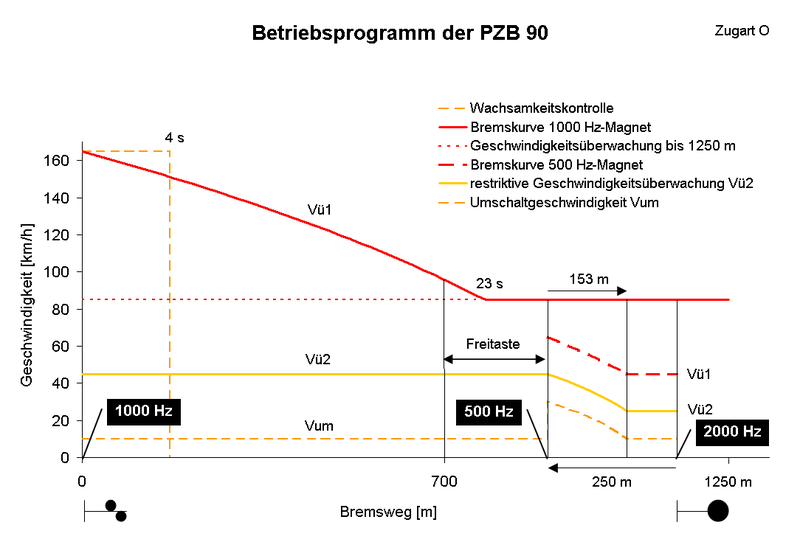
In Germany, all conventional lines are equipped with a GOA 1 system called "PZB", where magnets resonating at variable frequencies (500, 1000 or 2000 Hz) communicate basic signal configurations:

800px-PZB_90_Betriebsprogramm.PNG

Source: Wikipedia

Consequently, a 1000 Hz magnet (located at a pre-signal) is active whenever the following signal is in a restrictive ("slow" or "stop") state and the 500 Hz (located in front of a full signal) and 2000 Hz (located immediately at said full signal) are active when the signal shows a "stop". If you ever want to see that system in action, pay a visit to Ottawa, sit near the cab on the Trillium line and listen to the beeps every time the train runs over a yellow magnet (attached to the right of the tracks) - you will also notice that the system has never been made for systems where you constantly encounter active magnets (given that every signal either protects a passing section or a terminus station).

However, for all trains exceeding speeds of 160 km/h (100 mph), there is a different system (LZB), which continuously communicates with the train and allows for an autopilot, where the system accelerates or decelerates automatically to the maximum safe speed (given current and future speed limits) or the maximum speed which has been set by the driver (whichever is lower). PZB was conceived in the 1930s and LZB in the 1960s, so neither system is revolutionary and they both get currently superseded (just like all other national legacy systems in Europe) by the universal ETCS standard.

Please, critique the above to shreds..... I'm still working on the granular picture, better now before I have to rework stuff.

- Paul
This is already really good work, but no worries, I will share my spreadsheet as soon as I have presented it here, so no need to duplicate the efforts...!

 
Last edited:

Back
Top